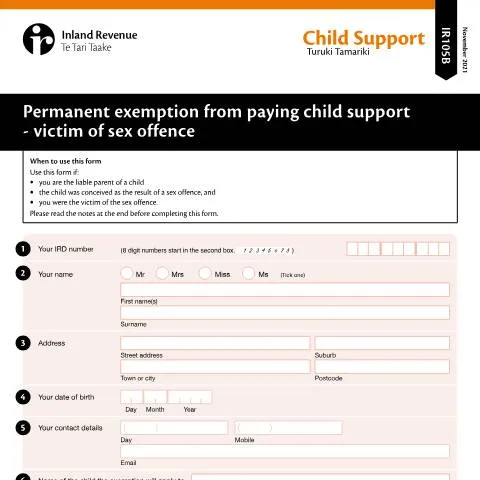
Understanding the IR105B Form: A Vital Step for Survivors
When life takes a difficult turn, navigating the administrative landscape can feel like a labyrinth. For those who have endured the trauma of a sexual offence and are facing child support obligations, the IR105B form—officially titled Victim of Sex Offence Exemption from Child Support Payments—offers a crucial pathway to relief. This form, administered by Child Support, is designed specifically for parents who find themselves in this unique situation, allowing them to seek an exemption from child support payments that may otherwise be compulsory.
Who Can Apply for Exemption?
This exemption is available specifically to individuals who meet a set of criteria. It’s intended for the liable parent of a child, where the child was conceived as a result of a sexual offence, and importantly, the applicant must be the victim of that offence. This highlights a critical intersection between child support obligations and personal trauma, aiming to offer some relief to those who have suffered significant hardships.
Criteria for Eligibility
- The individual is the liable parent of a child.
- The child was conceived due to a sexual offence.
- The applicant is the victim of that offence.
How to Complete the IR105B Form
Completing the IR105B form requires careful attention to detail to ensure all relevant information is accurately provided. Here’s how to navigate this process:
Step-by-Step Guide
- IRD Number: Begin by entering your 8-digit IRD number. This is crucial for identifying your tax obligations.
- Personal Details: Fill out your name, address, and contact details. Be sure to include correct information, as this will be used for any correspondence.
- Date of Birth: Enter your date of birth in the correct format (day, month, year).
- Child’s Name: Specify the name of the child for whom you are seeking the exemption.
- Conviction Status: Indicate whether someone has been convicted of the offence or if the Youth Court has made a finding regarding the offence. If applicable, provide the offender’s full name.
- Supporting Information: If no conviction has been made, attach any supporting documents that can substantiate your claim, such as police reports or medical records.
Submitting the Form: What to Expect
Once you have completed the IR105B form, the next step is to submit it to the Child Support office. This is typically done online, reflecting New Zealand’s strong emphasis on digital services. Upon submission, it is essential to remain proactive in following up on the status of your application.
Next Steps After Submission
After your application has been submitted:
- You will receive confirmation of your application’s receipt.
- The Child Support office will process your application and assess the information provided.
- In cases where additional information is required, they may reach out for further documentation or clarification.
- Finally, you will be notified of the outcome, which may either grant or deny the exemption.
Your Rights and Obligations as an Applicant
Filing for this exemption does not exempt you from your responsibilities as a parent; however, it acknowledges the unique circumstances affecting your ability to meet child support obligations. Understanding your rights and obligations can provide clarity during this stressful time.
Key Rights
- You have the right to submit supporting documentation that can aid in your exemption application.
- You may request information about the decision-making process and the rationale behind the outcome.
Key Obligations
- You must ensure that all the information you provide is accurate and truthful.
- You must respond promptly to any requests for additional information from the Child Support office.
Handling Challenges: What If Your Application Is Denied?
Receiving a denial can be disheartening, but there are pathways to address this. Understanding the reasons for denial is crucial.
Common Reasons for Denial
- Lack of sufficient evidence to support the claim of a sexual offence.
- Failure to provide necessary documentation.
Next Steps After a Denial
If denied, you have several options:
- Request a detailed explanation for the denial to understand the areas of concern.
- Gather any additional documentation that can address the reasons for denial.
- Consider reapplying if you believe you can provide the required information.
The Importance of Supporting Documentation
Supporting documentation plays a crucial role in the exemption process. It can substantiate your claims and facilitate a smoother application process.
What Types of Documents are Recommended?
Here are some examples of supporting documents that could strengthen your application:
- Police Reports: Any official documentation from law enforcement regarding the offence.
- Medical Records: Documentation from healthcare professionals confirming your victimization.
- Affidavits: Statements from individuals who can attest to your circumstances.
Understanding the Privacy Considerations
When applying for an exemption, it's important to be aware of your privacy rights and how your information will be handled. The Child Support office adheres to stringent privacy protocols as outlined in the Privacy Act 2020.
Key Privacy Provisions
- Your personal information will only be used for purposes related to your child support obligations.
- Information may be exchanged with other government agencies, but only as permitted by law.
- You can request access to your personal information held by the Child Support office.
Special Situations: What If You Are a Non-Resident Parent?
For parents living outside New Zealand, applying for the IR105B form can come with additional complexities. Understanding how your situation intersects with local laws is vital.
Steps for Non-Residents
- You must still meet the eligibility criteria as a victim and liable parent.
- Ensure that you have access to reliable means of communication with the Child Support office.
- Consider working with legal representatives familiar with both New Zealand and international family law if necessary.
Follow-Up and Status Tracking
After submitting your application, it's vital to remain engaged with the Child Support office. Here’s how you can effectively track your application status:
Methods for Checking Status
- Utilize online portals provided by the IRD for real-time updates.
- Contact the Child Support office directly via phone or email for inquiries.
- Keep records of your application submission and any correspondence.
Conclusion: Taking Control of Your Child Support Obligations
The IR105B form represents a significant resource for survivors of sexual offences, enabling them to navigate their child support responsibilities with dignity. By understanding the process, requirements, and implications of applying for this exemption, you empower yourself to make informed decisions that align with your rights and needs. Remember, support is available, and you are not alone in this journey.
Understanding the Legal Framework for Child Support Exemptions
In New Zealand, child support obligations are primarily governed by the Child Support Act 1991. This legislation outlines the responsibilities of biological parents toward their children, including financial contributions for their upbringing. However, certain circumstances can lead to exemptions from these obligations, particularly for individuals who have been victims of sexual offences. It is crucial for affected individuals to fully comprehend the legal framework surrounding these exemptions, which are not straightforward and can be influenced by a range of factors.
The exemption applies specifically to those individuals who have been convicted of sexual offences against certain individuals, including their own children. In situations where the offender is the biological parent, the law acknowledges the need to protect the victimized party, thus allowing them to apply for an exemption from child support payments. This can be a complex process that requires thorough understanding and documentation of the circumstances.
Victims must first navigate the legal system to establish their status as a victim of a sexual offence. This typically involves providing evidence of the conviction, alongside any relevant police reports or court documents. It is advisable to consult with legal professionals familiar with family law and child support matters to ensure that the application for exemption is formulated correctly. The process may require several steps, including completing forms such as the Child Support Exemption Application (form code not specified) and submitting it to the Inland Revenue Department (IRD).
The Application Process for Exemption: Step-by-Step Guide
Applying for an exemption from child support payments due to being a victim of a sexual offence involves several key steps that individuals must follow meticulously. Understanding each step in the process can significantly influence the successful outcome of an application.
1. Gather Necessary Documentation: As a first step, it is essential to collect all relevant documentation related to the case. This includes police reports, court records, and any documentation proving the conviction of the perpetrator. Any evidence demonstrating the nature of the sexual offence and its impact on the victim is also crucial.
2. Complete the Exemption Application Form: Once the documentation is in order, the next step is to complete the exemption application form. While the specific form code may vary, it is important to ensure that all sections are filled out accurately. Providing detailed information about the offence and how it relates to the child support obligations is vital for the approval of the application.
3. Submit Your Application: After completing the form, individuals must submit it to the IRD. It is recommended to do this electronically through the IRD’s online portal, particularly since New Zealand places a strong emphasis on digital services. Individuals should keep a record of their submission for future reference.
4. Await Processing: Following submission, the IRD will process the application. This may take several weeks, and applicants are encouraged to monitor their application status through the IRD’s online services. It is essential to remain patient during this period, as the processing time can vary depending on the complexities involved in each case.
5. Receive Notification and Follow Up: Once a decision has been made, the IRD will notify the applicant of the outcome. If approved, the exemption will be reflected in the applicant’s child support records. In the event of a denial, individuals should seek clarification on the reasons for rejection and consider consulting with legal professionals for guidance on possible next steps.
Implications of the Exemption on Financial Responsibilities
Understanding the implications of receiving an exemption from child support payments is pivotal for any individual navigating these waters. While the exemption alleviates financial obligations to a certain extent, it is essential to recognize that this does not absolve one of the moral or emotional responsibilities toward the child.
1. Temporary vs. Permanent Exemption: It is important to clarify whether the exemption is temporary or permanent. In many cases, exemptions may be reviewed periodically, especially if the circumstances surrounding the case change. Victims should maintain awareness of their situation and be prepared for any future assessments from the IRD.
2. Impact on Child’s Wellbeing: While the legal obligation to pay child support may be lifted, the child’s welfare remains a top priority. Victims should consider their long-term role in their child’s life, including emotional support and involvement in their upbringing. Financial contributions may still be needed in other forms, such as providing care, education, or emotional support.
3. Revisiting Financial Obligations: It is advisable for individuals with exemptions to periodically review their financial status in relation to the child's needs. Even with exemptions, individuals may wish to contribute voluntarily to support the child's upbringing, recognizing that financial assistance beyond mandated child support could positively impact the child's quality of life and development.
By approaching child support obligations with a comprehensive understanding of the legal landscape and the implications of exemptions, individuals can make informed decisions that ultimately benefit both themselves and their children.