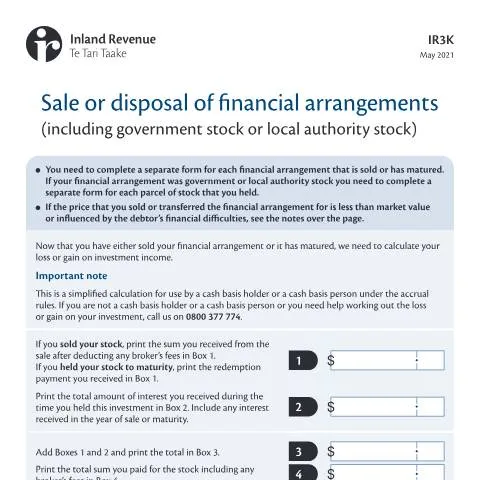
Understanding the IR3K Form: A Critical Component in Tax Reporting
The IR3K form, titled "Sale or disposal of financial arrangements," is an essential document for individuals and entities in New Zealand who have engaged in financial transactions involving government or local authority stock. The importance of this form lies not only in its role in tax reporting but also in its implications for how financial transactions are recorded and reported to the Inland Revenue Department (IRD). Understanding this form is pivotal for any taxpayer who has sold or disposed of financial arrangements.
The Regulatory Framework Surrounding Financial Arrangements
The necessity of the IR3K form stems from New Zealand's comprehensive tax framework, designed to ensure that all income is accurately reported and taxed. Under the Income Tax Act 2007, the IRD requires taxpayers to disclose any gains or losses from financial arrangements as part of their income tax assessments. This regulatory requirement not only enhances transparency but also safeguards the integrity of the tax system.
The Official Information Act 1982 and the Plain Language Act 2022 further emphasize the need for clarity and accessibility in tax documentation. This focus on clear communication is reflected in the design of the IR3K form, which is structured to guide users through the complexities of financial arrangement reporting.
Who Needs to File the IR3K Form?
The IR3K form is required for various stakeholders in the financial landscape. Any individual or entity that has sold or disposed of a financial arrangement must complete this form. Specifically, this includes:
- Individuals holding government or local authority stock.
- Investors who have engaged in financial arrangements that are now maturing.
- Taxpayers who have received interest or other returns from their financial investments.
Moreover, if the financial arrangement was sold for less than its market value, or if the transaction was influenced by the seller’s financial difficulties, the form must still be completed. This requirement helps the IRD accurately assess each taxpayer's financial situation and ensure compliance with tax obligations.
Navigating the IR3K Form: Step-by-Step Instructions
Completing the IR3K form requires attention to detail and a clear understanding of the financial arrangements involved. Here’s a breakdown of how to approach filling out the form:
- Box 1: Enter the total amount received from the sale of the financial arrangement after deducting broker fees.
- Box 2: Report the total interest received while holding the investment, including any amounts received in the year of sale or maturity.
- Box 3: Calculate the sum of Boxes 1 and 2, which represents your total income from the financial arrangement.
- Box 4: Provide the total sum paid for the stock, including any broker's fees.
- Box 5: Report any interest included in previous tax returns related to this financial arrangement.
- Box 6: Add Boxes 4 and 5 to get a total of previous costs and interest.
- Box 7: Subtract Box 6 from Box 3. This figure represents your profit or loss, and if it’s a loss, ensure that you denote it with a minus sign.
- Box 13A: Include any resident withholding tax withheld during the sale or maturity year.
This step-by-step process is crucial for ensuring accuracy and compliance in reporting investment income. Each box must be filled out carefully to avoid mistakes that could lead to complications with the IRD.
Submitting the IR3K Form: Options and Procedures
Once the form is completed, you have multiple options for submission. It's important to choose the method that best suits your circumstances:
- Online Submission: The IRD encourages taxpayers to submit their forms electronically through their secure online portal. This method is efficient and allows for immediate confirmation of receipt.
- Mail Submission: If you prefer to send in a paper form, you can mail the completed IR3K form to the IRD. Ensure that you allow sufficient time for delivery, particularly during peak filing seasons.
- In-person Submission: Although less common, individuals can submit their forms in person at designated IRD offices. This option may be useful if you have questions or need assistance while filing.
Understanding the Implications of the IR3K Filing
Completing and submitting the IR3K form carries significant implications for taxpayers. There are important considerations to keep in mind:
“Failure to accurately report financial gains or losses can lead to penalties, additional tax assessments, and potential audits by the IRD.”
By correctly filling out the IR3K, you are not only fulfilling your legal obligations but also ensuring that you are taxed correctly on your investment income. If the sale or maturity of a financial arrangement results in a loss, this loss can be used to offset other taxable income, which can be advantageous when calculating your overall tax liability.
What Happens If You Make a Mistake or Omit Information?
Errors in tax documentation can lead to complications, but knowing how to address these issues can mitigate potential problems:
- If you discover an error after submission, contact the IRD directly to inform them of the mistake. They can guide you through the process of amending your submissions.
- In cases of missing information, ensure that you provide all necessary details as soon as possible. This includes any supporting documents that may validate your claims.
- Keep records of any correspondence with the IRD regarding your form, as this can be useful if there are future inquiries about your tax filings.
Being proactive in rectifying mistakes can help prevent larger issues down the line, including possible audits or penalties for non-compliance.
Understanding the Importance of Deadlines
The submission of the IR3K form is tied to important deadlines within the New Zealand tax calendar. Typically, the tax year runs from 1 July to 30 June, with specific deadlines for filing tax returns.
Be aware of the following:
- The IR3K must be submitted alongside your annual tax return by the due date set by the IRD. This is usually around 7 July for those who file paper returns or earlier for online submissions.
- Late submissions may incur penalties, which can add financial strain. Staying informed about your obligations and deadlines is crucial for compliance.
After submission, you can generally expect to receive confirmation from the IRD regarding the acceptance of your form along with any tax assessment associated with your reported income.
Conclusion: The Strategic Role of the IR3K in Tax Efficiency
The IR3K form serves as more than just a tax requirement; it is a strategic tool that can significantly influence your overall tax position. Understanding its role, completing it accurately, and being aware of the implications of your financial arrangements can empower taxpayers to navigate the complexities of New Zealand’s tax system with confidence.
Whether you are an individual investor, a business owner, or a financial advisor, familiarizing yourself with the intricacies of the IR3K form is essential. As you engage in financial transactions, always remember that transparency and accuracy are paramount in maintaining a healthy relationship with the IRD and ensuring your financial well-being.
Understanding Financial Arrangements Under New Zealand Law
In New Zealand, financial arrangements are defined under the Income Tax Act 2007, and they refer to any agreement that creates a financial benefit and an obligation to pay in the future. These arrangements can include loans, leases, bonds, and derivatives. It's critical to comprehend the tax implications and obligations involved when selling or disposing of these financial arrangements.
The tax treatment of financial arrangements hinges on the timing of income recognition. Under the accrual basis of accounting, taxpayers are mandated to recognize income as it is earned, regardless of when payments are received. This can lead to complexities when you decide to sell or dispose of a financial arrangement. For example, if you sell a financial instrument, you may need to account for unrealized gains or losses that could impact your taxable income. Therefore, it's essential to consult a tax professional who understands the nuances of the Income Tax Act 2007.
Moreover, specific exemptions might apply based on the nature of the financial arrangement. For instance, if the arrangement is categorized as a 'financial instrument' under applicable New Zealand tax law, different rules may apply in terms of income recognition and tax liabilities. The categorization can significantly affect the fiscal outcomes of the sale or disposal.
Tax Implications When Disposing of Financial Arrangements
When it comes to selling or disposing of financial arrangements, taxpayers must be aware of various tax implications that can arise. Firstly, the treatment of any gain or loss from the disposal will depend on the classification of the financial arrangement. If it is deemed to be on revenue account, any gains will typically be taxed as ordinary income; conversely, if it's on capital account, capital gains tax may apply.
Taxpayers should be particularly vigilant about 'deferred income' situations. For example, if you have received payments in advance for a financial arrangement, you may not immediately recognize this as income for tax purposes. However, upon disposal, you may have to account for this deferred income, which could lead to a sudden tax liability that you may not have anticipated.
Furthermore, the application of the Financial Arrangement rules under the Income Tax Act means that any adjustments related to the sale, such as market valuations or adjustments for foreign exchange, can complicate your tax situation. Preparing accurate financial records reflecting these aspects will be essential to ensure compliance and accurate tax reporting.
Practical Steps for the Sale or Disposal of Financial Arrangements
Engaging in the sale or disposal of financial arrangements does not have to be a daunting task. However, it requires careful planning and execution. Here are practical steps to guide you through the process:
- Document Everything: Ensure all aspects of the financial arrangement are well-documented. This includes agreements, terms of sale, and correspondence with involved parties. This documentation will be invaluable for tax purposes and in case of an audit.
- Consult a Professional: Engaging a tax advisor or an accountant familiar with financial arrangements is crucial. They can provide tailored advice based on your specific situation and help you navigate the complexities of disposal.
- Assess Financial Impact: Before proceeding with the disposal, evaluate the financial implications, including any costs associated with the sale and potential tax liabilities. A thorough analysis can help you avoid unexpected expenses.
- Consider Timing: The timing of your disposal can significantly affect your tax position. For instance, if your financial year ends on 30 June, consider your overall financial position to determine the most tax-efficient time to sell.
- Notify the IRD: Depending on the nature of the transaction, you may need to notify the Inland Revenue Department (IRD) about the disposal and any associated tax obligations.
By following these steps, individuals can minimize potential pitfalls and ensure compliance, paving the way for a smoother sale or disposal process.