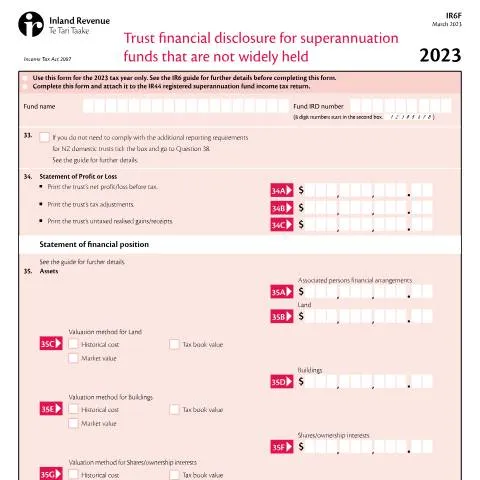
Diving into the IR6F: A Detailed Exploration for Superannuation Funds
Filing tax returns can often feel overwhelming, especially for entities like superannuation funds that are not widely held. The IR6F form, titled Trust Financial Disclosure for Superannuation Funds That Are Not Widely Held, serves a crucial role in ensuring compliance with New Zealand's tax regulations. In this article, we will unpack the nuances of the IR6F form, providing a comprehensive guide on the steps to take, who is required to file, and how to navigate potential complexities.
Understanding the Purpose of the IR6F Form
The IR6F form is vital for superannuation funds not broadly held within a larger public framework. This specific form is a requirement under the Income Tax Act 2007 and must be filed for the 2023 tax year. Its purpose is to facilitate the Inland Revenue Department (IRD) in assessing the trust's financial position for taxation purposes. It also plays a role in maintaining transparency and accountability in the management of superannuation funds.
Unlike standard tax returns, the IR6F requires detailed financial disclosures that reflect the trust's overall health, including profit or loss statements, asset valuations, and liabilities. Each section aims to provide the IRD with the necessary information to evaluate compliance and ensure that proper tax obligations are met.
The Profile of Filers: Who Needs to Complete the IR6F?
Primarily, the IR6F form is filed by trustees of superannuation funds that are not widely held. This includes:
- Private trusts holding superannuation funds;
- Trustees who manage funds for a limited number of beneficiaries;
- Entities that are closely held and do not meet the qualifying criteria for wider public trust status.
It's essential for trustees to understand the unique characteristics that distinguish their funds from widely held superannuation entities. This distinction affects the reporting requirements and the specific details required on the IR6F form.
Navigating the Completion Process
Completing the IR6F form involves several critical steps. To help streamline this process, we can break it down as follows:
- Gather Necessary Documentation: Before diving into the form, collect relevant financial documents, including profit and loss statements, balance sheets, and any previous tax returns related to the trust.
- Provide Trust Details: Fill in the basic information about the trust, including its name and the IRD number. Ensure that the IRD number is an 8-digit figure starting in the second box.
- Statement of Profit or Loss: Report the trust's net profit or loss before tax, including tax adjustments and untaxed realised gains. Ensure accuracy to avoid potential penalties.
- Statement of Financial Position: This section requires a detailed breakdown of assets and liabilities. It's helpful to categorize assets into types, such as land, buildings, and shares, along with their respective valuation methods.
- Notice of Assessment and Declaration: This final section involves a declaration of the accuracy of the information provided, along with the trustee's signature and date.
Key Sections of the IR6F: Breaking It Down
To shed light on the main sections of the IR6F form, let's analyze them in greater detail:
| Section | Description |
|---|---|
| Fund Name and IRD Number | Basic identification details for the trust and relevant tax identification. |
| Statement of Profit or Loss | Detailed account of the trust’s financial performance, including profit/loss before tax. |
| Statement of Financial Position | A comprehensive overview of the trust's assets and liabilities. |
| Notice of Assessment and Declaration | Final confirmation of the accuracy of the information, requiring a signature from the trustee. |
Important Dates: Filing and Follow-Up
Timeliness is crucial when it comes to tax compliance. The IR6F must be submitted with the accompanying IR44 registered superannuation fund income tax return by the deadline of July 7 of the following fiscal year. The fiscal year in New Zealand runs from July 1 to June 30.
For example, for the 2023 tax year, this means that all returns must be completed and submitted by July 7, 2023. Failure to meet this deadline could result in penalties, so it’s advisable to plan ahead and ensure all relevant documents are prepared in advance.
What Sets the IR6F Apart from Other Tax Forms?
One common misconception is that the IR6F is similar to other income tax forms, such as the IR3 used by individual taxpayers. However, several distinctions separate these forms:
- Target Audience: The IR6F specifically caters to trusts managing superannuation funds, while the IR3 is meant for individual taxpayers, making the IR6F's requirements more specialized.
- Complexity of Reporting: Trusts are required to disclose detailed financial information, including assets and liabilities, which is less extensive for individual tax returns.
- Accountability Measures: The IR6F includes strict penalties for inaccuracies and omissions, emphasizing the importance of compliance and accuracy in filings.
Dealing with Challenges: Errors and Missing Information
In the event that you notice an error after submission or if supporting documents are missing, it’s imperative to act swiftly. Here are the steps to follow:
- Review the Submitted Information: Understand the specific nature of the error or omission.
- Contact the IRD: Reach out to the Inland Revenue Department promptly for guidance on rectification. They can provide detailed instructions on how to proceed.
- Submit Corrected Documents: If required, submit a corrected IR6F form along with any necessary documentation to support your corrections.
- Maintain Records: Keep copies of all communications and submissions for your records.
Implications of Non-Compliance and Penalties
Understanding the potential consequences of failing to comply with filing requirements is crucial for trustees. If a trust does not file the IR6F on time, or if the information provided is deemed incorrect, the IRD can impose significant penalties. This could range from financial fines to additional scrutiny of the trust’s financial practices.
Moreover, failure to fulfill tax obligations could lead to legal repercussions or increased audits in the future. Therefore, it is advisable for trustees to prioritize accurate, timely submissions and consider seeking professional advice if they encounter uncertainties.
Conclusion: Preparing for a Successful Filing
Filing the IR6F form is more than a bureaucratic obligation; it is a fundamental element of trust management and accountability in New Zealand. By understanding the intricacies of the form, preparing documentation in advance, and adhering to deadlines, trustees can navigate this process with confidence.
As the landscape of tax regulation continues to evolve in New Zealand, staying informed and proactive in meeting compliance requirements will serve as a cornerstone of successful trust management.
Understanding Trust Financial Disclosure Requirements for Superannuation Funds
In New Zealand, trust financial disclosure requirements play a critical role in the administration of superannuation funds, particularly those that are not widely held. These requirements aim to ensure transparency and protect the interests of beneficiaries. Trusts must comply with the Financial Markets Conduct Act 2013 and adhere to specific reporting obligations set forth by the Financial Markets Authority (FMA).
For superannuation funds that are not widely held, it’s essential to understand the classification of participants and the implications for disclosure. The term "not widely held" generally refers to funds with a limited number of participants, often consisting of intimate groups such as family members or close associates. This unique status influences the financial disclosure requirements, as these trusts may be eligible for exemptions under certain conditions.
Trustees must prepare annual financial statements that accurately reflect the fund's position, detailing income, expenses, and distributions. However, the level of detail required may vary based on the number of members and other specific circumstances. For instance, while widely held funds may require extensive reporting to safeguard investor interests, closely-held trusts may benefit from streamlined disclosures.
Trustees should also be aware of their fiduciary duties, which include acting in the best interest of the beneficiaries and ensuring that the fund operates transparently. Regular communication with members about fund performance, investment strategies, and any changes in financial circumstances is crucial for maintaining trust and compliance.
Compliance Challenges and Best Practices for Trustees
Navigating compliance can be challenging for trustees of superannuation funds that are not widely held. Understanding regulatory expectations, coupled with the dynamic nature of financial markets, can create significant pressure. However, implementing best practices can make this process more manageable.
First and foremost, establishing a robust governance framework is essential. This includes appointing skilled and experienced trustees who understand both the operational and regulatory landscapes. Training sessions on compliance and financial reporting can enhance the trustees’ knowledge, ensuring they can effectively manage their obligations.
Regular audits are another vital best practice. Conducting internal audits can help identify potential compliance risks and areas for improvement before external audits occur. For superannuation funds not widely held, it's particularly important to maintain meticulous records of all transactions, as this can help streamline both internal and external audit processes.
Transparency should also be prioritized in communication with beneficiaries. Establishing clear, consistent channels of communication allows trustees to keep members informed about fund activities, performance, and compliance issues. Periodic updates, newsletters, or even informal meetings can facilitate open dialogue and foster trust among members.
Finally, considering the use of digital tools can enhance compliance and reporting efficiency. Online platforms can streamline document collection and storage, automate reporting processes, and ensure that all stakeholders have immediate access to necessary information. Additionally, using technology can help trustees maintain compliance with the latest data protection regulations.
The Role of the Financial Markets Authority in Oversight
The Financial Markets Authority (FMA) plays a pivotal role in overseeing compliance for superannuation funds in New Zealand, including those that are not widely held. Their mandate includes ensuring that funds operate fairly and transparently while protecting the interests of beneficiaries. The FMA provides guidance on the applicable laws and regulations, as well as the standards of conduct expected from trustees.
One key aspect of the FMA’s oversight is its ability to conduct investigations into potential breaches of the Financial Markets Conduct Act. Trustees must be aware that failure to comply with financial disclosure requirements can lead to significant penalties, including fines and sanctions. Therefore, proactive engagement with the FMA can be beneficial for trustees in clarifying their obligations and ensuring compliance.
The FMA also promotes educational initiatives aimed at trustees and beneficiaries, emphasizing the importance of understanding financial disclosures and the implications of fund management. By participating in these initiatives, trustees can enhance their knowledge and improve their practices, ensuring they align with the FMA's expectations.
Moreover, the FMA offers resources and tools for trustees of superannuation funds. These can include templates for financial disclosures, guidelines for best practices, and insights into common compliance pitfalls. Engaging with these resources can equip trustees with the knowledge they need to navigate the complexities of fund management effectively.