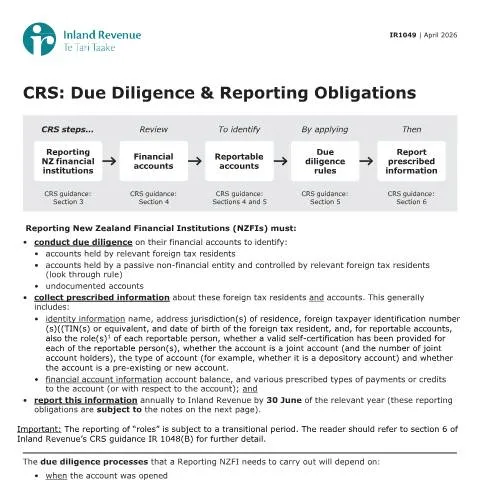
The Significance of Form IR1049 in the New Zealand Tax Reporting Landscape
Form IR1049, titled "CRS: Due Diligence & Reporting Obligations," plays a critical role in the regulatory framework governing financial institutions in New Zealand. This form is not merely a bureaucratic requirement; it serves as a vital instrument for ensuring compliance with the Common Reporting Standard (CRS) established by the Organisation for Economic Co-operation and Development (OECD). Financial institutions must undertake due diligence to identify accounts held by foreign tax residents and report pertinent information to the Inland Revenue Department (IRD).
In a global economy where tax evasion is increasingly scrutinized, the IR1049 form is a proactive measure that enables New Zealand to contribute to international efforts against tax avoidance. By adhering to the guidelines outlined in this form, New Zealand financial institutions uphold their responsibilities not just locally but also in a broader global context. The stakes are high: non-compliance could result in severe penalties and damage to the institution's reputation.
Navigating the Due Diligence Process: A Step-by-Step Approach
The due diligence process mandated by the IR1049 is comprehensive and can be broken down into several distinct steps. Understanding these steps is essential for institutions to ensure compliance and mitigate the risk of financial penalties.
Step 1: Identifying Financial Accounts
Financial institutions must first identify the financial accounts that fall under the CRS due diligence obligations. This involves reviewing account holders to determine their residency status.
- Accounts held by foreign tax residents
- Accounts held by passive non-financial entities controlled by foreign tax residents
- Undocumented accounts
Step 2: Applying Due Diligence Rules
The next step involves applying specific due diligence rules to ascertain the residency status of account holders. This is where understanding the differences between pre-existing and new accounts becomes crucial.
| Account Type | Pre-existing Accounts | New Accounts |
|---|---|---|
| Individuals | Can rely on existing information | Must obtain valid self-certification |
| Entities | Can rely on existing indicators | Must obtain valid self-certification |
Step 3: Collecting Prescribed Information
Once the accounts are identified, financial institutions must gather specific information about foreign tax residents. This includes:
- Name and address
- Jurisdiction(s) of residence
- Foreign taxpayer identification number(s) (TIN)
- Date of birth
For reportable accounts, additional information about account roles and the status of self-certifications is necessary. Understanding what constitutes a reportable account is essential for compliance.
Step 4: Reporting to Inland Revenue
Financial institutions must compile the collected data and report it to the IRD by 30 June of the relevant financial year. This step is crucial for ensuring transparency and accountability within the financial system.
Understanding the Context: Who Needs to Submit IR1049?
Form IR1049 is mandatory for New Zealand financial institutions (NZFIs). But what qualifies as a financial institution under the CRS? This question is crucial for identifying who must comply with the reporting obligations.
Profiling Financial Institutions
NZFIs include a range of entities, such as:
- Banks
- Credit unions
- Investment firms
- Insurance companies
- Asset management firms
Each of these institutions plays a distinct role in the financial ecosystem, and their obligations can vary based on the nature and scope of their services. For instance, investment firms may face additional scrutiny due to their involvement in managing assets for clients across various jurisdictions.
Exceptions and Exemptions: Who is Excluded?
While the regulatory framework is robust, certain entities may be classified as non-reporting financial institutions (NRFIs) under specific criteria. Understanding these exemptions is crucial for accurate reporting.
The Commissioner of Inland Revenue can determine other financial institutions that may meet the criteria for NRFIs, including:
- Entities with a low risk of being used to evade tax
- Institutions with characteristics similar to specifically excluded NRFIs
Handling Errors and Submissions: What to Do When Things Go Awry
The submission process is not without challenges. Financial institutions must be prepared to address issues such as missing information or errors in submission promptly. Taking proactive steps can mitigate potential complications.
Identifying Common Pitfalls
Common issues that may arise during the submission process include:
- Incomplete self-certifications from account holders
- Failure to report undocumented accounts
- Incorrectly identifying reportable accounts
Each of these pitfalls can result in significant adverse consequences, including financial penalties and increased scrutiny from tax authorities. Therefore, institutions must have robust error-checking processes in place.
Rectifying Mistakes: A Step-by-Step Guide
In the event of an error, financial institutions should follow these steps:
- Identify the error promptly and assess its impact.
- Gather any additional information required to correct the submission.
- Submit a corrected report to the IRD as soon as possible.
- Document all actions taken for future reference.
Timeliness is critical in rectifying errors to avoid further complications.
The Consequences of Non-Compliance: What’s at Stake?
Understanding the implications of failing to submit Form IR1049 correctly is essential for financial institutions. Non-compliance can result in serious repercussions, affecting both the institution and its clients.
Legal and Financial Ramifications
The penalties for non-compliance can be severe, including:
- Financial penalties imposed by the IRD
- Increased scrutiny in future reporting periods
- Potential damage to the institution’s reputation
Additionally, clients may face complications related to their tax obligations, leading to an erosion of trust between financial institutions and their clientele.
Protecting Your Interests: Best Practices for Compliance
To mitigate risks and ensure compliance, institutions should adopt the following best practices:
- Regular training for staff on CRS obligations and updates
- Implementing robust due diligence processes
- Conducting periodic audits of compliance procedures
Investing in these practices will not only reduce the risk of non-compliance but also enhance the overall integrity of the institution.
Submitting the Form: A Streamlined Process for Financial Institutions
With the understanding of the importance of Form IR1049 and the due diligence process, financial institutions must now focus on the practical aspects of submitting the form correctly.
Streamlining Submission Processes
The IRD encourages the submission of Form IR1049 through online channels, aligning with New Zealand's strong emphasis on digital services. Financial institutions are advised to:
- Utilize reliable digital platforms for submission.
- Maintain thorough records of submissions and correspondence with the IRD.
- Regularly check for updates or changes in reporting requirements.
Monitoring Submission Status
After submission, institutions should establish systems to track the status of their reports. This can involve:
- Regular communication with the IRD to confirm receipt of submissions.
- Setting reminders for follow-up actions if necessary.
- Utilizing online tools provided by the IRD to monitor submission history.
Being proactive in monitoring submission statuses will aid in quickly addressing any issues that may arise post-submission.
Looking Ahead: The Future of CRS Compliance in New Zealand
As New Zealand continues to align its tax reporting practices with international standards, the role of Form IR1049 will undoubtedly evolve. Financial institutions must remain vigilant in adapting to these changes.
Anticipating Changes in Regulatory Framework
Future changes may include:
- Amendments to reporting thresholds and criteria
- Updates to due diligence procedures
- Introduction of new reporting technologies
Institutions should engage with relevant stakeholders and keep abreast of developments to ensure ongoing compliance.
Investing in Technology and Training
To navigate the evolving landscape, financial institutions should invest in technology that facilitates compliance and enhances data accuracy.
- Utilizing advanced software for tracking and reporting
- Regularly training staff on new processes and technologies
Through these investments, institutions will be better positioned to meet their obligations under the CRS framework, ensuring a sustainable compliance strategy for the future.
Understanding the CRS Framework in New Zealand
The Common Reporting Standard (CRS) is a global standard for the automatic exchange of financial account information between countries. New Zealand implemented this standard to improve tax compliance and transparency. Under the CRS framework, financial institutions are tasked with identifying account holders that are tax residents of other jurisdictions participating in the CRS.
New Zealand's Inland Revenue Department (IRD) is the key authority responsible for overseeing CRS compliance. This includes ensuring that financial institutions, such as banks and investment firms, properly conduct due diligence procedures to identify reportable accounts. The CRS applies to a wide range of financial institutions, including trusts, investment entities, and certain insurance companies.
Financial institutions must establish robust procedures for the collection and verification of account holder information. This includes obtaining self-certification from account holders regarding their tax residency. The IRD provides guidelines for institutions on how to implement these due diligence procedures effectively and complies with reporting obligations, including the types of information that must be reported to the IRD and the timelines for submission.
Challenges and Best Practices in CRS Compliance
While complying with CRS requirements, financial institutions in New Zealand face several challenges. One significant issue is accurately determining the tax residency of account holders, especially for complex structures like trusts and companies. These entities may have multiple beneficiaries or shareholders spread across various jurisdictions, complicating the due diligence process.
To address these challenges, financial institutions are encouraged to adopt best practices. For instance, comprehensive training programs for staff can increase awareness of CRS requirements and enhance the quality of due diligence processes. Institutions should also leverage technology and data analytics to streamline the identification of reportable accounts. Automated systems can help in cross-referencing account information against tax residency databases, thereby reducing manual errors and improving efficiency.
Furthermore, maintaining open communication with the IRD is crucial. By seeking clarification or guidance when in doubt, financial institutions can ensure they are interpreting and implementing the CRS rules correctly. Regular internal audits of CRS compliance procedures can also help identify gaps and areas for improvement, ensuring ongoing adherence to regulatory expectations.
Implications of Non-Compliance with CRS Obligations
Non-compliance with CRS obligations can lead to significant repercussions for financial institutions in New Zealand. The IRD has the authority to impose penalties for failures to comply with reporting requirements. These penalties may include fines and, in severe cases, the possibility of criminal prosecution for willful neglect or fraud.
Moreover, non-compliance can harm the institution's reputation. Customers and investors increasingly expect transparency and ethical practices from financial service providers. A failure to meet CRS obligations could lead to loss of business, especially from clients who prioritize regulatory compliance.
In addition to financial penalties and reputational damage, non-compliance may also result in increased scrutiny from regulators. The IRD has been enhancing its monitoring and enforcement practices, which could lead to more frequent audits and reviews of financial institutions’ processes and documentation. Therefore, institutions must take their CRS obligations seriously and invest in compliance mechanisms to protect themselves from potential risks.