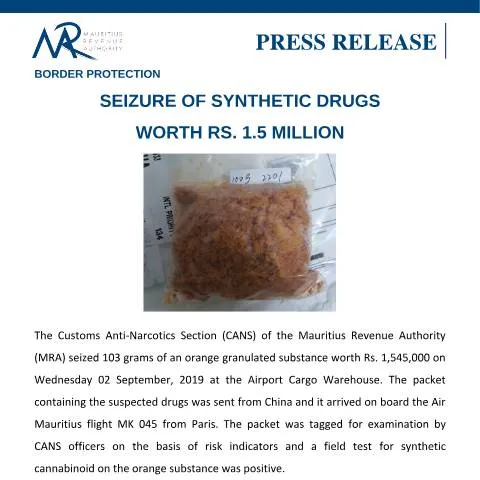
The Significance of Document PressRelease240920 in the Fight Against Drug Trafficking
In the ongoing battle against drug trafficking, the Mauritius Revenue Authority (MRA) plays a crucial role, particularly through its Customs Anti-Narcotics Section (CANS). The formal press release identified as PressRelease240920 serves as a pivotal document that outlines the seizure of synthetic drugs worth Rs. 1.5 million on September 2, 2019. This incident not only highlights the effectiveness of customs enforcement but also the procedural framework guiding drug-related investigations in Mauritius.
Regulatory Framework Surrounding Drug Seizures
The seizure of synthetic drugs is governed by several legislative provisions, with the Dangerous Drugs Act being a key piece of legislation. This legal framework ensures that actions taken by the MRA and the Anti-Drug and Smuggling Unit (ADSU) are within statutory guidelines. The recent seizure, amounting to 103 grams of an orange granulated substance, illustrates the proactive measures enforced by customs officers, derived from risk assessment indicators.
Following the arrival of the package via Air Mauritius flight MK 045 from Paris, CANS officers conducted a field test that confirmed the presence of synthetic cannabinoids. Such actions are vital as they reflect the MRA's continuous monitoring and enforcement efforts against the influx of illicit drugs, aiming to protect the Mauritian public.
Understanding the Process Flow of Drug Seizures
Document PressRelease240920 is not merely a report; it encapsulates a broader procedural context that commences with the monitoring of cargo shipments and culminates in legal actions against offenders. Each step in this process is critical in maintaining the integrity of operations.
- Monitoring and Risk Assessment: Customs officers utilize various risk indicators to identify packages for examination.
- Field Testing: Suspicious packages undergo preliminary testing to ascertain their contents.
- Seizure and Investigation: Upon confirmation, the drugs are seized and investigated in coordination with the ADSU.
- Legal Proceedings: Documented evidence, as found in press releases like PressRelease240920, supports the prosecution of involved individuals.
The Role of Media and Public Reporting in Drug Enforcement
The press release format is instrumental in enhancing transparency and public awareness regarding drug enforcement activities. The public plays a vital role in combating drug trafficking, and the MRA encourages reporting any suspicious activities through its Stop Drug platform or by contacting them directly at 8958. This multi-faceted approach encourages community involvement and creates a collaborative environment against drug-related crimes.
Digital Channels for Reporting and Submitting Evidence
In an increasingly digital world, the MRA’s emphasis on e-services and digital applications is evident. Individuals who wish to report suspected drug-related activities can do so effortlessly using the online platform provided by the MRA. Such systems ensure that the reporting process is efficient, secure, and accessible to all citizens.
For those seeking to understand how to use these digital channels effectively, the following steps are advisable:
- Visit the MRA's official website.
- Navigate to the Stop Drug section.
- Follow the prompts to report suspicious activities anonymously.
Who Should Be Involved? Profiles of Stakeholders
The stakeholders involved in the process of drug seizures and reporting extend beyond the MRA and ADSU; they include law enforcement agencies, customs officials, and the general public. Each group plays a specific role:
| Stakeholder | Role |
|---|---|
| Customs Officials | Conduct inspections and drug seizures at ports and airports. |
| Anti-Drug and Smuggling Unit (ADSU) | Investigate drug trafficking cases based on seizures and intelligence. |
| Public | Report suspicious activities and assist in drug prevention initiatives. |
Assistance for Individuals Impacted by Drug Trafficking
In the unfortunate event that someone is wrongfully accused or impacted by drug-related incidents, understanding the recourse available is essential. Affected individuals may appeal decisions through legal channels or reach out to community support organizations that assist in such cases.
Moreover, the MRA’s Taxpayer Education and Communication Department can provide additional guidance on legal rights and procedures to follow if complications arise from misunderstandings or errors in the investigative process. The contact details for assistance are:
Fill in your form directly online
No printing: type your details into the boxes of the official form, tick, then download the PDF ready to send.
- 1Type into the form boxes
- 2Tick in one click
- 3Save and download the PDF
- Email: [email protected]
- Phone: +230 207 6000
Following-Up on Reported Incidents
Once a report has been submitted, tracking the progress of the investigation can be challenging. However, the MRA provides mechanisms for follow-up inquiries. Engaging with the authority can be done through:
- Contacting the MRA directly via phone.
- Sending follow-up emails to the department handling the case.
- Checking the MRA's official website for updates on broader drug enforcement activities.
Patience is often required, as investigations can take time to ensure thoroughness and compliance with the law.
Conclusion: Vigilance and Community Involvement are Key
The release of information, as seen with the document PressRelease240920, is a testament to the commitment of the MRA in maintaining public safety and promoting awareness around drug trafficking issues. Community involvement is paramount in this fight, as collective efforts can significantly impact the levels of drug-related crime across Mauritius. By staying informed and engaged, citizens can contribute to a safer environment for all.