Unveiling the Sale of Abandoned Goods: An Overview of the Public Tender Process
In the realm of public administration in Mauritius, the sale of abandoned or unclaimed goods represents a significant opportunity for individuals interested in acquiring various items at competitive prices. The Public Tender process, specifically encapsulated in Communiqué 63 of 2019, is governed by the Mauritius Revenue Authority (MRA) and serves as an avenue for the disposal of goods that have been left behind or not claimed over time.
The Legal Framework Behind Public Tenders
Understanding the legal backdrop is crucial for prospective bidders. The Public Tender process aligns with Mauritius’s hybrid legal system, incorporating aspects of French civil law and English common law procedures. The MRA operates under the provisions laid out in the Constitution of 1968 and relevant statutory instruments.
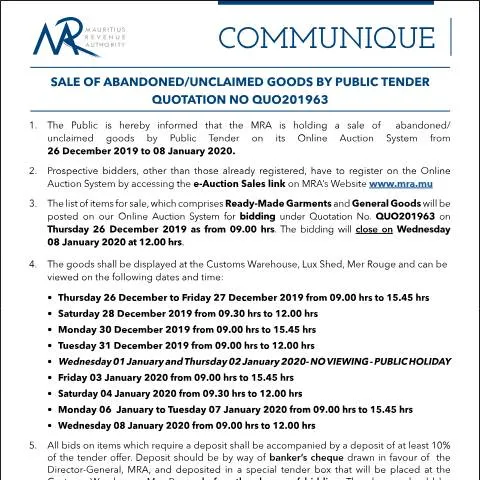
Specifically, the Sale of Abandoned/Unclaimed Goods by Public Tender is scheduled to occur between 26 December 2019 and 08 January 2020, as announced through a public communiqué. This sale is not only a mechanism for clearing unclaimed goods but also a means of generating revenue for the state. The precise identification of goods available for tender is documented under Quotation No. QUO201963.
Engaging with the Tender Process: Initial Steps
Prospective bidders must be proactive in their engagement with this tender process. The initial step involves registering on the MRA’s Online Auction System. This registration can be accomplished by accessing the e-Auction Sales link on the MRA's official website. Registration is essential for those who have not previously participated in MRA auctions.
Following registration, bidders will have access to the list of items up for grabs, which may include categories such as Ready-Made Garments and other general goods. The item list becomes publicly available at 09:00 hrs on 26 December 2019, allowing bidders to evaluate their options ahead of the bidding closure at 12:00 hrs on 08 January 2020.
Viewing the Goods: Essential Dates and Locations
To facilitate informed bidding, the MRA provides opportunities to view the abandoned goods. The designated display site is the Customs Warehouse, Lux Shed, Mer Rouge, with specific viewing hours outlined as follows:
- 26–27 December 2019: 09:00 hrs – 15:45 hrs
- 28 December 2019: 09:30 hrs – 12:00 hrs
- 30 December 2019: 09:00 hrs – 15:45 hrs
- 31 December 2019: 09:00 hrs – 12:00 hrs
- 03 January 2020: 09:00 hrs – 15:45 hrs
- 04 January 2020: 09:30 hrs – 12:00 hrs
- 06-07 January 2020: 09:00 hrs – 15:45 hrs
- 08 January 2020: 09:00 hrs – 12:00 hrs
It is vital to note that no viewing is permitted on public holidays, specifically on 01–02 January 2020.
Understanding the Tender Submission Process
As bidders prepare to participate in the tender, understanding the submission requirements is essential. Each bid submitted must be accompanied by a deposit, which is stipulated at a minimum of 10% of the tender offer. This deposit must be provided via a banker’s cheque drawn in favor of the Director-General of the MRA.
The cheque should be submitted in a designated envelope that clearly states the bidder's name and identifies the items for which the deposit is intended. It is critical to ensure that personal cheques are not utilized, as they will be rejected, underscoring the necessity of adhering to the prescribed format for submissions.
Utilizing Bidding Booths: An Alternative for Non-Online Access
Recognizing the diversity in internet access, the MRA accommodates bidders without online facilities by establishing three bidding booths at the Customs Warehouse. These booths are equipped with computer terminals, ensuring that all interested individuals have the opportunity to participate in the bidding process, even without internet access.
Navigating Potential Issues: What If Things Go Wrong?
Despite thorough preparation, bidders may encounter issues such as errors in submission, missing documents, or even a potential bid rejection. In such cases, it is crucial to address these issues promptly:
- Review Submission: Double-check the completed form for accuracy before submission.
- Contact MRA: For any clarifications or issues, immediately reach out to the MRA's contact points via email or phone.
- Documentation: Ensure all required documents are attached, particularly the banker’s cheque.
In the event of a bid rejection, understanding the reasons behind it can provide valuable insights for future participation. Bidders are encouraged to seek feedback from the MRA to ensure a more successful bidding experience next time.
After the Bid: Understanding the Outcome
Once the bidding period concludes at 12:00 hrs on 08 January 2020, successful bids are formally accepted, and the MRA will notify bidders of the outcomes. Winning bidders are responsible for ensuring that payment is settled promptly in accordance with the agreed terms.
Upon successful confirmation of the bid and payment, arrangements for the collection of the items must be made. The MRA typically stipulates collection timelines and procedures, which all winning bidders must adhere to in order to avoid additional fees or forfeiture of the goods.
Final Considerations: The Importance of Compliance
Throughout the entire process, compliance with all MRA guidelines, submission protocols, and payment instructions is essential. Failing to adhere to these regulations can lead to complications, including bid disqualification or legal repercussions regarding the ownership of goods.
Engaging with the sale of abandoned or unclaimed goods through public tender not only offers unique purchasing opportunities but also demands a thorough understanding of the procedural intricacies involved. With the right preparation and diligence, bidders can navigate this process effectively.
Key Contacts and Resources for Potential Bidders
For any inquiries regarding the Public Tender process or to clarify specific guidelines, prospective bidders can reach out to the Mauritius Revenue Authority:
- Telephone: +230 202 0500
- Fax: +230 216 5946
- Email: [email protected]
- Website: www.mra.mu
Being proactive and well-informed is fundamental in participating successfully in the sale of abandoned goods. Each step taken towards understanding the bidding process ultimately contributes to a seamless and rewarding experience for bidders.
Understanding the Public Tender Process for Abandoned Goods
The sale of abandoned or unclaimed goods by public tender in Mauritius follows a specific procedure, governed by regulations set forth by public authorities, primarily the Ministry of Finance and Economic Development. Understanding this process is essential for both potential bidders and those looking to declare goods as abandoned. The key stages involve notification, assessment of goods, and the actual tendering process.
Firstly, authorities must ensure that goods considered for tendering are indeed abandoned or unclaimed. This often requires a thorough investigation, including attempts to contact the original owner. Once deemed abandoned, a formal notification is issued in the Government Gazette and possibly in local newspapers, specifying the details of the goods, the location, and the upcoming tender date.
Next, potential bidders are encouraged to inspect the goods before the tender closes. There is usually a designated period during which interested parties can view the items, which is critical for assessing their value and condition. This inspection period is typically announced in conjunction with the tender notification.
After the inspection, interested bidders must submit their tenders by the specified deadline, along with any required documentation. Typically, a Tender Form, often PSC Form 7 or equivalent, must be completed detailing the bidder's information and their offer. It's crucial to adhere to the submission guidelines provided in the tender notice to ensure the bid is considered valid.
Fill in your form directly online
No printing: type your details into the boxes of the official form, tick, then download the PDF ready to send.
- 1Type into the form boxes
- 2Tick in one click
- 3Save and download the PDF
Finally, the evaluation of tenders takes place, where the committee reviews all submissions, often focusing on the bid amount and the bidder's compliance with the tender requirements. The highest bid does not necessarily guarantee a sale; other factors, including adherence to legal requirements and past performance, may also influence the decision.
Legal Considerations in the Disposal of Abandoned Goods
The legal framework governing the sale of abandoned or unclaimed goods in Mauritius is nuanced and rooted in both common and civil law traditions. The Public Procurement Act 2006 is a significant piece of legislation that provides guidelines on public tenders, ensuring fairness, transparency, and accountability in the procurement process. Bidders should be aware that all transactions must comply with this Act, as well as other relevant regulations.
Before participating in a public tender, bidders are encouraged to familiarize themselves with the legal obligations regarding abandoned goods. For instance, there are specific provisions related to the ownership of goods, liability for damages, and the responsibilities of the authorities in handling unclaimed items. Understanding these legalities can prevent disputes and ensure a smoother bidding process.
Moreover, it is vital to consider the implications of making an unsuccessful bid. Bidders should be aware of the potential for rejection without explanation and the fact that they are not entitled to claims or compensations regarding their bids. Conditions regarding appeal processes may be stipulated in the tender notice, but they are generally limited.
Additionally, successful bidders must be prepared to comply with any obligations post-purchase, such as removing the goods within specified timeframes and adhering to any restrictions on resale or usage. Such stipulations are usually outlined in the tender agreement, which bidders must review carefully before acceptance.
Maximizing Opportunities: Tips for Bidding on Abandoned Goods
Bidding on abandoned goods can be a lucrative venture, but success requires strategic preparation. Here are some practical tips to enhance your chances during the public tender process.
Firstly, conduct thorough research on the types of goods commonly sold through public tenders in Mauritius. This includes understanding market trends and potential resale value for various items. Knowing what to expect can aid in formulating a competitive yet realistic bid.
Secondly, take full advantage of the inspection period. This is your opportunity to assess the quality and condition of the goods. Bring along a knowledgeable colleague or expert who can provide insight into the value of the items. Document any findings to support your bid rationale.
Thirdly, ensure that your tender submission is complete and compliant. Double-check that all forms, including any necessary identification and proof of financial capability, are included. Missing documentation can lead to disqualification. It is advisable to submit your bid well before the deadline to account for any unforeseen issues.
Lastly, network with previous bidders and industry experts. They can provide valuable insights and tips based on their experiences, which may not be available through official channels. Engaging in forums or associations related to public procurement could open doors for additional opportunities and knowledge sharing.