Navigating the Sale of Abandoned or Unclaimed Goods: A Practical Guide
When you think about acquiring a unique item through a public tender, understanding the nuances of the process is crucial. The Sale of Abandoned/Unclaimed Goods by Public Tender under the CommuniqueQu09of2017 is an opportunity that allows citizens to engage in the bidding of various goods that have been abandoned or unclaimed, provided they navigate the corresponding administrative requirements.
The Landscape of Abandoned Goods in Mauritius
Abandoned and unclaimed goods accumulate due to various reasons, leading to their seizure by authorities. The Mauritius Revenue Authority (MRA) plays a pivotal role in the management of these items. This serves both public interest and the revenue needs of the state. The auction of such items is an essential service that encourages a transparent process of redistributing these goods.
Context of Public Tender Sales
The public tender process allows for the auctioning of items that would otherwise remain unutilized. With a significant timeframe outlined—from the initial notification to the closure of bidding—participants must be well-informed to make the most of this opportunity.
A Step-by-Step Journey from Registration to Bidding
Understanding the mechanics of participation is vital for prospective bidders. Here’s a chronological breakdown of the essential steps involved in the process.
1. Registration on the Online Auction System
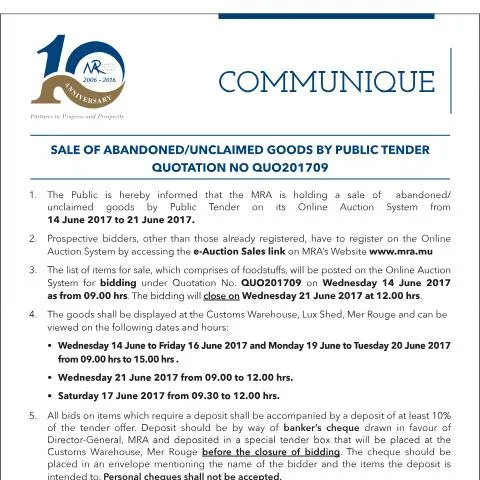
- Prospective bidders must register on the MRA's Online Auction System. This can be achieved by visiting the MRA's official website.
- Registrations must be completed prior to the bidding dates to ensure eligibility.
2. Accessing the List of Available Goods
On the specified date, typically the first day of the auction, a list of items available for bidding is published. This list includes various categories of goods, such as:
- Foodstuffs
- Household items
- Electronics
3. Viewing the Goods in Person
To make informed bids, potential bidders are encouraged to view the items physically at the Customs Warehouse. The designated viewing dates are:
| Date | Time |
|---|---|
| 14 June to 16 June 2017 | 09:00 - 15:00 |
| 19 June to 20 June 2017 | 09:00 - 15:00 |
| 21 June 2017 | 09:00 - 12:00 |
| 17 June 2017 | 09:30 - 12:00 |
This viewing period is essential for evaluating the condition and value of the goods.
4. Deposit Requirements
When participating in auctions, a deposit is a requisite for certain items. The deposit is typically set at 10% of the tender offer. Here are the key points to remember:
- The deposit must be submitted in the form of a banker’s cheque, payable to the Director-General, MRA.
- The cheque must be placed in a sealed envelope that clearly identifies the bidder's name and the item related to the deposit.
- Deposits must be made prior to the auction's closure in a special tender box located at the Customs Warehouse.
- Personal cheques are not accepted.
Understanding the Bidding Process
Bidding within the public tender framework requires adherence to specific protocols to ensure fairness and transparency. The bidding process occurs online, except for those who require assistance at the physical auction site.
Access to Bidding Facilities
For individuals without internet access, the MRA provides alternative bidding solutions:
- Three bidding booths equipped with computer terminals are available at the Customs Warehouse.
- Assistance is provided to guide participants through the online bidding process.
Post-Bidding Procedures: What Happens Next?
After the bidding concludes, understanding the subsequent steps is crucial for successful bidders.
1. Notification of Results
Successful bidders will receive official notification regarding their bids. This communication will detail the next steps, including payment instructions and item collection procedures.
2. Payment and Collection of Goods
Upon receiving confirmation of success in the bidding process, bidders must facilitate payment within a stipulated time frame. The process often includes:
- Payment of the remaining balance of the tender price.
- Arranging for the collection of the goods at the designated warehouse, adhering to specified timings.
Addressing Challenges during the Process
As with any administrative procedure, participants may encounter challenges. Knowing how to address these can ease the process.
Dealing with Missing Documentation or Errors
In the event of an incomplete application or missing documents, proactive measures should be taken:
- Immediately contact the MRA to clarify the specifics of the required documentation.
- Provide the missing pieces or rectify errors promptly to avoid disqualification.
Refusal or Denial of Participation
Should a bid be refused, understanding the rationale behind this decision is critical. Bidders have the right to:
- Request a formal explanation from the MRA.
- Appeal the decision if they believe it to be unjust, following the proper channels outlined by the MRA.
Maximizing Your Chances: Best Practices for Bidders
To enhance your chances of success in bidding for abandoned or unclaimed goods, consider the following strategies:
1. Thorough Research
Prior to bidding, conduct thorough research on the types of goods available and their market value. This ensures you place a competitive but informed bid.
2. Prepare Your Documentation
Ensure all required documents are ready and correctly filled out before the bidding period commences. This includes:
- Your identity card for verification.
- Any necessary financial documentation related to the deposit.
3. Timing is Key
Pay close attention to the timeline for both viewing and bidding. Arriving early to view items can provide an advantage over other bidders.
The Role of Public Tender in Mauritius' Economic Ecosystem
The sale of abandoned or unclaimed goods through public tender is an integral part of Mauritius's economic landscape. It not only facilitates the reintegration of these items into the market but also promotes transparency and accountability within the public sector.
Encouraging Sustainable Practices
By allowing for the auctioning of unclaimed goods, the MRA supports sustainable practices. This initiative encourages recycling and repurposing of items instead of disposal, thereby benefiting the environment.
Boosting Local Economy
Engaging the community in such sales also stimulates local economies. Individuals participating in auctions can uncover unique items at potentially lower prices, fostering consumer engagement and satisfaction.
Final Tips for Successful Bidding
As you prepare to engage with the public tender for the sale of abandoned goods, consider the following practical tips:
- Review the auction items thoroughly during the viewing period.
- Ensure your financial readiness to make timely deposits and payments.
- Engage with community members and previous bidders to gain insights and experiences.
With the right preparation and understanding of the process, participating in the Sale of Abandoned/Unclaimed Goods by Public Tender can be a rewarding and enriching experience. Remember to check the MRA's official website for the latest updates, as information regarding future auctions and guidelines may evolve.
Understanding the Process of Abandoned Goods Auction
The sale of abandoned or unclaimed goods by public tender in Mauritius is subject to specific legal frameworks and administrative procedures. This process not only involves selling goods that have been left unclaimed for a certain period but also ensures that such sales are conducted transparently and fairly. Let’s delve deeper into the steps involved in this process, the roles played by various authorities, and the nuances that potential bidders should be aware of.
Initially, the relevant authority tasked with managing unclaimed goods is typically the local government body, which may collaborate with the Mauritius Revenue Authority (MRA) to facilitate the auction. The goods in question may include items left at public transport stations, lost property, or goods abandoned after legal proceedings. These items are typically held for a specified retention period, often not less than three months, after which they can be sold at auction. It is essential for potential bidders to understand the legal basis of the auction, which stems from the provisions outlined in the Local Government Act and the Public Procurement Act.
Once the retention period is complete, notices about the auction are published in local newspapers and on government websites, ensuring transparency in the process. Interested bidders can often find details of the auction, including the date, time, and location, along with a catalogue of the goods to be auctioned. It is advisable for bidders to attend the preview session, typically held a day or two prior to the auction, to assess the condition of the items they are interested in.
To participate in the auction, bidders must register, typically by filling out an LGSC Form 7a, which collects essential details such as the bidder’s identification, contact information, and the items they wish to bid on. A registration fee may be applicable, which will be outlined in the auction notices. This step is crucial, as it ensures that the auction remains orderly and that serious bidders are prioritized.
Documentation Required for Bidding
Engaging in the auction of abandoned or unclaimed goods requires a clear understanding of the documentation needed, which serves as a verification mechanism for bidders. The primary document is the completed LGSC Form 7a, but additional paperwork may also be necessary depending on the nature of the goods and the auction procedures in place. Here are the essential documents prospective bidders should prepare:
- Identification: A valid National ID card or passport must be provided. This verifies your identity and ensures compliance with the auction regulations.
- Proof of Address: A recent utility bill or bank statement may be required to prove your current residential address.
- Registration Fee Payment Receipt: If applicable, a receipt of the registration fee must be submitted alongside your bidding form. Keep this handy to avoid last-minute complications.
Once all documents are gathered, bidders should submit their registration forms and supporting documents to the designated auction authority ahead of the auction date. Without proper documentation, potential bidders may find themselves disqualified from participating in the auction, emphasizing the importance of thorough preparation.
Post-Auction Procedures and Responsibilities
Winning an auction for abandoned goods is merely the beginning of the process. Successful bidders must adhere to several post-auction responsibilities to ensure compliance with local regulations and effective transfer of ownership. After the auction concludes, winners are typically required to fulfill the following:
- Payment of Winning Bid: Payment must be completed within a specified timeframe, usually within 48 hours. This payment is often required in cash or certified cheque, and failure to do so may result in forfeiture of the item.
- Collection of Goods: After payment is made, the winning bidder must arrange to collect the items at the designated pickup location. It is the bidder’s responsibility to transport the goods safely; hence, bringing appropriate vehicles and assistance is advisable.
- Transfer of Ownership Documentation: In some cases, especially for vehicles or electronics, additional paperwork may be required for ownership transfer. This could include customs clearance documents or proof of compliance with local regulations.
Moreover, it’s important to understand that unclaimed goods often come with conditions. For instance, they may be sold “as is,” meaning that any repairs or refurbishments required are the responsibility of the new owner. Therefore, bidders should ascertain whether the items are in working condition and factor in any potential costs for repairs before placing a bid.
Finally, post-auction communication with the local authority is essential for feedback and clarification of any queries regarding future auctions or potential disputes regarding the goods purchased.