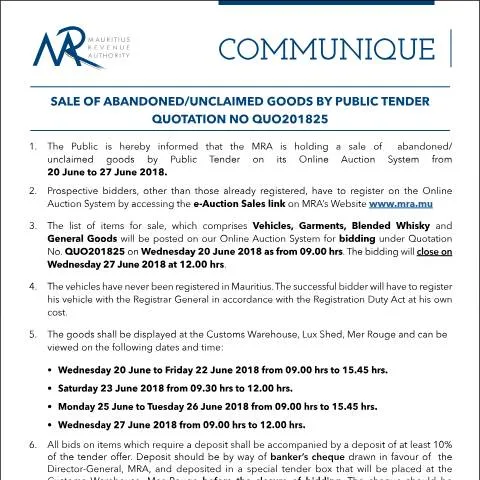
Understanding the Sale of Abandoned/Unclaimed Goods: A Practical Guide
The sale of abandoned or unclaimed goods by public tender represents a unique opportunity for individuals and businesses to acquire a diversity of items at potentially lower prices. Conducted by the Mauritius Revenue Authority (MRA), this public tender process is not only about bidding on goods, but it also involves a series of administrative steps that can be daunting without a clear understanding of the procedures involved. This article aims to detail the nuances of the related official document, Communique Q25 of 2018, focusing on its practical implications for prospective bidders.
Who Engages with This Public Tender Process?
Engagement with the public tender process initiated by the MRA is open to anyone interested in purchasing unclaimed goods, provided they meet certain criteria. While individuals are the primary participants, businesses may also take part. Here's a deeper look into the profiles of potential bidders:
- Individuals: Local citizens looking for good deals on various items, including vehicles, garments, and general goods.
- Businesses: Small to medium enterprises seeking inventory at reduced costs, which can enhance their operational efficiencies.
- Foreign Bidders: Non-residents willing to participate must ensure compliance with local regulations, including registering with relevant authorities.
Eligibility Considerations
While general eligibility is broad, certain conditions must be fulfilled:
- Prospective bidders must be at least 18 years old.
- If bidding as a company, legal documentation proving the company’s registration is necessary.
- Individuals must present valid identification, typically a National Identity Card.
Key Stages of Completion and Submission
Completing and submitting the required documents for the sale of abandoned goods involves several important stages. Timing is critical, and understanding the submission process can prevent unnecessary complications.
Document Preparation and Registering Online
The first step for new bidders is to register on the MRA's Online Auction System. This can be done through the MRA website by accessing the e-Auction Sales link. This registration process entails:
- Providing personal identification details.
- Submitting any relevant business documents if participating as a company.
- Accepting the terms and conditions outlined by MRA for participation.
Once registered, bidders will have access to the list of items available for auction, detailed under Quotation No. QUO201825, which will be posted on the online auction platform from June 20, 2018, at 09:00 hrs.
Bidding Process and Deposits
During the bidding period, participants must adhere to specific guidelines:
- Bids must be submitted before the closing time on June 27, 2018, at 12:00 hrs.
- A deposit of 10% of the bid amount is required for items that necessitate a deposit.
- Deposits are to be made via a banker’s cheque in favour of the Director-General of the MRA, which must be placed in an envelope indicating the bidder’s name and the item.
Accessing Viewing Opportunities
For those interested in physically assessing the goods, MRA provides specific viewing hours:
Goods will be displayed at the Customs Warehouse, Lux Shed, Mer Rouge from:
- June 20 to June 22, 2018, from 09:00 hrs to 15:45 hrs.
- June 23, 2018, from 09:30 hrs to 12:00 hrs.
- June 25 to June 26, 2018, from 09:00 hrs to 15:45 hrs.
- June 27, 2018, from 09:00 hrs to 12:00 hrs.
Identifying Challenges: What If Things Go Wrong?
While the process is straightforward, complications may arise. Understanding the possible issues and their resolutions is essential for prospective bidders.
Common Issues Encountered
- Incomplete Documentation: Submissions lacking required documents can lead to disqualification. Ensuring all paperwork is complete is vital.
- Technical Difficulties: Online bidders may face issues with the auction platform. In such cases, MRA has made provisions by offering access to bidding terminals at the Customs Warehouse.
- Missed Deadlines: Late submissions will not be considered. It’s critical to be aware of all deadlines and plan accordingly.
Process for Addressing Errors
In case of an error in the bid submission or any miscommunication regarding bids, bidders must:
- Contact the MRA promptly using the provided contact details.
- Provide a clear explanation of the issue faced.
- Follow any instructions to rectify the mistake or provide missing documentation.
The Role of Public Tenders in Economic Activity
Public tenders like the one for selling abandoned goods serve as an integral part of economic activity in Mauritius. They not only help clear warehouse space but also provide an avenue for consumers and businesses to benefit from government assets.
Economic Implications for Bidders
Participating in public tenders can yield substantial benefits:
- Access to affordable goods that can be resold for profit.
- Utilization of surplus government assets that would otherwise remain unclaimed.
- Contributing to a more efficient market where goods are circulated effectively.
What Happens Post-Tender? Understanding the Aftermath
Once the bidding process concludes, several actions take place that bidders must be prepared for:
Successful Bidders: Next Steps
Those who receive confirmation of winning their bid will need to complete specific actions:
- Obtain the necessary documentation to finalize the purchase, including proof of payment.
- Register any vehicles acquired through the auction with the Registrar General, in accordance with the Registration Duty Act, at their own cost.
Handling Unsuccessful Bids
For those not successful in their bids, no further action is required. However, it may be beneficial to:
- Monitor future tenders through the MRA website.
- Seek feedback if available, to enhance bidding strategy for future opportunities.
Conclusion: A Pathway to Opportunity
The process surrounding the sale of abandoned and unclaimed goods through public tender, encapsulated within Communique Q25 of 2018, is multifaceted. It represents an opportunity for bidders to acquire valuable items through a structured, albeit challenging process. By understanding the various stages, eligibility criteria, and common pitfalls, prospective participants can navigate this landscape successfully. In a country like Mauritius, such public tenders not only serve the government’s operational needs but also invigorate the local economy by engaging citizens and businesses alike in the cycle of commerce.
Understanding the Process of Bidding for Abandoned Goods
The sale of abandoned or unclaimed goods by public tender in Mauritius is a structured process designed to ensure transparency and fairness. The procedure is regulated by the relevant authorities, namely the Ministry of Finance and Economic Development, which oversees the disposal of government property, including unclaimed goods. Bid participants must fully understand the bidding process to enhance their chances of success.
To initiate a bid, potential buyers should keep an eye on public announcements, which are often published in local newspapers or on official government websites. This is essential as the announcements outline the types of goods available, the terms of the tender, and the deadlines for submission. Interested parties are encouraged to thoroughly review the details of each tender notice, as they contain critical information about the goods on offer, including their condition, any minimum bid requirements, and the necessary documentation needed for participation.
Once the bidding period begins, participants must submit their bids through the designated portal or in person, adhering strictly to the guidelines provided in the tender notice. It is essential for bidders to submit a complete application, including a specified deposit, typically a percentage of the estimated value of the goods being auctioned. Failure to provide the required deposit may result in disqualification from the bidding process.
The evaluation of bids is conducted by a committee appointed by the relevant authority. They will assess each bid based on predetermined criteria, such as the amount offered, the bidder’s reputation, and adherence to the conditions laid out in the tender notice. Successful bidders will be notified and required to complete any remaining formalities, including payment and collection arrangements, within the stipulated timeframe. It is important to note that goods must be collected within a defined period after the conclusion of the tender; otherwise, additional charges may apply.
Legal Framework Governing the Sale of Abandoned Goods
The legal framework governing the sale of abandoned or unclaimed goods in Mauritius is built on a hybrid system where French civil law principles are blended with English common law procedures. This unique amalgamation shapes the rules and procedures that dictate how abandoned goods are identified, reported, and eventually sold. The primary legislation includes various acts that detail the conditions under which goods can be deemed unclaimed, and the responsibilities of public authorities in managing these goods.
According to the guidelines, goods may be classified as unclaimed if they have remained in storage for a specified period without any claim from the owner. This time frame is typically established based on the type of goods and relevant public policies aimed at ensuring efficient use of space and resources. Each authority managing such goods has its own regulations detailing how it conducts inventories, storage protocols, and the eventual auction process.
Moreover, the laws stipulate that proper notification must be given to the original owners, where possible, before the goods are put up for tender. This notification process is crucial as it seeks to balance the rights of property owners with the need for public authorities to reclaim and utilize unclaimed items. If the owner cannot be located, the goods are declared abandoned, and the tender process can then proceed.
Additionally, bidders should be aware that certain categories of goods may be exempt from the tender process due to legal constraints. For instance, items that are considered hazardous, sensitive, or illegal cannot be auctioned off and will follow a different procedure as mandated by relevant authorities. Understanding these legal nuances is essential for anyone considering participating in the tender process.
Practical Considerations for Potential Bidders
Engaging in the sale of abandoned goods through public tender can be a lucrative opportunity, but potential bidders must approach it with diligence and awareness of practical considerations. One of the primary factors to consider is the nature of the goods being auctioned. Bidders should assess the potential resale value of the items and factor in any restoration or repair costs that may be necessary to make the goods marketable.
Furthermore, it is advisable to conduct thorough research on previous auctions and the types of goods that typically sell well. This information can provide bidders with insights into market trends and help them determine how much they are willing to bid. Participating in any pre-tender viewings organized by the authorities can also be beneficial. Such viewings allow bidders to inspect goods in person, assess their condition, and make informed decisions prior to submitting bids.
Another vital aspect is ensuring that all required documentation is prepared ahead of time. This includes identification, proof of funds for deposits, and any additional paperwork that may be specified in the tender notice. Delays in documentation can lead to missed opportunities if bidders are not adequately prepared.
Lastly, bidders should consider the logistical implications of winning a bid. Arranging for the collection and transport of goods can be complex, especially if the items are large or heavy. Hence, it is advisable to plan ahead and secure any necessary assistance to facilitate a smooth collection process once a bid is won. By taking these practical considerations into account, potential bidders can significantly enhance their chances of a successful and profitable tender experience.