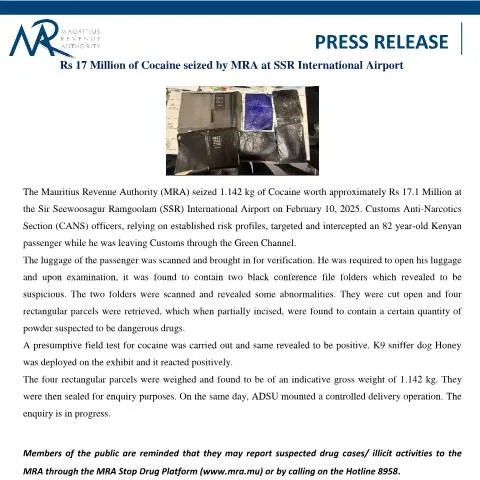
Understanding the Press Release: A Key Document in the Fight Against Drug Trafficking
The recent press release by the Mauritius Revenue Authority (MRA) serves as a crucial document in documenting operations against drug trafficking, particularly the significant seizure of Rs 17 million worth of cocaine at Sir Seewoosagur Ramgoolam International Airport. This press release is not merely an announcement; it reflects the MRA's ongoing commitment to combat illicit drug trade and highlights the operational strategies employed by Customs Anti-Narcotics Section (CANS) officers.
The Incident: A Deeper Look
On February 10, 2025, MRA officials acted on established risk profiles that guide their customs operations. The focal point of the incident was an 82-year-old Kenyan passenger, who, despite his age, was subjected to thorough scrutiny due to the nature of his travel. After expressing suspicion during the standard customs procedure through the Green Channel, his luggage was scanned, leading to the discovery of two black conference file folders containing four rectangular parcels of cocaine.
The detailed process of verification, from the initial scanning to the deployment of the K9 sniffer dog, exemplifies the rigorous checks in place at the airport. This operational detail is significant, as it not only underlines the MRA's capabilities but also emphasizes the importance of well-trained personnel and technology in identifying illicit substances.
The Role of the Press Release in Public Awareness
This document serves as a public-facing channel for the MRA, aiming to inform citizens about ongoing anti-drug operations. By disseminating such information, the authority not only raises awareness about drug trafficking but also encourages public participation in reporting illicit activities. Citizens are urged to report suspicious activities through the MRA Stop Drug Platform or by phone, reinforcing the role of community involvement in combating drug-related issues.
Timelines and Potential Outcomes Following the Seizure
Following such a significant seizure, several procedural timelines come into play. The MRA's immediate response involves sealing the drugs for investigative purposes, as noted in the press release. The controlled delivery operation initiated by the Anti-Drug and Smuggling Unit (ADSU) underscores the meticulous approach taken post-seizure. This action signifies the initiation of further inquiries that are vital in breaking down drug trafficking networks.
What Happens Next?
- Investigation Process: A thorough investigation follows the seizure, analyzing the circumstances surrounding the incident, including tracing the origin of the drugs.
- Legal Proceedings: If evidence substantiates trafficking charges, legal proceedings may be initiated against the individual involved.
- Public Engagement: Continuous updates may be provided to the public regarding the status of investigations, ensuring transparency.
Such timelines are vital for maintaining public trust and showcasing the government’s dedication to addressing drug trafficking. The MRA's actions and subsequent documentation provide a framework for understanding how these procedures unfold and their implications for the wider community.
Channels for Document Submission and Reporting Illicit Activities
The MRA facilitates multiple avenues for the public to engage with their operations, especially concerning reporting drug-related activities. This is crucial for enhancing community involvement in drug prevention efforts.
Various Avenues Available
| Channel | Description |
|---|---|
| MRA Stop Drug Platform | An online platform for citizens to report suspected drug activities anonymously. |
| Hotline 8958 | A dedicated phone line for immediate reporting of suspicious activities, ensuring privacy and rapid response. |
| In-Person Reporting | Individuals may visit the MRA offices to report cases in person, allowing for detailed conversations and immediate advice. |
Each of these channels plays a unique role in fostering a collaborative environment between the MRA and the public. The diversity in reporting methods caters to different comfort levels and urgencies among citizens, ensuring that everyone has the opportunity to contribute to the fight against drug trafficking.
Exploring the Context and Framework Behind the Document
The significance of the documentary processes surrounding the seizure of illicit drugs cannot be understated. The press release acts as a bridge between operational activities and public accountability, grounding itself in the legal frameworks established by the MRA.
Legal Foundations
The actions taken by the MRA and the documentation of these events are rooted in a strong legal framework that governs drug enforcement in Mauritius. This includes adherence to the Constitution of 1968 and the PSC Act of 1955, which guide how the authorities interact with the public and enforce laws around drug trafficking.
This legal backing is pivotal, as it provides the necessary authority for customs officials to conduct searches, seize contraband, and engage in investigative operations. Understanding this context is essential for citizens to appreciate the legitimacy and necessity of such initiatives.
Unique Cases: Special Considerations in Reporting and Investigation
While the press release primarily addresses a specific incident, it also opens discussions on how unique cases are managed within the framework of drug enforcement. Various scenarios may present themselves, prompting special considerations by the authorities.
Special Situations
- Foreign Nationals: Increased scrutiny may apply when non-citizens are involved, particularly in cases where international drug trafficking networks are suspected.
- Minors: Cases involving minors or vulnerable individuals may lead to different handling approaches, focusing on rehabilitation rather than prosecution.
- Complex Situations: Instances involving multiple parties or domestic trafficking may necessitate broader investigations and collaborative efforts with other law enforcement agencies.
These complexities highlight the nuanced decision-making involved in drug enforcement operations and underscore the need for continuous training and education for customs officials to effectively manage each unique scenario.
Monitoring and Follow-Up Procedures Post-Seizure
The seizure of illicit substances, as recorded in the press release, is only one facet of the broader anti-drug operations conducted by the MRA. Post-seizure procedures are equally important, as they help maintain momentum in investigations and build public confidence in law enforcement.
Tracking the Investigation
Once a seizure is made, follow-up actions are critical. Citizens may want to know how they can stay informed about ongoing investigations or what actions are being taken against suspects. The MRA ensures that there is a framework for transparency and accountability in these processes.
- Public Updates: The MRA may issue further press releases to update the public on the investigation's progress, demonstrating the impact of community reporting.
- Engagement through Workshops: The tax authority may conduct workshops or forums to educate citizens about drug laws and encourage further community involvement.
- Feedback Mechanisms: A mechanism may be in place for the public to provide feedback on the efficacy of reporting channels and the responsiveness of the authorities.
Such measures not only reinforce the authority's commitment to transparency but also create a sense of community ownership over the fight against drug trafficking.
The MRA's Commitment to Transparency and Community Involvement
The press release regarding the Rs 17 million cocaine seizure is emblematic of the MRA's broader strategy to not only enforce drug laws but also to engage with the public actively. Transparency and community involvement remain at the core of their operational ethos.
Encouraging Public Participation
As noted in the documentation, the MRA encourages public reporting of suspicious activities through various channels. This engagement is essential for fostering trust and cooperation between citizens and law enforcement.
Such collaborative efforts are vital in ensuring that Mauritius remains vigilant against the threats posed by drug trafficking. The MRA’s proactive approach, coupled with its commitment to transparency, sets a benchmark for how governmental agencies can work with communities to tackle complex societal issues.
Understanding the Role of MRA in Drug Seizures
The Mauritius Revenue Authority (MRA) plays a critical role in safeguarding the nation’s borders, particularly in the fight against drug trafficking. This responsibility extends beyond tax collection to include enforcing laws and regulations that protect the public from illicit substances. The recent seizure of Rs 17 million worth of cocaine at SSR International Airport exemplifies the MRA's commitment to combatting drug-related crimes. Through rigorous inspection protocols and close collaboration with international law enforcement agencies, the MRA has strengthened its operational capabilities in detecting and intercepting narcotics entering the country.
Fill in your form directly online
No printing: type your details into the boxes of the official form, tick, then download the PDF ready to send.
- 1Type into the form boxes
- 2Tick in one click
- 3Save and download the PDF
To optimize their effectiveness, the MRA trains its officers in the latest detection techniques and use of technology. Additionally, they conduct regular workshops and simulations to prepare for real-life scenarios. Such preparatory measures ensure that officers remain vigilant and adept at identifying suspicious activities and materials, thus fostering a proactive approach to drug prevention.
Furthermore, the MRA’s initiatives, such as public awareness campaigns, aim to educate the community about the dangers of drug abuse and the legal consequences of trafficking. These efforts not only support the agency's operational goals but also promote a culture of compliance and collaboration among citizens.
Legal Implications of Drug Trafficking in Mauritius
Drug trafficking in Mauritius is governed by stringent laws designed to deter potential offenders and ensure strict penalties for violations. The Dangerous Drugs Act of 1988 lays down the framework within which all drug-related offenses are prosecuted. Under this act, possession, trafficking, and distribution of controlled substances carry severe penalties, including lengthy prison sentences and substantial fines. The recent seizure highlights the ongoing challenge posed by drug trafficking networks, which often exploit loopholes within legal frameworks.
In the event of a drug seizure, like the significant quantity of cocaine intercepted by the MRA, various legal proceedings are set into motion. The law enforcement agencies must verify the origin and intended distribution channels of the drugs. Furthermore, the judiciary plays a vital role in ensuring due process. Cases involving drug trafficking are handled with urgency, reflecting the judiciary's commitment to countering drug-related crimes effectively.
In addition, the 2019 amendment to the Dangerous Drugs Act introduced measures to allow for asset forfeiture, enabling authorities to seize properties and financial gains linked to drug trafficking operations. This legal framework not only seeks to punish offenders but also aims to dismantle the financial foundations of drug trafficking organizations.
The Impact of Drug Trafficking on Society and Economy
The social and economic ramifications of drug trafficking extend far beyond the immediate law enforcement context. Drug abuse and trafficking have been shown to correlate with increased crime rates, public health issues, and economic instability. In Mauritius, communities grappling with drug-related challenges experience a decline in quality of life, social cohesion, and public safety.
Moreover, the financial burden on healthcare systems due to drug-related health issues, such as addiction and mental health disorders, is substantial. Resources that could be allocated to other vital public services are often diverted to address these challenges, thereby affecting overall community welfare.
In response, the Mauritian government, alongside various NGOs, has initiated programmes aimed at rehabilitation and prevention. These initiatives seek to support individuals battling substance abuse, thereby reducing the demand for illicit drugs and fostering healthier communities. Prevention efforts focus on education, targeting youth and vulnerable populations to raise awareness about the dangers of drug use.
Ultimately, addressing drug trafficking in Mauritius requires a multi-faceted approach that encompasses not only law enforcement but also community engagement, education, and health services. The collaboration between agencies like the MRA, local governments, and non-profit organizations is essential to combat drug-related issues effectively.