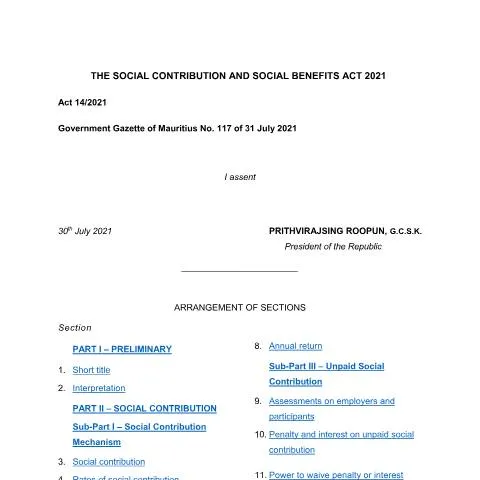
Understanding the Social Contribution and Social Benefits Act 2021 of Mauritius
The Social Contribution and Social Benefits Act 2021, enacted as Act 14/2021 and published in the Government Gazette of Mauritius No. 117 on 31 July 2021, introduces a comprehensive legal framework aimed at regulating social contributions and social benefits within the country. This legislation seeks to formalize the mechanisms for social contributions, ensuring the delivery of various social benefits to eligible individuals, and establishing the administrative procedures for their management and review.
Object and Scope of the Legislation
The primary objective of the Act is to create a unified system that facilitates the collection of social contributions from employers and self-employed persons, while simultaneously providing a structured approach to social benefits such as retirement, industrial injury, disability allowances, and family support. It applies broadly to all persons engaged in trade, business, or occupation within Mauritius, including both citizens and non-citizens who meet specific eligibility criteria.
The legislation also delineates the responsibilities of government authorities, notably the responsible ministry and the Director-General, in administering and overseeing the social contribution system. It emphasizes the importance of compliance, accountability, and transparency in the management of social contributions and benefits, with provisions for review and appeals.
Main Provisions of the Act
Social Contribution Mechanisms
- Social contribution rates: The Act specifies the rates at which contributions are to be calculated, deducted by employers, and remitted to the Director-General.
- Deduction and remittance: Employers are mandated to deduct social contributions from their employees’ wages and remit these amounts regularly to the designated government authority.
- Return submissions: Employers and self-employed individuals are required to submit monthly and annual returns detailing their contributions, ensuring transparency and accountability.
Enforcement and Penalties
- Assessments and recovery: The legislation grants powers to assess unpaid contributions, impose penalties, and recover arrears through legal mechanisms.
- Penalties and interest: Penalties and interest may be levied on late or unpaid contributions, with provisions to waive such penalties under specific circumstances.
- Transactions avoidance: Measures are included to prevent and penalize attempts to evade social contribution obligations.
Social Benefits Framework
- Eligibility: The Act defines who qualifies for social benefits, including retirees, persons injured at work, disabled individuals, and families eligible for allowances such as child, school, maternity, and income support.
- Types of benefits: Benefits encompass retirement pensions, industrial injury allowances, disability benefits, and various family support allowances, with detailed criteria for each.
- Payment procedures: Payments are to be made into bank accounts, with provisions for regular review and adjustment based on individual circumstances.
Administration and Review
The Act establishes the responsibilities of the responsible ministry, which include determining claims, ensuring timely payments, and maintaining records. It also creates a Social Benefits Review Committee tasked with overseeing the review process, hearing appeals, and making determinations on benefit claims.
Implications for Employers and Individuals
This legislation signifies a shift towards a more structured and transparent social security system in Mauritius. Employers are now legally obliged to deduct and remit contributions accurately and punctually, while individuals can expect clearer pathways to access social benefits. The framework aims to enhance social protection, reduce informal employment, and promote social cohesion.
For self-employed persons and small business owners, understanding the contribution rates and reporting obligations is crucial to ensure compliance and avoid penalties. The availability of online portals for submitting returns and claims facilitates easier access to the system, aligning with the government’s push towards digital governance.
Conclusion
The Social Contribution and Social Benefits Act 2021 represents a significant legislative milestone in Mauritius’s social policy. By formalizing contribution mechanisms and expanding social benefits, it aims to strengthen social safety nets and promote equitable development. Stakeholders are encouraged to familiarize themselves with the provisions of this Act and adhere to the stipulated procedures to benefit from the enhanced social protection framework.