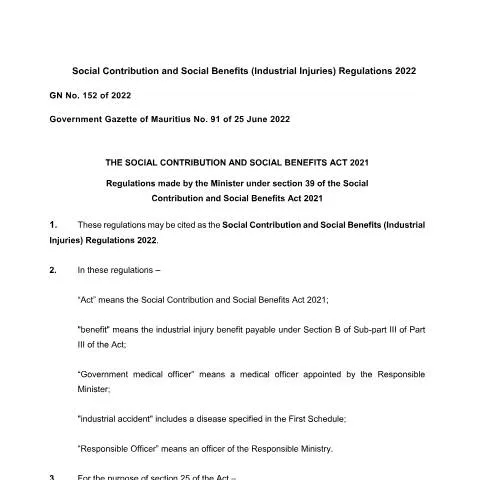
Understanding the Social Contribution and Social Benefits (Industrial Injuries) Regulations 2022 in Mauritius
The Social Contribution and Social Benefits (Industrial Injuries) Regulations 2022, published as Government Gazette No. 91 on 25 June 2022 under GN No. 152 of 2022, establish the legal framework governing industrial injury benefits in Mauritius. These regulations are made pursuant to the authority granted by the Social Contribution and Social Benefits Act 2021, aiming to clarify procedures, entitlements, and responsibilities concerning workplace injuries and related benefits.
Scope and Objectives of the Regulations
The primary objective of these regulations is to define the processes for reporting, recording, and managing industrial injuries, as well as the conditions under which injured employees or self-employed persons can access social benefits. They set out the obligations of employers, self-employed individuals, and medical practitioners to ensure timely and accurate handling of industrial injury cases, thereby safeguarding workers’ rights and promoting workplace safety.
Key Provisions and Procedures
Reporting Industrial Injuries
In the event of an industrial accident, the injured employee or their representative must inform their employer as soon as practicable. The notification should include the circumstances of the injury and be directed to the foreman or designated supervisor. For self-employed persons, the obligation extends to notifying the National Pensions Officer promptly. This prompt reporting ensures that the incident is documented and processed efficiently.
Record Keeping and Documentation
Employers are required to maintain a register recording details of each industrial accident, including information specified in the Second Schedule of the regulations. These records must be preserved for at least three years from the date of the last entry. Additionally, within three weeks of an injury, employers must submit the relevant details to the Responsible Officer designated by the government. Self-employed individuals have similar obligations to keep records and provide necessary information for benefit assessment.
Eligibility and Payment of Benefits
Access to industrial injury benefits is conditional upon certification by a Government medical officer or an approved medical practitioner, confirming the incapacity resulting from the injury. Benefits are payable only after the first 14 days of incapacity unless the medical certification indicates a longer period. The regulations specify that days of incapacity include public holidays unless the injured person normally works on those days or the incapacity extends beyond the holiday period.
Calculation of Benefits
The daily benefit amount is calculated as one three hundred and sixty fifth (1/365) of 80% of the employee’s annual earnings, ensuring a proportionate compensation based on earnings. Expenses incurred for medical treatment and rehabilitation are also covered, as specified in the Fourth Schedule of the regulations.
Role of Medical Assessments and Dispute Resolution
A Medical Board, comprising qualified medical practitioners, assesses the degree of disablement and determines whether the injury resulted from an industrial accident. The Board also indicates the period for which the assessment applies and whether further medical examination is necessary. This process ensures that benefits are awarded accurately and fairly, based on medical evidence.
Fill in your form directly online
No printing: type your details into the boxes of the official form, tick, then download the PDF ready to send.
- 1Type into the form boxes
- 2Tick in one click
- 3Save and download the PDF
Implications for Workers and Employers
For workers, these regulations clarify the procedures for reporting injuries and claiming benefits, emphasizing the importance of prompt notification and proper medical certification. Employers are tasked with maintaining accurate records, providing necessary medical treatment, and cooperating with authorities during investigations or benefit assessments. The regulations reinforce Mauritius’s commitment to protecting workers’ rights and ensuring a systematic approach to industrial injury management.
Conclusion
The Social Contribution and Social Benefits (Industrial Injuries) Regulations 2022 constitute a comprehensive legal framework that enhances the protection of workers in Mauritius. By outlining clear procedures for reporting, record-keeping, benefit calculation, and medical assessment, these regulations aim to streamline the process of industrial injury management, ensuring timely support for affected individuals and promoting a safer working environment across the country.