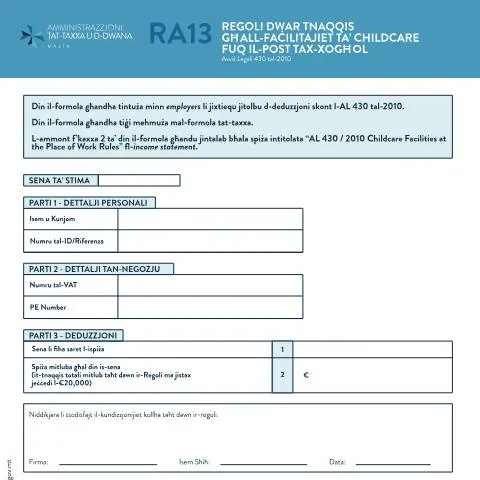
Navigating the RA Forms: Understanding RA13 for Childcare Deductions at the Workplace
In the bustling world of Maltese employment, the significance of workplace childcare facilities cannot be overstated. For parents balancing work commitments and family responsibilities, the availability of childcare provisions directly impacts productivity and overall job satisfaction. The RA13 Form plays a pivotal role in this dynamic, serving as a key document for those seeking deductions related to childcare facilities at work. Understanding how to effectively engage with this form can lead to significant benefits, both financially and in terms of workplace support.
Who needs to engage with the RA13 Form?
This document is crucial for employees and employers alike. Employees who utilize childcare facilities provided by their workplace or those who incur expenses for external childcare services can leverage the RA13 Form to claim deductions on their income tax. Employers, on the other hand, are responsible for submitting this form on behalf of their employees to avail of potential tax benefits. Thus, understanding who must complete this form and the implications of its submission is essential for both parties.
Eligibility Criteria: Are You in the Right Position?
- Employees: Must be registered with the Maltese income tax authority and actively contribute to the tax system.
- Childcare Provisions: The childcare facility must be recognized and compliant with Maltese regulations.
- Expenses Incurred: Employees must provide evidence of expenses incurred, which can include both in-house and external childcare services.
Before proceeding, individuals should ensure they meet the necessary criteria to avoid delays or complications during the processing of the RA13 Form.
Completing the RA13 Form: A Step-by-Step Guide
Filling out the RA13 Form requires attention to detail and a clear understanding of the required information. Here’s a structured approach to ensure a flawless submission:
Gather Necessary Information
Before starting the form, collect the following:
- Personal identification details (Maltese ID number or e-ID).
- Details of the childcare provider, including registration information.
- Documentation of payments made for childcare services.
Form Sections Breakdown
| Section | Description |
|---|---|
| Personal Information | Includes name, address, and identification number. |
| Childcare Provider | Details of the childcare facility, including its registration number. |
| Expenses Claimed | A breakdown of costs incurred, alongside proof of payments. |
| Signatures | Both employee and employer signatures are required to validate the form. |
Ensuring each section is accurately completed is vital, as discrepancies could result in delays or denials of claims.
Submission Channels: Where and How to File Your RA13
Once the RA13 Form is completed, the next step involves choosing the appropriate submission channel. This choice can significantly impact the processing time and subsequent claims:
Digital Submission via e-ID
The most efficient method is through the Maltese e-ID system. This online platform allows users to securely submit forms and track the status of their claims. The key advantages include:
- Immediate confirmation of submission.
- Easy access to historical data and past submissions.
- Less paperwork and a streamlined process.
Paper Submission
For those who prefer traditional methods, paper submission is still an option. However, it requires mailing the completed form to the relevant income tax office. This method can lead to longer processing times, as the document must be physically delivered and scanned into the system.
In-Person Submission
Submitting the RA13 Form in person at designated offices provides immediate feedback and the opportunity to clarify any uncertainties with officials. However, this method may involve waiting times and is subject to the office’s operating hours.
What Happens After Submission? Understanding the Processing Timeline
Once the RA13 Form has been submitted, it enters the processing phase. Understanding this phase is crucial for managing expectations and ensuring timely follow-up.
Typical Processing Timeline
While specific timelines may vary based on workload and other factors, a standard processing time can be anticipated:
- Digital Submissions: Typically processed within a few weeks.
- Paper Submissions: May take longer, often extending to several weeks due to mail delays.
Following Up on Your Submission
It is important to stay proactive. If a considerable amount of time has passed without communication from the income tax authority, consider the following:
- Check your submission confirmation (for digital submissions).
- Contact the income tax office for an update on the status of your claim.
- Be prepared to provide additional documentation if requested.
Potential Rejections: Navigating When Things Don't Go as Planned
In some cases, the RA13 Form may be rejected or processed with issues. Understanding the reasons for rejection and the subsequent steps is critical.
Common Reasons for Rejection
- Incomplete or inaccurate information.
- Missing documentation to support the claim.
- Childcare provider not registered or recognized by the Maltese authorities.
Steps to Address Rejections
If your RA13 Form is rejected, there are several pathways to resolve the issue:
- Review the Feedback: Carefully read any communications regarding the rejection.
- Gather Additional Documents: If the issue is due to missing information, collect the necessary documents to support your claim.
- Submit an Appeal: If you believe the rejection is unjustified, submit an appeal to the income tax authority with supporting evidence.
Timeliness is of the essence; ensure you act quickly to address and rectify any issues to maximize your benefits.
Implications of the RA13 Form: What It Means for You
Filing the RA13 Form has several implications for both employees and employers. Understanding these impacts is essential for maximizing the potential benefits.
For Employees
Successfully filing the RA13 Form can lead to significant tax deductions, ultimately reducing your financial burden. This financial relief allows for:
- Increased disposable income for other family needs.
- Greater overall job satisfaction with workplace support for childcare.
- Encouragement to maintain a work-life balance, knowing that childcare needs are partially met through tax deductions.
For Employers
Employers are also positioned to benefit from the RA13 Form. By facilitating childcare deductions, they can enhance employee satisfaction and retention. Key advantages include:
- Attracting and retaining top talent who prioritize work-life balance.
- A positive workplace culture that values family support.
- Potential tax benefits for providing childcare provisions.
Thus, the RA13 Form not only serves as a tool for financial relief but is also a strategic asset in workforce management.
Key Dates and Deadlines: Stay Ahead of the Game
Understanding the timelines associated with the RA13 Form is crucial for successful submissions and claims. Here’s what you need to know:
Application Timeline
Typically, the RA13 Form can be submitted as soon as childcare expenses are incurred and should ideally be filed:
- Within the tax year to which the deductions apply.
- Prior to the deadline set by the income tax authority for tax filings.
Potential Impacts of Delays
Missing deadlines can lead to missed opportunities for tax deductions. Employees should maintain a calendar of important dates, including:
- Tax filing deadlines.
- Submission deadlines for the RA13 Form.
- Dates for any required documentation to be submitted alongside the form.
Conclusion: Maximizing Your Benefits Through the RA13 Form
The RA13 Form is more than just a document; it represents a crucial opportunity for financial relief and enhanced workplace support for childcare. By understanding the nuances of this form—from eligibility and completion to submission channels and potential implications—both employees and employers can navigate the Maltese income tax landscape more effectively.
Whether you are an employee looking to ease your childcare expenses or an employer aiming to support your staff, leveraging the RA13 Form can pave the way for a more balanced and fulfilling working environment. With the right information and timely action, you can ensure that this form translates into meaningful benefits.
Understanding RA 13: Deductions on Childcare Facilities at the Workplace
Navigating the complexities of the RA 13 form in Malta can often seem daunting, particularly for employers looking to provide childcare facilities at their workplaces. The RA 13 form is essential for those seeking to apply for tax deductions linked to the expenses incurred in establishing childcare services. Understanding this form not only aids in compliance but also helps employers optimize their tax liabilities beneficially.
The key point to note is that the RA 13 form is primarily designed for businesses that cater to the needs of their employees through childcare provisions. Deductions can be claimed for various costs including the establishment of a physical childcare facility, the purchasing of equipment, and ongoing operational expenses. Employers must ensure that their childcare facilities meet the criteria stipulated by the relevant government authorities to be eligible for these deductions.
To successfully complete the RA 13 form, employers should gather all necessary documentation, including invoices, contracts, and any relevant business certificates. The Maltese tax authority, specifically the Inland Revenue Department, provides guidance on what constitutes eligible expenses. Furthermore, it is essential to demonstrate that the childcare service directly benefits the employees and adheres to the local regulations concerning childcare.
Employers should also consider the timing of submitting the RA 13 form. Typically, it aligns with the annual tax return submission deadlines, but it’s advisable to consult with a tax advisor for specific timelines applicable to your business scenario.
Eligibility Criteria for Claiming Deductions on Childcare Facilities
Eligibility for claiming deductions via the RA 13 form is contingent upon meeting specific criteria set forth by the Maltese tax authorities. Firstly, businesses must be registered and operating within Malta, with a valid tax identification number. The childcare facilities must be used exclusively for the children of employees, which means that if the facility is open to the general public, that expense may not qualify for deduction.
Additionally, businesses must ensure that the childcare services adhere to the legislative framework governing childcare in Malta. This includes compliance with licensing requirements dictated by the Early Childhood Development and Care Unit within the Ministry for Education. Non-compliance could lead to disqualification from claiming the deductions entirely.
Moreover, a significant aspect of the eligibility criterion lies in the financial limits imposed on the deductions. Businesses are expected to maintain comprehensive records as proof of expenditures related to childcare services. Failure to document these expenses adequately can lead to an inability to claim the deduction.
It is also important for businesses considering claiming these deductions to assess their workforce demographics. Employers with a significant number of employees who are parents may find that offering childcare facilities not only garners tax benefits but also enhances employee satisfaction and retention.
Steps to Complete the RA 13 Form Effectively
Completing the RA 13 form requires careful attention to detail and a systematic approach to ensure that all requirements are met. Here’s a step-by-step guide to assist employers in the completion of the form:
Gather Necessary Documentation: Before starting on the RA 13, collect all relevant documents including proof of expenses, such as invoices from childcare service providers, receipts for equipment purchases, and contracts with childcare providers.
Review Eligible Expenses: Familiarize yourself with the list of expenses that are deemed eligible for deductions by the Maltese Inland Revenue Department. This can include one-off costs such as renovation or setup costs, as well as recurring operational expenses.
Fill Out the Form: Access the RA 13 form, which is available through the servizz.gov.mt portal. Ensure that you are logged in with your e-ID to access the document. Fill out the required sections diligently, providing all necessary information regarding your business and the childcare services.
Attach Supporting Documentation: Once the form is completed, attach all supporting documents to substantiate the claims being made. This is crucial for the assessment process by the tax authorities.
Submit the Form: Review the completed RA 13 form to ensure accuracy and submit it electronically via the e-ID system or in person at the local Inland Revenue Department office, as applicable.
Follow Up: After submission, keep records of the submitted RA 13 form and any correspondence with tax authorities. Should questions arise, being able to reference your original submission and supporting documentation will facilitate a smoother communication process.
In conclusion, while the RA 13 form serves a vital role in facilitating tax deductions for childcare facilities at the workplace, the successful navigation and completion of the form hinge upon understanding the requirements and maintaining meticulous records. Engaging with a tax professional can provide additional reassurance, ensuring compliance and maximizing potential financial benefits.