Navigating the RA Forms: Understanding RA14 and Deductions for Tertiary Fees
In the complex landscape of tax obligations and educational expenses in Malta, the RA14 form represents a crucial tool for students and their families. Whether you’re a recent high school graduate venturing into higher education or a mature student returning to study, understanding the nuances of the RA14 can have significant financial implications. This article delves into the role of the RA14 form, elaborating on its importance, completion process, and the aftermath of its submission.
The Importance of RA14: More Than Just a Form
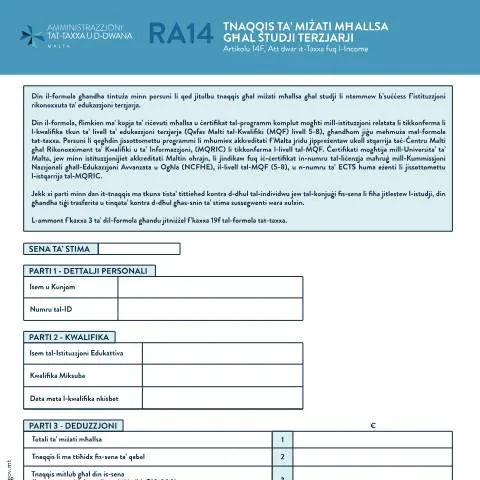
The RA14 form, officially titled RA Forms — ra14-deductions-for-fees-paid-in-respect-of-tertiary-studies.pdf, is not merely a bureaucratic requirement; it opens doors to financial relief for educational expenses incurred during tertiary studies. By requesting deductions for fees paid, eligible students can minimize their taxable income, ultimately reducing the amount of tax owed to the Inland Revenue Department.
Understanding the impact of this deduction is essential. For many, tertiary education fees represent a substantial financial burden. Neglecting to submit the RA14 could result in losing out on significant deductions, making the cost of education even more daunting. The potential for tax savings is particularly beneficial for families with multiple students enrolled in higher education.
Who Can Submit the RA14 Form?
Primarily, the responsibility to submit the RA14 lies with individuals who are registered students in an approved tertiary education institution. However, eligibility extends beyond students to include:
- Parents or guardians paying fees on behalf of dependent students.
- Non-Maltese residents studying in Malta, as long as they meet specific criteria.
- Individuals pursuing courses recognized by the Maltese government or designated authorities.
Decoding the Completion Process
Filling out the RA14 form requires careful attention to detail. Here’s a breakdown of the key sections that applicants must navigate:
Essential Information Required
The RA14 form is divided into several sections, each demanding specific information. Careful completion ensures a smoother processing experience:
- Personal Details: Full name, address, and identification number (including the ID card number).
- Course Information: Details about the tertiary course, including the name of the institution and duration of the program.
- Fees Paid: A comprehensive breakdown of fees, including tuition and any additional costs recognized by the institution.
Documentation That Might Be Required
As you prepare your RA14 submission, gather pertinent documents to support your application. This includes:
- Official receipts for fees paid.
- Confirmation of enrolment from the educational institution.
- Any related correspondence or documents that may substantiate your claim.
Filing the RA14: Timing and Submission Guidelines
Understanding the timeline for submitting the RA14 is critical for successful processing. The submission period typically coincides with the annual income tax return period.
When to Submit
The RA14 form should be filed as part of the annual income tax return process. It's essential to note the following:
- Submission usually begins in January and must be completed by the end of April to ensure timely processing.
- Late submissions may result in the loss of tax deductions for that assessment year.
- It’s advisable to submit earlier rather than later to alleviate potential processing delays.
What Happens After Submission?
Once the RA14 is submitted, applicants may wonder about the subsequent processes. Understanding these can alleviate anxiety and clarify what to expect.
Review and Processing
The Inland Revenue Department undertakes a review of all submitted forms. During this stage, applicants may experience:
- A confirmation of receipt, which is normally communicated via email or postal mail.
- A request for further documentation if any discrepancies or questions arise regarding the submitted fees.
Outcomes of the RA14 Submission
Upon successful processing, applicants will receive a tax deduction in their annual income tax calculation. It’s vital to monitor your tax assessments to ensure the deduction is reflected accurately. If there are issues:
- Contact the Inland Revenue Department for clarification.
- Check your online account linked to the e-ID for updates regarding your tax status.
Understanding the Differences: RA14 vs. Other Forms
It’s crucial to differentiate the RA14 from other tax-related forms. The RA14 specifically pertains to educational fee deductions. In contrast:
| Form Code | Purpose | Key Differences |
|---|---|---|
| RA14 | Deductions for fees paid for tertiary studies | Focused solely on educational expenses |
| RA15 | Deductions for charitable donations | Applies to donations made, not educational costs |
| RA16 | Deductions for medical expenses | Focused on healthcare-related costs |
Special Considerations: Unique Circumstances and Exceptions
While the RA14 form is designed for general use, several unique circumstances warrant special consideration. Being aware of these can help applicants navigate any complexities:
Non-Maltese Residents
International students who are not Maltese citizens may still qualify for deductions under specific conditions. It’s essential to confirm:
- Whether their course is recognized by Maltese authorities.
- Any additional documentation required to validate their status.
Dependent Students
For parents or guardians filing on behalf of a dependent student, it’s crucial to establish:
- Proof of guardianship or parental status.
- The student’s enrollment status in the approved institution.
Complications or Disputes
In cases where discrepancies arise or if there are disputes regarding fees or eligibility, applicants should:
- Contact the Inland Revenue Department directly for guidance.
- Keep records of all communications and documentation related to the claim.
Staying Informed: Resources and Further Assistance
Knowledge is power. Staying informed about changes in regulations regarding the RA14 form and tax deductions is vital. For the most accurate and up-to-date information, applicants can refer to:
- The Inland Revenue Department website.
- Official publications or newsletters related to taxation in Malta.
- Consultation with tax professionals familiar with Maltese law.
By ensuring a thorough understanding of the RA14 form, its requirements, and implications, individuals and families can better navigate the financial landscape of tertiary education in Malta, ultimately benefiting from the available tax reliefs and supporting their educational aspirations.
Navigating the RA14 Form: Eligibility Criteria for Tertiary Study Deductions
The RA14 form, formally known as the 'Deductions for fees paid in respect of tertiary studies', is a crucial document for individuals seeking to benefit from tax deductions linked to their educational expenses. To successfully claim these deductions, applicants must first meet specific eligibility criteria.
Firstly, the applicant must be a tax resident of Malta and must have incurred these fees for courses that are recognized by the National Commission for Further and Higher Education (NCFHE). This recognition is vital as it underpins the validity of the educational institution's fees that the applicant is claiming. Recipients of financial aid, scholarships, or other forms of educational grants may not qualify for the full deduction, depending on the specifics of the funding received.
It is worth noting that the fees in question must pertain to tertiary education levels, which include diplomas, degrees, and other higher qualifications. The deduction can cover tuition fees, registration fees, and related educational expenses, but does not typically extend to costs associated with accommodation or living expenses. If the applicant is enrolled in a part-time program, they may also qualify, provided the course load meets certain criteria laid out by the NCFHE.
For those who have taken out student loans to finance their education, it is important to clarify that while the interest on these loans may sometimes be deductible under specific conditions, the principal fees paid for college tuition are what the RA14 form primarily addresses. It’s advisable for applicants to maintain proper documentation of all payments made, including receipts and bank statements, as these will need to be submitted alongside the RA14 form.
Completing the RA14 Form: Step-by-Step Guidance
Completing the RA14 form requires careful attention to detail, as the accuracy of the information provided is critical to ensuring that the deductions are processed without delays. Here is a step-by-step guide to assist applicants in navigating this process effectively:
- Gather Required Documents: Before starting the application, collate all necessary documentation, including proof of enrollment, tuition fee receipts, and any other relevant invoices that support your claim. Be sure to have your e-ID ready for authentication as it is required for most online submissions.
- Access the Form: The RA14 form can be accessed through the official servizz.gov.mt portal. Navigate to the section related to tax deductions and locate the RA14 form, which is available as both a downloadable PDF and an online e-form.
- Fill Out Personal Information: Begin by entering your personal details, including your full name, Maltese ID number (using the 7-digit + letter format), and contact details. Ensure that your information matches your official documents to avoid discrepancies.
- Detail Your Educational Expenses: In the designated section, provide a breakdown of your tuition fees and other eligible costs. Clearly indicate the amounts paid and attach supporting documents as evidence. This section is crucial, as it determines the extent of your tax deduction.
- Submit the Form: Once you have thoroughly reviewed the completed form for accuracy, submit it electronically via the e-ID system or print and mail it to the relevant tax authority. Ensure that you retain copies of all submitted documents for your records.
After submission, applicants can monitor the status of their claim through the servizz.gov.mt portal, where updates regarding the processing timeline and approval status may be provided. In the event of any queries or issues, contacting the Inland Revenue Department directly is advisable.
Common Challenges and Solutions when Claiming Deductions
While the RA14 form offers a pathway for individuals to reclaim costs associated with their tertiary education, applicants may encounter various challenges during the process. Recognizing these issues and knowing how to address them can facilitate a smoother experience.
One common challenge is the collection of proper documentation. Many students may overlook retaining invoices or receipts as they progress through their studies. To circumvent this, it’s advisable to establish a systematic record-keeping practice from the onset of the academic program, ensuring that all documents are stored securely and are readily accessible when it’s time to complete the RA14 form.
Another frequent issue arises from misunderstandings regarding eligible expenses. Applicants may mistakenly believe that certain costs, such as course materials or textbooks, qualify for the deduction when they do not. To avoid confusion, individuals should familiarize themselves with the official guidelines provided by the Inland Revenue Department and the NCFHE, which can often clarify what constitutes eligible fees.
Moreover, some applicants may face technical difficulties when submitting the form online, particularly with e-ID authentication or the online submission portal. In such cases, seeking assistance from the servizz.gov.mt helpdesk or consulting with peers who have successfully navigated the form can provide valuable insights and troubleshooting tips.
Lastly, delays in processing times can cause frustration for applicants eager to finalize their tax returns. Keeping an open line of communication with the Inland Revenue Department and regularly checking the status of the application can help manage expectations. If significant delays are encountered, applicants should not hesitate to follow up on their submission to ensure it is being processed.