Navigating the Registration Partnership Form: A Comprehensive Guide
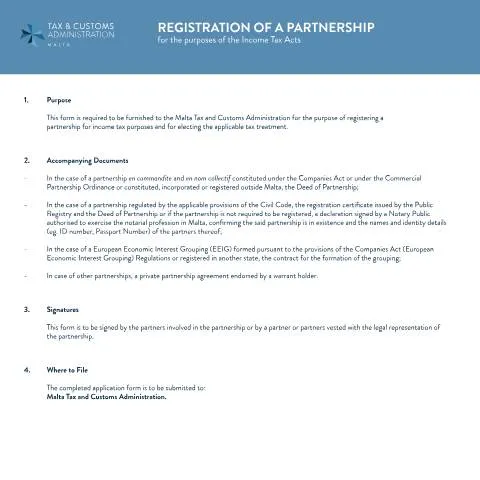
The registration_partnership5022c7ce-8d68-4906-bd37-01bca2197a5d form, one of the essential documents managed by Corporate Tax, plays a pivotal role in the establishment and regulation of partnerships within Malta's corporate landscape. Understanding its importance, and the intricate details involved in its completion and submission, are crucial for any entrepreneur or business entity seeking to operate legally in Malta.
Understanding the Role of the Registration Partnership Form
This specific document is designed to formally register a partnership, a common business structure in Malta, where two or more parties collaborate to manage and operate a business. The form is not merely a bureaucratic hurdle; it sets the foundation for the legal and operational framework of the partnership. The necessity for this registration arises from the need to comply with the regulations laid out in the Public Administration Act (Cap. 595 of the Laws of Malta).
Legal Framework and Historical Context
The legal requirements for registering a partnership in Malta trace back to the evolution of commercial laws designed to foster a transparent and accountable business environment. The registration is mandated by law, ensuring that partnerships adhere to specific regulatory standards, fostering trust among stakeholders. Failure to submit the form appropriately can lead to legal repercussions, including fines and restrictions on business operations.
The Lifecycle of the Registration Process
- Initiation: Start by gathering necessary information about the partnership’s stakeholders, structure, and proposed activities.
- Completion: Fill out the registration_partnership5022c7ce-8d68-4906-bd37-01bca2197a5d form with precise details.
- Submission: Submit the completed form to the Corporate Tax office, typically accompanied by relevant documentation.
- Approval: Await confirmation of registration, which will officially recognize the partnership's existence.
Breaking Down the Registration Form: Key Sections Demystified
Completing the registration partnership form requires a keen understanding of its various sections. A misstep in any part could lead to delays or rejections. Below, we delve into the key components of the form, along with tips to avoid pitfalls during completion.
Section One: Partnership Details
This initial section demands a clear articulation of the partnership's name, registered address, and primary business activity. Ensure that the partnership name does not infringe on existing registered entities, as this could cause significant delays.
Section Two: Partner Information
Here, each partner's details must be inputted accurately. This includes:
- Name and surname
- Date of birth
- Nationality
- Identification number or tax identification number
Ensure that the identification numbers are up to date and correctly formatted. For Maltese residents, this follows a specific 7-digit + letter structure, which must be double-checked.
Section Three: Financial Information
This segment requires an overview of the partnership's financial projections and potential revenue streams. Be prepared to substantiate figures with supporting documentation, which could include business plans or financial forecasts.
Submission Protocol: Navigating the Bureaucratic Maze
Once your form is complete, the next step involves its submission. The Corporate Tax authority requires that all documents be submitted electronically through the central e-ID system, a crucial step in ensuring secure and authenticated processing. This digital submission process necessitates that you have your e-ID credentials ready.
Timelines and Next Steps
After submission, applicants should anticipate a waiting period for processing. The typical timeline for approval can vary greatly depending on the volume of applications being processed. Always keep track of your submission through the designated tracking system that can be accessed using your e-ID.
Consequences of Non-compliance: The Stakes Involved
The implications of neglecting the registration partnership form can be severe. Without proper registration, a partnership may face legal challenges, including:
- Inability to operate legally within Malta
- Pursuit of fines and penalties by regulatory bodies
- Increased scrutiny and potential audits from tax authorities
Additionally, personal liability could extend to the partners individually, emphasizing the importance of compliance.
Differentiating the Registration Partnership Form from Other Corporate Forms
Given the myriad of corporate documents and forms that exist in the Maltese administrative landscape, it is essential to differentiate this specific form from others that may appear similar. For instance, the forms related to sole proprietorship registration and limited liability company registration serve entirely different purposes and have distinct requirements.
Key Differences
| Form Type | Purpose | Number of Partners | Liability |
|---|---|---|---|
| Registration Partnership | To register a partnership | Two or more | Joint liability |
| Sole Proprietorship | To operate as a single entity | One | Unlimited liability |
| Limited Liability Company | To limit partner liability | One or more | Limited liability |
Conclusion: Empowering Your Business Journey
Completing the registration_partnership5022c7ce-8d68-4906-bd37-01bca2197a5d form may seem daunting, but armed with the right knowledge, it can be a straightforward process that paves the way for legal and successful business operations in Malta. The form is an essential stepping stone for any partnership aiming to thrive while adhering to local laws and regulations.
Understanding the Registration Process for Partnerships in Malta
Registering a partnership in Malta involves a series of steps that ensure compliance with both local laws and regulations. The primary governing framework is outlined in the Commercial Partnerships Act, which provides the legal backbone for all partnerships, including general partnerships and limited partnerships. One of the first steps is to decide on the type of partnership that best suits your business needs. A general partnership allows all partners to manage the business, whereas a limited partnership offers a structure where certain partners have limited liability.
Once the type of partnership is determined, the next step is to secure a unique name for the partnership, which must not only comply with the Companies Act but also be distinctive enough to avoid confusion with existing entities. It is advisable to check the name availability through the online services provided by the Malta Business Registry. Following the selection of a name, the partners must draft the partnership agreement, which should detail the roles, responsibilities, profit-sharing ratios, and other critical operational aspects of the partnership.
The partnership agreement must be signed by all parties involved and should ideally be notarized to enhance its legal standing. Subsequently, the partnership must be registered with the Malta Business Registry. This entails filling out the appropriate forms, such as Form 7 for partnerships, and submitting them along with the partnership agreement and payment of the requisite registration fee.
Partnerships are also required to register for tax purposes with the Commissioner for Revenue, which can be accomplished online via the e-ID system. Proper registration ensures that the partnership complies with the Income Tax Act and other relevant taxation laws, thereby avoiding penalties and ensuring smooth operational capabilities. Additionally, partnerships must hold annual meetings and maintain proper accounting records to comply with the established legal frameworks.
Tax Obligations and Benefits for Partnerships
Partnerships operating in Malta benefit from a favorable tax regime, particularly when compared to other jurisdictions in Europe. Under Maltese tax law, partnerships are not subject to income tax on the partnership level; instead, profits are passed through to individual partners, who are then taxed on their personal income tax returns. This pass-through taxation helps avoid the double taxation scenario often encountered in corporations.
However, it is essential for partnerships to be aware of their obligations regarding the submission of annual tax returns. Each partner must declare their share of the partnership income on their tax return, which must be filed with the Commissioner for Revenue. Partnerships are also required to maintain meticulous accounting records and prepare annual financial statements, which must adhere to the International Financial Reporting Standards (IFRS) if certain thresholds are met.
Furthermore, partnerships may qualify for various tax incentives and exemptions offered by the Maltese government, particularly if they engage in specific sectors such as research and development, technology, or tourism. Engaging a local tax advisor familiar with Maltese tax law can provide insights into potential tax planning strategies to optimize the partnership's tax obligations.
Partnership Dissolution and Exit Strategies
Dissolving a partnership in Malta is a structured process that must adhere to both the terms outlined in the partnership agreement and the stipulations of Maltese law. A partnership can be dissolved voluntarily through mutual consent of all partners or involuntarily in cases where the partnership objectives can no longer be met.
The first step in the dissolution process is to notify all partners of the intent to dissolve the partnership, followed by holding a meeting to discuss and agree upon the terms of dissolution. It is crucial to settle any outstanding debts and obligations before officially dissolving the partnership. This ensures that all partners are released from liability associated with the partnership's debts once it is officially closed.
Once agreements have been reached, the final step is to file a notice of dissolution with the Malta Business Registry. This involves submitting Form 9, which officially informs the registry of the partnership's termination. Additionally, a final tax return must be filed with the Commissioner for Revenue, detailing the partnership's income up until the date of dissolution. Keeping detailed records throughout the dissolution process can help prevent legal complications and ensure that all steps are followed in compliance with Maltese regulations.