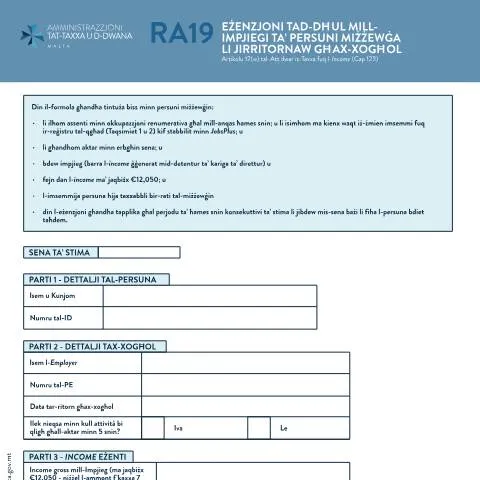
Understanding the RA Form: A Crucial Component of Income Tax Compliance
In the complex landscape of Maltese taxation, the RA Form (mtca-ra19-mlt-eng) stands out as a pivotal document for individuals and entities alike. This form serves as a conduit for taxpayers to communicate essential information to the Income Tax Department, thereby facilitating the processing and assessment of their tax obligations. Navigating through this form can have far-reaching implications for compliance, refunds, and overall tax liability.
Defining the RA Form's Functionality Within Tax Procedures
The RA Form is instrumental in the various tax procedures observed in Malta. Primarily, it is used to report income and claim allowances or deductions that may be applicable to an individual's or entity's tax situation. Its importance cannot be overstated, as the accurate completion of this form can significantly impact the taxpayer's financial standing and ensure adherence to Maltese tax law.
Who Needs to Submit the RA Form?
This form is generally required from:
- Individuals earning income from employment, self-employment, or investments.
- Companies and partnerships with taxable income.
- Foreign entities having a tax presence in Malta.
Understanding your obligation to submit the RA Form is the first step in fulfilling your tax responsibilities. Missing the deadline or incorrectly filling out the form can lead to delays, penalties, or even audits.
Clarifying Distinctions: RA Form Versus Other Tax Documents
Within the realm of Maltese tax documentation, the RA Form is often mistakenly conflated with other forms such as the Income Tax Return or the Capital Gains Tax Form. While all these documents may serve the function of reporting income, they cater to different aspects of tax law:
| Form | Purpose | Applicable Users |
|---|---|---|
| RA Form (mtca-ra19-mlt-eng) | Reporting income and claiming deductions | Individuals, entities with taxable income |
| Income Tax Return | Annual income reporting for tax assessment | All taxpayers |
| Capital Gains Tax Form | Reporting gains from the sale of assets | Individuals, businesses involved in asset sales |
Each form has its unique requirements and implications, making it essential for taxpayers to use the correct documents to avoid complications.
Preparation: Collecting Supporting Documents for RA Form Submission
Completing the RA Form necessitates a range of supporting documents that substantiate the information reported. Depending on individual circumstances, one may need to gather:
- Tax identification numbers for all income sources
- Proof of income (e.g., payslips, bank statements)
- Documentation for any tax deductions claimed (e.g., receipts for business expenses, charitable donations)
Tailoring Documentation to Individual Tax Scenarios
As tax situations vary widely, consider the specifics of your financial circumstances:
- Employees: Collect payslips and any other income statements.
- Self-employed Individuals: Maintain comprehensive records of income and business-related expenses.
- Investors: Prepare statements from financial institutions documenting dividends and interest earned.
Meticulously preparing these documents not only simplifies the filling process but also enhances the likelihood of a smooth review by the Income Tax Department.
Decoding Each Section of the RA Form
The RA Form comprises multiple sections, each designed to capture specific information pertinent to a taxpayer's financial situation. Below is a breakdown of the form's sections alongside possible pitfalls.
Section A: Personal Information
This section requires basic personal details such as name, address, and identification number. Common errors to watch for include:
- Incorrect or incomplete identification numbers.
- Misrepresentation of residency status.
Section B: Income Details
Here, taxpayers must report all sources of income. It is crucial to:
- Include all forms of income, such as wages, investments, and rental income.
- Calculate totals accurately to prevent discrepancies.
Section C: Deductions and Allowances
This part allows for the inclusion of deductions. Ensure to:
- Attach necessary proof for each claimed deduction.
- Check for specific eligibility criteria associated with certain deductions.
Processing and Follow-Up: What Happens After Submission?
Once submitted, the Income Tax Department undertakes a series of checks to validate the information provided in the RA Form. Here’s how the process typically unfolds:
- Initial Review: The form is screened for completeness and accuracy.
- Assessment: Tax officers assess the submissions, cross-referencing against available data.
- Notification: Taxpayers are notified of their tax liability or refund status.
Taxpayers can expect a communication, often through the central e-ID platform, detailing any actions required on their part or confirming acceptance of their submission.
Key Timelines: When to File the RA Form
Understanding the timeline for submission is essential for compliance. The RA Form typically follows specific deadlines, which align with Malta's tax year. Key dates include:
- Tax Year End: Usually aligns with the calendar year, concluding on December 31st.
- Filing Deadline: Generally set for the end of June of the following year.
Being aware of these dates is crucial. Failing to submit on time may result in late fees or penalties.
A Comprehensive Timeline: From Submission to Outcome
To navigate the RA Form process with greater clarity, consider the following chronological steps:
- Document Preparation: Gather all necessary information and supporting documents.
- Form Completion: Carefully fill in the RA Form, paying special attention to detail.
- Submission: Use the e-ID system for a streamlined process, ensuring all data is accurately captured.
- Processing: Allow time for assessment; monitor communications for updates.
- Outcome Notification: Respond promptly to any requests for additional information or clarifications from the tax office.
This approach helps demystify the process and enables taxpayers to remain engaged with their submissions, facilitating easier resolutions to any issues that may arise.
Final Considerations: Staying Informed and Proactive
As a taxpayer in Malta, staying informed about your obligations and the nuances of the RA Form can greatly impact your financial dealings and compliance with tax regulations. Regularly consulting the Income Tax Department's resources or seeking professional advice can keep you aligned with the current laws and practices.
In conclusion, the RA Form is more than just a piece of paper; it embodies a taxpayer's responsibility and diligence towards their fiscal obligations. By understanding its intricacies, preparing thoroughly, and submitting accurately, taxpayers not only fulfill their legal duties but also position themselves for potential financial benefits.
Understanding RA Forms: Key Components and Their Significance
The RA Form, particularly the mtca-ra19-mlt-eng.pdf, is integral to various administrative processes in Malta. Understanding its components is essential for any individual or entity submitting applications. The RA Form typically includes sections covering personal information, details of the property involved, and specific requests related to land use or ownership. Each section is designed to capture necessary data that assists the Land Authority in processing applications efficiently.
Personal information, for instance, requires detailed identification, which is crucial for verifying the applicant's identity against the Central e-ID authentication system. In the property details section, the applicant must accurately describe the land, including its location, size, and current use. This level of detail helps streamline the evaluation process and reduces the likelihood of delays due to missing or incorrect information.
Furthermore, understanding the legal grounds under which the application is made can be beneficial. The RA Form often requires applicants to reference relevant legislation or guidelines that support their request. Being well-informed about the Public Administration Act (Cap. 595 of the Laws of Malta) and other pertinent laws can enhance the quality of the submission and improve the chances of approval.
Common Missteps in RA Form Submissions: How to Avoid Them
Completing the RA Form can be a straightforward process if approached methodically. However, there are several common missteps that applicants often make, which can lead to delays or rejections. One such error is the incomplete filling of mandatory fields. It is crucial to ensure that every required section is filled out completely and accurately; failing to do so can result in the application being returned with a request for additional information.
Another frequent mistake is the misinterpretation of the application type. Applicants often select the wrong category or type of application associated with their request, leading to significant processing delays. Familiarizing oneself with the various categories outlined in the Land Authority's guidelines can mitigate this risk.
Additionally, poor documentation can hinder the application process. While the RA Form itself is critical, supporting documents such as land surveys, title deeds, and planning permissions are equally essential. Applicants should ensure that these documents are current, relevant, and correctly referenced in the form.
Lastly, not adhering to submission timelines can jeopardize an application. The timelines for submissions may vary depending on the nature of the request, so it is advisable to check the Land Authority’s website for specific deadlines associated with different types of applications.
Post-Submission Process: What Applicants Should Expect
Once the RA Form has been submitted, the next steps in the administrative process can be pivotal to the outcome of the application. After receiving the form, the Land Authority will typically acknowledge receipt via the central e-ID system, confirming that the application is under review. It is advisable for applicants to keep an eye out for this acknowledgment as it serves as proof of submission.
During the review period, which can vary depending on the complexity of the application, the Land Authority may contact the applicant for additional information or clarification. Proactively responding to these inquiries can significantly speed up the process. Applicants should also maintain a record of all communications regarding their application, as this can be useful for future reference or in case of disputes.
Following the evaluation of the application, the Land Authority will issue a decision. If approved, applicants will receive formal documentation outlining the terms and conditions of the approval. Conversely, if the application is rejected, the applicant will be provided with the reasons for the denial, along with information on the possibility of appeal or resubmission.
It's also essential for applicants to be aware of the potential fees associated with the processing of the RA Form. These fees can vary based on the type of application and should be confirmed via the Land Authority’s official channels to ensure compliance.