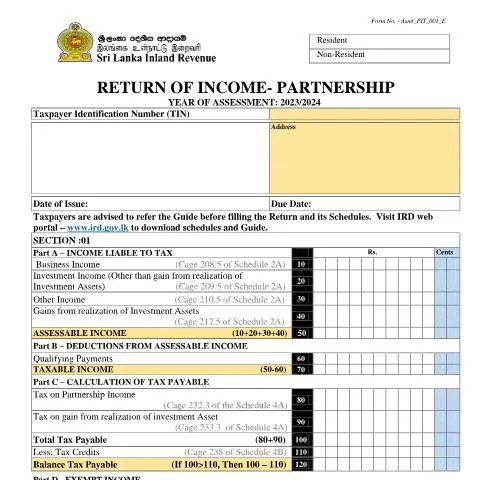
The Significance of the Return of Income - Asmt_PIT_001_E
In the complex landscape of taxation in Sri Lanka, the Return of Income form, designated as Asmt_PIT_001_E, holds a pivotal role for partnerships. It is not merely a document; it is a formal declaration of all income derived from business activities as well as details of any deductions, ultimately determining the tax liabilities of the partnership for the assessment year.
Context of Partnerships in Sri Lanka
Partnerships in Sri Lanka operate under specific regulations framed within the confines of the Inland Revenue Act, No. 24 of 2017. This act lays the groundwork for tax obligations, guiding how partnerships report their income and compute taxes owed. As partnerships can vary widely in structure and income generation, this form enables the Inland Revenue Department (IRD) to ensure compliance and accurate tax collection. The necessity for such a form is underscored by the legal imperatives of English common law principles, which significantly influence administrative processes.
Understanding the Workflow: From Preparation to Submission
The process surrounding the completion and submission of the Return of Income involves intricate steps. These steps begin with the collection of relevant financial data, proceeding through calculations and culminating in submission to the IRD.
- Collect Financial Information: Gather all pertinent details regarding business income, investment income, and any other earnings. This information forms the basis of the calculations that will appear on the return.
- Calculate Taxable Income: Utilize the Return of Income form to calculate the taxable income by following the structured sections, including deductions for qualifying payments.
- Verification: If an approved accountant prepares the return, ensure that their certification is attached as specified.
- Complete the Form: Accurately fill in all required sections, including income types, deductions, and the final tax calculations.
- Submit the Form: File the completed form electronically through the IRD e-Services portal before the designated deadline.
Key Dates: Navigating the Tax Calendar
Understanding the timeline associated with the Return of Income is crucial for partnerships. The due date for submissions is generally set for 30th November following the end of the assessment year, which in this case concludes on 31st March 2024. This structured timeline is critical as late submissions can lead to penalties and interest charges on overdue tax payments.
Here is a summary of important dates to keep in mind:
| Event | Date |
|---|---|
| End of Assessment Year | 31st March 2024 |
| Submission of Return of Income Due Date | 30th November 2024 |
Following Up: What Happens After Submission?
Post-submission, there are several points of consideration for partnership entities. Upon filing the Return of Income, it is advisable to keep a record of submission confirmations provided by the IRD. This forms a part of your audit trail and can be vital in the event of disputes or queries raised by the IRD.
- Confirmation of Receipt: Once submitted, it is essential to receive confirmation from the IRD, indicating that your return has been successfully filed.
- Assessment Result: The IRD will review your submission, after which they will issue a notice of assessment, informing you of your tax liabilities based on the declared income.
- Payment Schedule: Be prepared to make tax payments based on the assessment notice, which will outline any outstanding tax due.
Addressing Common Issues: Errors and Appeals
In the event of discrepancies, errors, or omissions on the filed Return of Income, partnerships must navigate the correction process. If a partnership discovers an error post-submission, they are permitted to amend their return, provided that it is done in accordance with the stipulations outlined by the IRD.
- Correction of Mistakes: If a mistake is identified, fill out an amended return and submit it, clearly indicating that it is a correction.
- Missing Documentation: Should any documents be missing at the time of submission, partnerships must ensure to furnish these documents promptly upon request from the IRD.
Furthermore, in situations where the partnership receives a notice of refusal or an unfavorable assessment, there are mechanisms for appeal. Partnerships can file an appeal to the Commissioner General of Inland Revenue, detailing the grounds for the appeal.
Considerations for Non-Resident Partnerships
For non-resident partnerships operating in Sri Lanka, additional considerations apply under the tax laws. Non-residents may be subject to different tax rates and obligations; hence, understanding their specific tax responsibilities is crucial. They must also fill out the Return of Income form accurately, reflecting any income sourced within Sri Lanka.
Moreover, non-resident partnerships should take note of:
- A potential requirement to appoint a local representative who can facilitate communication with the IRD.
- Specific provisions for exemptions or reduced tax rates under double tax treaties, where applicable.
Interplay with Other Administrative Processes
The Return of Income is not an isolated document; it plays a significant role within a broader administrative framework. This framework encompasses other filings and compliance measures required of partnerships. For example, partnerships may also need to prepare and file financial statements and tax computations alongside their income returns, as mandated by the IRD.
- Documentation Requirements: Ensure that financial statements are prepared in compliance with the Sri Lankan Accounting Standards and are attached to the return.
- Annual Audit Requirements: Depending on the size and type of partnership, annual audits may be required, further necessitating accurate record-keeping.
This interconnectedness emphasizes the importance of meticulous adherence to all filing requirements, as failure to comply may result in penalties or legal repercussions.
Wrap-Up on the Importance of Accurate Tax Reporting
In summary, the Return of Income - Asmt_PIT_001_E is a crucial document for partnerships navigating the tax landscape in Sri Lanka. It serves as a comprehensive account of both income and deductions, impacting tax obligations significantly. Partners must approach this form with diligence, ensuring accuracy, completeness, and compliance with the stipulated timelines. Knowledge of the entire reporting process, the potential for errors, and the avenues for redressal form a robust framework for managing tax obligations effectively.
Ultimately, by understanding the intricacies of the Return of Income, partnerships can not only fulfill their legal obligations but also contribute positively to the fiscal governance of Sri Lanka.
Understanding the Integral Components of the Return of Income Form
The Return of Income (Asmt_PIT_001_E) form is a crucial document for taxpayers in Sri Lanka. It is primarily designed for individuals who have generated income during the assessment year, which runs from April 1 to March 31 of the following year. Understanding the integral components of this form is vital for ensuring accurate completion and compliance with the regulations set forth by the Department of Inland Revenue (DIR).
First, it is essential to differentiate between various types of income, as not all need to be reported on the Return of Income. Taxpayers must report income earned from employment, business profits, rental income, and investment income, among others. Each category may have specific sections within the form requiring detailed information.
Let us delve deeper into each section of the Return of Income form:
- Personal Information: This section requires you to input your National Identity Card (NIC) number, full name, address, and contact details. Accurate information is imperative, as any discrepancy may lead to delays or complications in processing your return.
- Income Details: Here, taxpayers categorize their income sources. This is subdivided into: salary, business income, capital gains, and other miscellaneous income. It is essential to maintain accurate records and documentation to substantiate these earnings.
- Deductions and Allowances: Taxpayers can claim certain deductions, such as expenses incurred in earning income, contributions to approved retirement plans, and health insurance premiums. It is vital to keep receipts and relevant documentation to support these claims.
The accuracy of these components directly affects the taxpayer's liability and potential refunds, making it essential to approach the completion of the Return of Income with diligence and care.
The Consequences of Late Submission of the Return of Income
Failing to submit the Return of Income on time can result in a series of penalties and complications for the taxpayer. Under the Sri Lankan tax regime, the deadline for filing this return is generally set for November 30 of each year for the previous assessment year. However, taxpayers are encouraged to check for any announcements from the Department of Inland Revenue (DIR) for potential extensions or changes in deadlines.
If a taxpayer fails to submit the Return of Income by the deadline, they may face a late filing penalty. The penalty can be significant, ranging from a fixed monetary amount to a percentage of the unpaid tax liability. Additionally, interest may accrue on any outstanding tax owed, compounding the financial burden on the taxpayer.
Moreover, late submission may lead to an automatic assessment by the DIR, where the authorities may estimate the taxable income and levy taxes accordingly. This estimation is often unfavorable to the taxpayer, as it may not accurately reflect their actual income or deductions. Consequently, this could lead to an inflated tax liability that may be difficult to contest.
Taxpayers should also be aware of the potential repercussions regarding the ability to claim deductions and credits for which they may otherwise be eligible. If the Return of Income is submitted late, the right to claim certain deductions may be forfeited, meaning that taxpayers can end up paying more tax than they would have had they submitted their return on time.
In summary, the consequences of late submission extend beyond immediate financial penalties. They can affect a taxpayer's future dealings with the DIR, their credit rating, and their overall financial health. Hence, it is prudent to prioritize timely submission of the Return of Income and to monitor any changes in tax regulations that may affect this requirement.
Common Mistakes to Avoid When Filing the Return of Income
Filing the Return of Income can be a complex process, and many taxpayers make common mistakes that can lead to issues with the Department of Inland Revenue (DIR). Awareness of these pitfalls can facilitate a smoother filing process and enhance compliance.
- Incorrect Personal Information: One of the most prevalent errors is the input of incorrect or outdated personal information, such as the NIC number or address. This can lead to complications in processing the return and may delay any refunds due.
- Omitting Income Sources: Taxpayers sometimes neglect to report all sources of income, especially if they have multiple income streams. It is essential to report all earnings, as failure to do so can attract penalties and interest.
- Inaccurate Deductions: Claiming deductions without adequate documentation or failing to understand the rules surrounding eligibility can lead to disputes with the DIR. Taxpayers should ensure they keep receipts and understand what constitutes an allowable expense.
- Ignoring Tax Credits: Many taxpayers overlook tax credits available to them, such as those for certain investments or expenses. Claiming all eligible credits can significantly reduce the tax liability.
- Filing Late: As previously discussed, failing to submit the Return of Income on time can lead to penalties and interest. It is critical to manage time effectively and file well before the deadline.
To avoid these pitfalls, it is advisable for taxpayers to set reminders for critical dates, double-check all entries on the form, and, if necessary, seek assistance from tax professionals familiar with local regulations. Adopting a systematic approach to the filing of the Return of Income will enhance accuracy and ensure compliance with Sri Lankan tax laws.