Navigating the Return of Income Form: Your Essential Guide to Asmt_PIT_001_2024
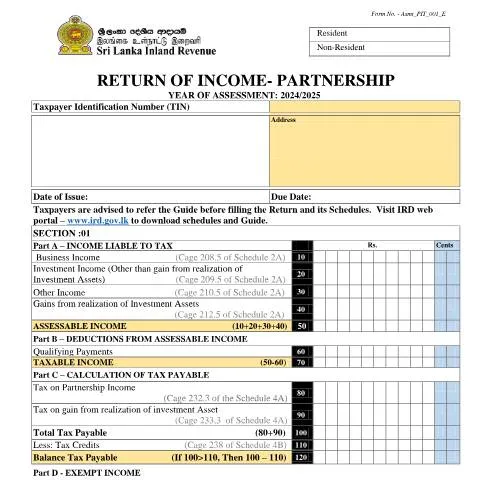
Completing the Return of Income - Asmt_PIT_001_E is a fundamental requirement for partnerships in Sri Lanka as they navigate their tax obligations for the assessment year 2024/2025. This document serves as a conduit for declaring income, calculating tax liabilities, and ensuring compliance with national tax laws. Failure to file correctly can lead to severe penalties, making it crucial for taxpayers to grasp the intricacies of this form.
Understanding the Role of the Return of Income in Partnership Taxation
The Return of Income form is not merely a bureaucratic hurdle; it is pivotal in the taxation framework for partnerships. By accurately reporting income and deductions, partnerships can ascertain their tax liabilities, which are governed under the Inland Revenue Act, No. 24 of 2017. This form must be filed by all partnerships irrespective of their scale of operation, ensuring that they contribute to the national revenue.
Who is Required to File?
All registered partnerships operating within Sri Lanka—whether they are resident firms or non-resident entities earning income in the country—must file the Return of Income. The document requires the following:
- Taxpayer Identification Number (TIN): Essential for tracking tax obligations.
- Income Breakdown: Detailed disclosure of business income, investment income, and any other income sources.
- Financial Statements: These should accompany the return to substantiate reported figures.
Key Dates and Deadlines: When to Act?
| Action | Date |
|---|---|
| Assessment Year End | 31st March 2025 |
| Submission Deadline | 30th November 2025 |
| Penalties for Late Filing | Immediate upon missing the deadline |
The submission deadline is paramount; failing to file on or before the 30th of November, 2025, could incur penalties. It is advisable to initiate the completion of the form well in advance to avoid last-minute complications.
Filling Out the Return: Step-by-Step Instructions
Completing the Return of Income involves several sections, each demanding attention to detail:
Section 1: Income Liable to Tax
Taxpayers must categorize their income accurately:
- Business Income: Captured in Cage 208.5.
- Investment Income: Not including gains from the sale of assets, reported in Cage 209.5.
- Other Income: Clarified in Cage 210.5.
- Gains from Realization of Investment Assets: Entered in Cage 212.5.
The total assessable income, reflected in the bottom line of this section, must be calculated accurately by summing the figures from the relevant cages.
Section 2: Deductions from Assessable Income
This section allows taxpayers to declare any qualifying payments that reduce their taxable income. The calculated total, displayed in Cage 70, is crucial to derive the Taxable Income.
Section 3: Calculation of Tax Payable
Partnerships must compute their tax obligations as follows:
- Tax on Partnership Income: Noted in Cage 80.
- Tax on Gains from Realization of Investment Assets: Recorded in Cage 90.
- Tax Credits: Applied from Cage 110.
Tax payable must be calculated by carefully deducting tax credits from the total tax due, ensuring to follow the instructions for potential penalties for incorrect filings.
Importance of Accurate Reporting and When to Seek Assistance
The declaration must include a statement of truth under Part B, where the taxpayer affirms the accuracy of all submissions. Misleading information can lead to serious legal repercussions. Hence, partnerships dealing with complex finances might consider enlisting an Approved Accountant to navigate the nuances of the return.
Role of Approved Accountants
Should the return be prepared by an approved accountant, the form requires additional details about this individual, including their contact information and certification date. Taxpayers should ensure that they retain the certificates from the accountant as they become integral to the filing.
Consequences of Neglecting the Return of Income
It is critical to understand that neglecting to file the Return of Income can lead to severe repercussions. The Inland Revenue Department (IRD) imposes penalties that can include:
- Fines for late submissions or omissions.
- Interest charges on unpaid taxes.
- Potential legal action for fraudulent reporting.
Partnerships must prioritize their tax returns as part of their overall financial governance and regulatory compliance strategy.
Connecting the Dots: The Return of Income in the Broader Taxation Landscape
The Return of Income form is not an isolated document; it plays a vital role within a larger framework of tax compliance, contributing to the overall functionality of the country's fiscal policy. Filing this return accurately impacts not only the financial health of the partnership but also the collective economic landscape of Sri Lanka.
Simplifying Tax Compliance through Digital Services
The ICTA has been at the forefront of digitizing government services. Partnerships are encouraged to utilize the digital submission platform available at forms.gov.lk, which streamlines the filing process and reduces the likelihood of errors. Using digital tools can also facilitate easier access to previous submissions and clarity in record-keeping.
Understanding the nuances of the Return of Income - Asmt_PIT_001_E is key for partnerships in fulfilling their tax obligations in Sri Lanka. By adhering to deadlines, ensuring accurate income reporting, and possibly seeking professional guidance, partnerships can navigate their tax responsibilities effectively while contributing to the nation's fiscal framework.
Understanding the Structure and Components of the Return of Income Form
The Return of Income form, particularly the Asmt_PIT_001_E, is meticulously structured to capture essential financial details needed for an accurate assessment of Personal Income Tax (PIT) in Sri Lanka. Understanding this form's components is paramount for individuals and entities to ensure compliance and avoid potential penalties.
Typically, the form is divided into several sections, each targeting specific financial aspects:
- Personal Information: This section requires detailed identification, including your National Identity Card (NIC) number, name, address, and date of birth. It's critical to ensure that all details align with official documents to prevent discrepancies during processing.
- Income Details: Here, you will categorize your income streams, such as employment, business income, and any other earnings. It is essential to report all sources accurately, as underreporting can lead to serious legal repercussions.
- Deductions: Taxpayers can claim deductions for various expenses, including contributions to approved retirement schemes, educational expenses, and medical costs. Familiarity with allowable deductions can significantly reduce your taxable income, leading to tax savings.
- Tax Computation: This section is where the actual tax liability is calculated based on the reported income and applicable deductions. Understanding the progressive tax rates and applying them correctly is crucial for determining the final tax due.
- Declaration and Signature: Finally, the form concludes with a section for the taxpayer’s declaration, affirming the truthfulness of the information provided. Failing to sign or submitting false information can result in heavy fines or even legal action.
Each component must be filled out with precision to facilitate a smooth and efficient processing of your tax return, and ignorance of any of these sections may lead to complications during assessment.
Common Mistakes and How to Avoid Them When Filing the Return of Income
Filing the Return of Income can often be a daunting task, leading to several common mistakes that taxpayers should be vigilant about to avoid complications. Understanding these pitfalls can help taxpayers significantly reduce the likelihood of errors:
- Omitting Income Sources: One of the most frequent mistakes is failing to include all income sources. Taxpayers must ensure that every source of income, no matter how minor, is reported. This includes foreign earnings and any freelance work outside of standard employment.
- Incorrect Deductions: Misunderstanding which expenses are deductible is another common error. Taxpayers should consult the latest guidelines published by the Department of Inland Revenue (DIR) regarding allowable deductions to ensure compliance.
- Calculation Errors: A simple arithmetic error can lead to significant issues. It is advisable to double-check all calculations or use legitimate software tools advocated by ICTA to minimize these errors.
- Missing Deadlines: The return must be filed within the stipulated timeframe as outlined in the fiscal calendar. Failure to file on time can incur fines. Taxpayers should mark important dates on their calendars and consider setting up reminders.
- Inaccurate Personal Information: It is essential to ensure that your NIC number and other personal information are entered correctly. Discrepancies in identification can result in processing delays and additional inquiries.
By being aware of these common mistakes and implementing strategies to avoid them, you can achieve a more straightforward and hassle-free tax filing experience.
Post-Filing Responsibilities and the Appeal Process in Sri Lanka
Once you have successfully submitted your Return of Income, your responsibilities do not end there. Understanding post-filing duties and the appeal process is vital for ensuring compliance and addressing any potential disputes with the tax authorities.
After submission, keep the following responsibilities in mind:
- Record Keeping: Maintain all records related to your income and deductions for a minimum of five years. This includes receipts, bank statements, and any supporting documents. These records may be requested by the Department of Inland Revenue (DIR) in case of an audit.
- Responding to Queries: The DIR may reach out for further clarification on your submission. Being prompt and thorough in your responses can help expedite the process and mitigate any potential issues.
- Payment of Taxes Due: If there is a tax liability determined following your submission, make sure to pay this on time to avoid penalties. The DIR provides various payment options, including bank transfers and online payments.
If you receive a tax assessment that you believe is incorrect, you have the right to appeal:
- Grounds for Appeal: Ensure your appeal is based on valid grounds, such as miscalculation of income or incorrect application of tax rates. Keep all relevant documentation ready for submission.
- Submission Process: Appeals must be filed in writing to the Commissioner General of the Inland Revenue within a specified time frame post-assessment notification. Your letter should include your details, the assessment number, and a clear explanation of your disagreement.
- Awaiting Response: The DIR will review your appeal and may request additional information. It is advisable to be patient during this process, as timelines can vary greatly.
Understanding these post-filing responsibilities and the appeal process can empower taxpayers to manage their tax affairs effectively and navigate any complexities that may arise.