The Significance of the Schedule to Return of Income - Partnership
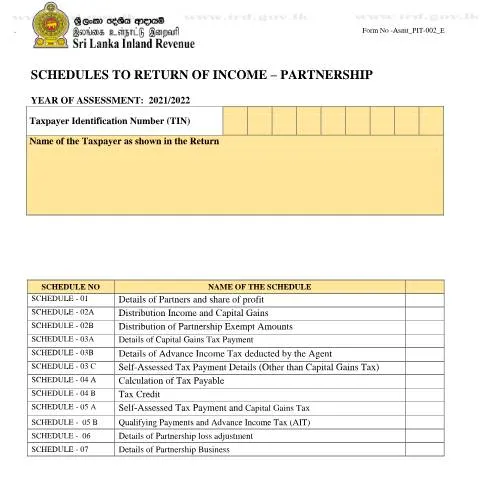
In the context of Sri Lanka’s taxation landscape, the Schedule to Return of Income - Partnership (Asmt_PIT_002_E) plays a pivotal role for partnerships navigating their tax obligations. This document is not merely a form but a comprehensive account of a partnership’s income and distribution among partners, essential for compliance with the Income Tax Ordinance. The insights reported through this schedule contribute to the nation's revenue while ensuring fair taxation practices among partners operating in various sectors.
Partnerships, defined under Sri Lankan law, are arrangements where two or more individuals or entities collaborate to conduct business for profit. Given the complexities of partnerships, accurately documenting and reporting income, expenses, and other financial activities is crucial. This schedule specifically caters to this need, capturing extensive details necessary for tax assessment, thus aiding the Department of Inland Revenue (DIR) in their evaluation of taxable income.
Contextual Framework: Partnerships and Tax Forms
Understanding the relationship between the Schedule to Return of Income - Partnership and other related tax forms is essential for effective tax compliance. Partnerships in Sri Lanka must not only deal with this particular schedule but also complete other forms that support their tax returns, such as the Return of Income form itself and various schedules detailing partner incomes and distributions. The following outlines the interactions between these requisite forms:
- Return of Income Form: This is the primary document where the overall financials of the partnership are presented.
- Schedule 01: Details of partners and their respective profit shares.
- Schedule 02A: Breakdown of income distributions and capital gains.
- Schedule 03: Details regarding any taxes already paid or withheld.
- Schedule 04: Calculation of tax liabilities, including tax credits.
The interplay between these documents ensures that partnerships present a comprehensive financial picture to the DIR, facilitating accurate assessments and minimizing the risk of audits or penalties due to discrepancies.
Decoding the Form: Components and Their Importance
The Schedule to Return of Income - Partnership consists of several sections designed to capture specific financial data. Each section has distinct requirements and documentation needs, which must be meticulously completed. Below is an overview of the key components:
| Schedule No | Description | Purpose |
|---|---|---|
| 01 | Details of Partners and share of profit | Captures partner identities and their profit-sharing ratios. |
| 02A | Distribution of Income and Capital Gains | Reports income and gains distribution among partners. |
| 03A | Details of Capital Gains Tax Payment | Documents any capital gains tax already paid by the partnership. |
| 04A | Calculation of Tax Payable | Calculates the total tax liabilities based on reported income. |
Each section requires specific data entries that are crucial for calculating the accurate tax obligation of the partnership. Failing to provide complete information may lead to penalties or audits, making it essential for partnerships to be diligent in their reporting.
Identifying Stakeholders: Who is Affected by This Schedule?
The completion of the Schedule to Return of Income - Partnership affects a wide range of stakeholders. Notably, partners within the partnership take on the primary responsibility of ensuring that the schedule is correctly filled out and submitted. However, several sub-categories exist within this group:
- Active Partners: Those involved in the daily operations and decision-making processes. Their income and contributions often reflect in the Schedule 01 and 02.
- Silent Partners: Partners who may invest capital without engaging in daily operations. Their share of profits reported must reflect their investment accurately.
- New Partners: When a new partner joins, adjustments in profit-sharing ratios must be revisited, requiring accurate reporting in Schedule 01.
Each category has its nuances regarding tax obligations and reporting requirements, underscoring the importance of clear communication and documentation among partners and with tax authorities.
Key Dates: Navigating the Tax Calendar for Partnerships
Compliance with tax obligations requires an acute awareness of deadlines concerning the Schedule to Return of Income - Partnership. The tax year in Sri Lanka traditionally runs from April 1 to March 31, and several critical dates must be noted:
- Submission Deadline: Typically, the completed schedule and associated returns must be submitted within 30 days of the end of the tax year. For the 2021/2022 assessment year, this deadline would be April 30, 2022.
- Payment Due Dates: Partnerships must also mark dates for installment tax payments, which usually occur in four quarters during the tax year.
- Assessment Notifications: Following submission, the DIR may issue notifications regarding assessments and any additional information requests.
Timely submissions and payments are critical to avoid penalties. The DIR maintains a strict monitoring system for compliance, and timely adherence to these timelines contributes to the overall financial health of the partnership.
Documentation and Preparation: Essential Papers to Accompany the Schedule
Preparing the Schedule to Return of Income - Partnership entails more than simply filling out forms; it requires gathering a suite of supporting documents that substantiate the reported figures. These documents can vary based on the nature of the partnership and its financial activities but generally include the following:
- Taxpayer Identification Number (TIN): A prerequisite for identification in all tax-related documents.
- National Identity Card (NIC): Essential for each partner to verify identity and residency.
- Financial Statements: Comprehensive records, including balance sheets and profit and loss statements, must be prepared to provide clarity on income and expenses.
- Partnership Agreement: This document should outline the profit-sharing ratio, roles, and responsibilities of each partner.
Additionally, for those with complex financial situations, professional accounting services may be beneficial to ensure compliance and accuracy.
Distinguishing Features: Understanding How This Schedule Differs from Similar Forms
While the Schedule to Return of Income - Partnership shares similarities with other tax forms, it is distinct in its requirements and focus. For instance, sole proprietorships and corporations have their unique returns that do not necessitate the same level of partnership-specific detail.
- Partnership vs. Individual Returns: Individual tax returns do not require detailed partner income distributions. The partnership schedule must capture each partner's income separately, based on their agreements.
- Corporate Returns: These often involve complex taxation structures, including corporate taxes on profits, which do not exist in the partnership context. The partnership tax structure is passed through to the partners, avoiding double taxation.
Recognizing these differences aids in ensuring that partnerships do not inadvertently submit incorrect forms, thus streamlining their compliance process and enhancing their standing with tax authorities.
Understanding the Schedule to Return of Income - Partnership
The Schedule to Return of Income for Partnerships, referred to as Asmt_PIT_002_E, is a critical document that must be submitted by partnerships operating in Sri Lanka. This form is essential for the accurate assessment of partnerships' income tax obligations and ensures compliance with the provisions stipulated under the Income Tax Ordinance. Understanding the intricacies of this Schedule is vital for partners in managing their tax liabilities effectively.
The form requires detailed disclosure of the partnership's income, expenses, and profits for the relevant assessment year. Each partner’s share of income must be distinctly declared, noting that failure to provide accurate information may result in penalties or delays in processing. Moreover, partnerships must ensure that they are mindful of the deadlines for submission, which is typically aligned with the fiscal year ending on March 31st, as per the Sri Lankan fiscal calendar.
Filing Process and Required Documentation
Filing the Schedule to Return of Income involves several key steps. Partnerships should begin by gathering all necessary documentation to support the figures reported in the Schedule. This includes, but is not limited to, financial statements, bank statements, and records of income and expenditures. The Income Tax Department provides clear guidelines on what documentation is required, emphasizing the importance of maintaining proper records that reflect the partnership's financial activities.
Once all documents are compiled, partnerships can proceed to complete the Asmt_PIT_002_E form. It is recommended to utilize the online portal provided by the Inland Revenue Department (IRD) for electronic submissions, which is in line with Sri Lanka's push towards digital governance via the Electronic Transaction Act. The portal can facilitate a smoother filing process, allowing for real-time updates and electronic acknowledgements. After submitting the form, partnerships should keep a copy of the submission confirmation for their records.
Tax Implications and Partner Responsibilities
Understanding the tax implications arising from the submission of the Schedule to Return of Income is crucial for all partners within a partnership. Each partner's share of the profits is subject to personal income tax, which is determined based on the progressive tax rates as outlined by the IRD. Consequently, each partner must ensure they adequately report their income from partnership activities on their individual tax returns.
Additionally, partnerships must be aware of their obligations regarding the payment of advance tax, as stipulated by the IRD. This involves estimating the tax liability for the current financial year based on the previous year's earnings. Advance tax payments are generally due in quarterly installments and should be calculated accurately to avoid underpayment penalties.
Partners within a partnership should also engage in ongoing dialogue to discuss the financial performance of the partnership and any tax implications that may arise from changes in income or expenditures throughout the financial year. Regular reviews of the partnership's finances can help in making informed decisions regarding tax planning and compliance.