Official Guide to the List of Exempt Amounts, Gains, and Profits Under the Third Schedule of the Inland Revenue Act No. 24 of 2017 in Sri Lanka
The Inland Revenue Act No. 24 of 2017 establishes specific exemptions applicable to resident and non-resident companies, entities, and corporations operating within Sri Lanka. This guide provides an overview of the key exemptions outlined in the Third Schedule of the Act, aiming to assist taxpayers and legal practitioners in understanding the scope and application of these provisions.
Scope and Purpose of the Exemptions
The exemptions listed under the Third Schedule are designed to promote specific sectors, encourage investment, and support charitable and governmental initiatives. They serve to delineate income, gains, and profits that are either fully or partially exempt from taxation, thereby influencing tax planning and compliance strategies for eligible entities.
Principal Categories of Exempt Amounts and Gains
Government and Public Sector Income
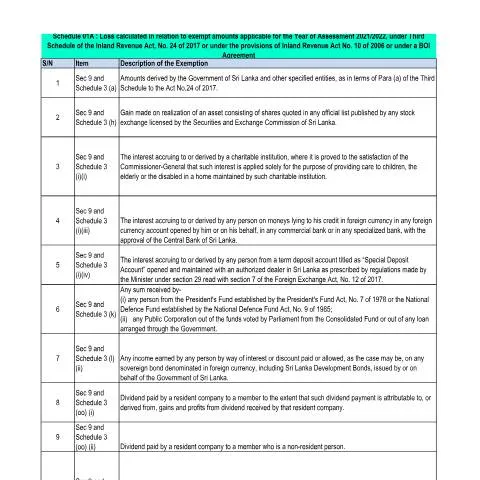
- Amounts derived by the Government of Sri Lanka and other specified entities: This includes income as specified under Paragraph (a) of the Third Schedule, reflecting government-related financial transactions.
- Gains on realization of shares listed on approved stock exchanges: Gains made from the sale or transfer of shares quoted in officially recognized stock markets, as per Paragraph (h), are exempt to promote capital market activities.
- Income from certain funds: Income received from the President's Fund or the National Defence Fund, or from public corporations funded through parliamentary votes or loans, is exempt to support national development initiatives.
Charitable, Religious, and Cultural Exemptions
- Interest accruing to charitable institutions: When such interest is used solely for caregiving purposes for children, the elderly, or disabled persons, it qualifies for exemption, provided the charitable institution can substantiate this use.
- Income from donations and grants: Profits and income derived from property donated before 1815 for religious purposes are exempt if used for the intended charitable activities.
- Dividends from non-resident companies: Dividends earned from shares in non-resident companies where the taxpayer holds a substantial participation are exempt, encouraging international investments.
Financial and Investment Income
- Interest from foreign currency accounts: Interest earned on foreign currency deposits or special deposit accounts maintained with authorized banks, with the approval of the Central Bank of Sri Lanka, is exempt to incentivize foreign currency savings.
- Sovereign bonds and government securities: Income from sovereign bonds issued by or on behalf of the Government of Sri Lanka is exempt, supporting government borrowing programs.
- Dividends paid by resident companies: Dividends attributable to profits from dividend income or paid to non-residents are exempt, fostering dividend distribution and investment.
Commercial and Sector-Specific Exemptions
- Profits from agricultural produce: Gains from the sale of agricultural produce by the producer are exempt, promoting agribusiness development.
- Information technology and service sectors: Gains derived from providing IT-enabled services or services rendered outside Sri Lanka for use outside the country are exempt, aligning with sector growth policies.
- Export-related services: Payments for aircraft, software licenses, or related services from Sri Lankan Airlines Limited to non-residents are also exempt, encouraging export services.
Legal and Administrative Considerations
The exemptions are subject to specific legal provisions and administrative procedures. Entities claiming exemption must ensure compliance with the relevant sections of the Inland Revenue Act and maintain adequate documentation to substantiate their claims. The exemptions are generally applicable for the assessment year 2021/2022, but entities should verify the current legal provisions and any updates issued by the Sri Lankan Inland Revenue Department.
Implications for Taxpayers
Understanding these exemptions allows entities to optimize their tax liabilities legally and strategically. Proper classification of income and gains can lead to significant tax savings and facilitate compliance with Sri Lanka's tax laws. Entities engaged in sectors such as finance, agriculture, IT, and charitable work should review their activities in light of these exemptions to ensure eligibility and proper reporting.
Conclusion
The list of exempt amounts, gains, and profits under the Third Schedule of the Inland Revenue Act No. 24 of 2017 provides a comprehensive framework for certain income streams to be exempt from taxation in Sri Lanka. It reflects the government's policy priorities, including support for public sector initiatives, charitable activities, sector-specific growth, and foreign investment. Entities should consult the official legal texts and seek professional advice to ensure accurate application of these exemptions in their tax planning processes.