Navigating the Release of Terminal Benefits: An Essential Guide
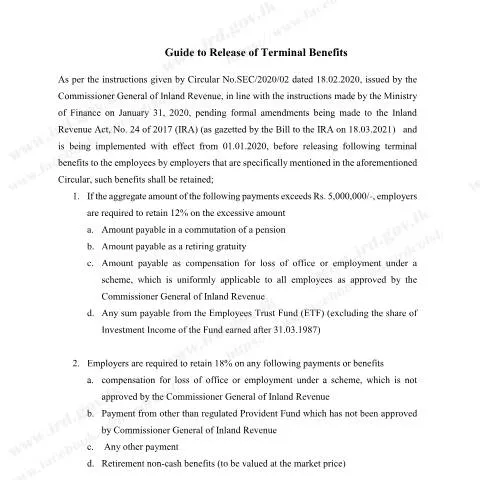
In the complex landscape of Sri Lankan employment law, understanding terminal benefits is critical for both employers and employees. The "Guide to Release of Terminal Benefits," published by the Inland Revenue Department, lays down the procedural framework and stipulations surrounding terminal benefits, including gratuities, pensions, and compensation. This guide serves as an invaluable resource for navigating the often daunting administrative process, particularly following the announcement made through Circular No. SEC/2020/02 on February 18, 2020. This article examines the contents of the guide and offers practical insights into its application.
Decoding the Core Elements of Terminal Benefits
The guide elucidates various types of terminal benefits employees may be entitled to upon retirement or termination of employment. These benefits typically include:
- Gratuity: A monetary benefit paid to employees who have completed a specified period of service.
- Commuted Pension: A portion of the pension that can be withdrawn as a lump sum.
- Compensation for Loss of Office: Payments made to employees who are laid off or terminated.
- Employees Trust Fund (ETF): Contributions made on behalf of employees to a national pension scheme.
Understanding these elements is foundational for both employees seeking their due benefits and employers responsible for administering them. The guide stipulates specific criteria for each type of benefit, as well as the applicable tax rates for retention before the benefits are released.
Understanding Withholding Tax: Key Percentages
Tax implications are a significant consideration when processing terminal benefits. The Inland Revenue Department mandates retention of taxes on terminal benefits exceeding certain thresholds. Below is an overview of the tax retention requirements that employers must comply with:
| Benefit Type | Tax Retention Percentage | Conditions |
|---|---|---|
| Gratuity | 12% | Aggregate amount exceeds Rs. 5,000,000 |
| Commuted Pension | 12% | Aggregate amount exceeds Rs. 5,000,000 |
| Compensation (approved scheme) | 12% | Must be approved by the Commissioner General of Inland Revenue |
| Compensation (non-approved scheme) | 18% | Not approved by the Commissioner General of Inland Revenue |
| ETF Payments | 12% | Excludes investment income post-31.03.1987 |
It's essential for both employees and employers to be aware of these percentages as they directly impact the net benefits received by employees upon termination or retirement.
Essential Documentation for Application Submission
To initiate the process for the release of terminal benefits, employees must compile all necessary documentation as outlined in the guide. This is a crucial step that can often determine the speed and efficiency of the application process. The guide specifies the following required documents:
- National Identity Card or Passport copy.
- Employer-issued letter detailing the terminal benefit payment, including specifics on the amount, whether it follows a uniform scheme, and the calculation methodology (i.e., based on basic or gross salary).
- Employee Trust Fund contribution records, along with T-10 certificates.
- For compensation claims, a letter of approval from the Commissioner General of Inland Revenue if tax exemptions apply.
Each type of terminal benefit has its unique requirements. For example, gratuity applications necessitate a letter confirming the gratuity payment and the calculation basis, while ETF payments require a specific document issued by the ETF Board.
Step-by-Step Process for Application Submission
The process of applying for the release of terminal benefits can feel overwhelming. However, the guide provides a structured approach that can simplify the navigation through different stages. Here’s a step-by-step breakdown:
- Gather Required Documents: Collect all necessary documentation as mentioned earlier. Ensure you have multiple T-10 certificates, as they are mandatory.
- Complete the Application for Release: Prepare the application form, ensuring all information is accurate and aligns with the documentation you have collected.
- Submit to the Relevant Authority: Hand over your application along with the supplementary documents to the Commissioner, PAYE Audit Branch, Inland Revenue Department, located at 100, Wekanda Road, Nawam Mawatha, Colombo 02.
- Await Confirmation: The Inland Revenue Department is mandated to provide a direction within 90 days of the retention date. Keep track of your application and follow up if necessary.
Each step in this process is essential to ensure the efficient release of terminal benefits. Failing to submit the required documentation or not adhering to stipulated guidelines may lead to delays in receiving the benefits.
Critical Insights for Employers: Responsibilities and Challenges
Employers play a pivotal role in the release of terminal benefits. They are held accountable for retaining the appropriate taxes as specified and ensuring that employees understand their entitlements. Employers should be aware of the following responsibilities:
- Timely communication of terminal benefits to employees upon their exit.
- Correct calculation of benefits and tax retention amounts.
- Submission of necessary documentation to the relevant authorities.
Employers must also navigate challenges such as misunderstandings regarding benefit entitlements or discrepancies in employee records, which can hinder the smooth processing of terminal benefits. Regular training and up-to-date knowledge about changes in regulations can mitigate such issues.
The Role of the Inland Revenue Department: Oversight and Compliance
The Inland Revenue Department serves as the regulatory body overseeing the release of terminal benefits. Their responsibilities include:
- Issuing guidelines and circulars that clarify policies regarding terminal benefits.
- Ensuring compliance with the tax laws concerning the retention of benefits.
- Providing assistance and clarifications to both employers and employees when needed.
Understanding the role of this department can be beneficial for employees looking to navigate the complexities of terminal benefits. The guide encourages individuals to reach out to designated officers for queries regarding their applications or entitlement benefits.
Final Considerations: Preparing for the Future
The Guide to Release of Terminal Benefits is not just a procedural document; it is an essential tool that can dictate financial security for employees in their post-employment lives. With changes to the Inland Revenue Act continually evolving, it's vital for both employees and employers to remain informed about their rights and responsibilities.
As the world shifts towards more digital solutions in governance, the expectation is that terminal benefit processes will also evolve. Staying updated with resources available on forms.gov.lk can provide additional support, ensuring that all involved parties are prepared for the necessary steps as legislation changes.
Understanding Terminal Benefits: Eligibility and Types
Terminal Benefits in Sri Lanka are primarily designed to provide financial support to employees after the termination of their service. Eligibility for these benefits varies based on numerous factors, such as the nature of the employment, duration of service, and the terms outlined in the employment contract.
In general, employees who have completed a minimum period of continuous service (generally five years) may be entitled to a range of benefits, which can include:
- Gratuity: This is a lump sum payment made to employees as a reward for their service, calculated based on the last drawn salary and years of service.
- Provident Fund Benefits: Many organizations in Sri Lanka contribute to a Provident Fund established for their employees, which typically includes both employer and employee contributions.
- Leave Encashment: Unused leave days may be encashed, providing an additional financial benefit upon termination.
It’s important to note that different organizations may have varied policies regarding these benefits, and any changes to the employment contract during the employee's service can affect their terminal benefits. Therefore, employees are encouraged to thoroughly review their contracts and discuss with HR to understand their specific entitlements.
Documentation Required for Claiming Terminal Benefits
To successfully claim Terminal Benefits, employees must provide a set of documents that substantiate their eligibility. The documentation required can vary depending on the type of benefit being claimed, but generally includes:
- Application Form: A duly filled application form is the primary document needed to initiate the claim.
- National Identity Card (NIC): The NIC serves as proof of identity and is mandatory for all claims.
- Service Certificate: An official document from the employer confirming the duration of service and nature of employment.
- Last Pay Slip: This document is often required to calculate the gratuity correctly.
- Bank Account Details: Providing this information is essential for the disbursement of benefits. It is advisable to include a bank statement or a canceled cheque to avoid any discrepancies.
In certain cases, additional documentation may be necessary, particularly if there are discrepancies or disputes regarding the employee's tenure or salary. It is prudent to consult the HR department for a comprehensive list specific to your situation.
Procedure for Submitting a Claim for Terminal Benefits
The process for submitting a claim for Terminal Benefits in Sri Lanka is structured to ensure transparency and efficiency. Here is a step-by-step guide to navigating this process:
- Preparation of Documentation: Gather all necessary documents as listed previously. Ensure that everything is accurate and up-to-date.
- Completion of Application: Fill out the relevant application form (e.g., Form 1 or Application Form for Terminal Benefits). This form can typically be obtained from the HR department or downloaded from the relevant government portal.
- Submission: Submit the completed application along with all supporting documents to the HR department. It is advisable to keep copies of everything submitted for your records.
- Review Process: Upon submission, the HR department will review your application and documentation. This process may take some time, depending on the complexity of your claim and the workload of the HR team.
- Await Confirmation: You should receive a confirmation once your claim is approved or if further documentation is needed. Follow up if you do not hear back within a reasonable time frame.
- Disbursement of Benefits: Once approved, the benefits will be disbursed as per the established timelines. Ensure you have provided accurate bank details to facilitate a smooth transaction.
It is important to remain patient during this process, as it can be time-consuming. Familiarizing yourself with the entire procedure can help manage expectations and lead to a more successful claim experience.