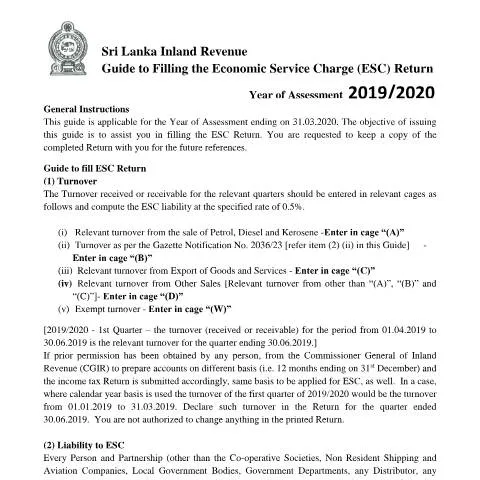
Navigating the Economic Service Charge (ESC) Return: A Comprehensive Overview
The Economic Service Charge (ESC) Return serves as a critical document for businesses in Sri Lanka, enabling them to comply with the tax regulations as stipulated by the Sri Lanka Inland Revenue. The guide, designated as ASMT_ESC_Guide_1920, is essential for ensuring that your business correctly accounts for and submits the required information related to the Economic Service Charge. This guide is particularly relevant for the Year of Assessment ending 31st March 2020, helping stakeholders understand their obligations and navigate the complexities of the submission process.
Understanding the Scope of the ESC Guide
The Guide to Filling the Economic Service Charge (ESC) Return outlines various aspects of the ESC, including definitions, calculations, and submission procedures. Primarily aimed at businesses and partnerships whose turnover exceeds LKR 12.5 million, the document clarifies the circumstances under which the ESC is applicable. However, it is essential to note that certain entities, such as cooperative societies and government departments, are exempt from this charge. This distinction ensures that the guide addresses a specific audience, providing tailored instructions based on various business models.
Key Areas Covered by the ESC Guide
- Turnover Specifications: Different categories of turnover need to be reported in the ESC Return, including sales of petrol, diesel, kerosene, and exports.
- Calculation of ESC Liability: Detailed formulas guide users in calculating their ESC liability based on their reported turnover.
- Credits and Payments: The guide elaborates on how ESC credits paid at customs can be utilized against a business's liability, streamlining the payment process.
- Mandatory Declarations: It stipulates the necessary declarations required when the return is prepared by an external accountant.
Clarifying the Relationship with Other Tax Documents
The ESC Return does not exist in isolation; it interacts with various other tax documents that businesses may need to submit. It is essential to understand how the ESC Return fits into the broader tax compliance framework in Sri Lanka. For instance:
- The ESC Return must align with the annual income tax return, especially regarding reported turnover. Businesses that utilize a calendar year basis for income tax will report a different turnover for the ESC Return than those using a financial year ending 31st March.
- Documents like the Value Added Tax (VAT) returns may also need to be considered, as certain turnovers reported there may intersect with the ESC obligations.
Comprehending these relationships ensures that businesses maintain consistency across their submissions, reducing the likelihood of discrepancies and penalties.
Step-by-Step Guide to Utilizing the ESC Return
Successfully navigating the ESC Return requires a systematic approach. Below is a structured procedure to assist businesses in completing the return effectively:
- Gather Necessary Documents: Collect all revenue records for the relevant quarters, including sales receipts and invoices.
- Identify Relevant Turnover: Categorize the turnover into the specified cages:
- Cage (A): Turnover from petrol, diesel, and kerosene.
- Cage (B): Any turnover as stipulated in Gazette Notification No. 2036/23.
- Cage (C): Revenue from the export of goods and services.
- Cage (D): Other sales not included in the above categories.
- Cage (W): Any exempt turnover.
- Calculate Total Turnover: Use the provided formulas to compute the total turnover by adding values from cages (A), (B), (C), and (D) and entering the result in cage (Y).
- Assess ESC Liability: Depending on whether the total turnover exceeds the LKR 12.5 million threshold, calculate the liability as directed in the guide.
- Document ESC Credits: If applicable, document any ESC credits from customs in the relevant section of the return.
- Finalize Payment Details: Report any tax paid to the Commissioner General, entering the amounts in the designated section.
- Complete Declarations: Fill in the mandatory declarations if prepared by an external accountant, ensuring that the signatories are correctly designated.
- Submission: Submit the completed ESC Return along with the acknowledgment sheet to the relevant unit by the deadline of 20th April 2020.
Common Misinterpretations and Their Avoidance
When dealing with the ESC Return, businesses often encounter various misinterpretations that can lead to errors in their submissions. Awareness of these common pitfalls can significantly facilitate accurate reporting. These include:
- Misunderstanding Turnover Categories: Businesses might incorrectly categorize their turnover, leading to misguided liability calculations. Familiarity with the definitions and boundaries within the guide is crucial.
- Incorrect Application of ESC Rates: The guide specifies different calculations for ESC liabilities for export and non-export turnovers. Misapplying these rates can result in incorrect tax payments.
- Submission Timing Oversights: The deadline for submitting the ESC Return is strictly enforced. Late submissions can incur penalties, so maintaining an organized calendar regarding tax obligations is essential.
Important Considerations for Various Business Profiles
The ESC Return is designed to accommodate a wide range of business profiles, each facing unique circumstances. Understanding these differences is essential when preparing the return:
Small Enterprises and Startups
Small businesses may often stay below the LKR 12.5 million turnover threshold, potentially exempting them from the ESC. However, those that surpass this limit must comply, even if it is just for a single quarter. It is critical for startups to continuously monitor their financial growth and turnover to ensure timely compliance.
Exporters and International Traders
For businesses engaged in exporting goods, special provisions apply. Turnovers from exports are calculated differently, allowing exporters to utilize specific rates. Therefore, keeping meticulous records of all export transactions is vital for accurately reporting to avoid discrepancies during audits.
Established Corporations
Established corporations with multiple revenue streams must pay close attention to how various turnovers interact within the ESC Return. The complexity of their operations may require more comprehensive documentation and potentially consulting with tax professionals to ensure all regulations are met.
Clarifying the Submission Requirements and Penalties
The submission of the ESC Return is not merely a procedural step; it is a legal obligation. Failure to submit the return on time can attract substantial penalties. Therefore, businesses must plan adequately to meet the submission deadline of 20th April 2020. The penalties for late submission can vary, but they may encompass a percentage of the ESC liability or a fixed fee. It's advisable to consult the Inland Revenue Department for specifics related to penalties based on the severity of the late submission.
Steps to Mitigate Risks of Non-Compliance
- Set Calendar Reminders: Use digital tools to remind relevant personnel of upcoming submission deadlines.
- Implement Regular Financial Reviews: Regular audits of turnover and financial records can help ensure compliance and readiness for the ESC Return.
- Consult with Tax Professionals: Engaging with tax experts familiar with the ESC can provide valuable insights and support for navigating complex issues.
Final Notes on Accessing Resources and Additional Help
For further assistance, businesses can access resources through the Sri Lanka Inland Revenue's official website. The site hosts a wealth of information including detailed guides, contact information for support services, and updates regarding any changes to the ESC regulations or procedures. Keeping abreast of these resources is essential for maintaining compliance and optimizing the management of tax liabilities.
Understanding the Economic Service Charge (ESC) and Its Applicability
The Economic Service Charge (ESC) is a tax implemented in Sri Lanka aimed at generating revenue from businesses engaged in providing specific services. This charge is applicable to a diverse range of industries, and understanding its applicability is crucial for compliance. The ESC is levied on the turnover of businesses, meaning that it may impact enterprises of varying sizes—whether they are large corporations or small and medium-sized enterprises (SMEs).
To determine if your business is subject to the ESC, it is vital to consider the nature of the services provided and your annual turnover. As of the latest tax year, businesses with an annual turnover exceeding LKR 12 million are generally required to pay ESC at a rate of 0.5% of the turnover. Certain exemptions may apply based on the type of services rendered, such as specific agricultural activities or services provided by non-profit organizations. Familiarizing yourself with these nuances can help ensure compliance and avoid potential penalties.
Moreover, the ESC applies only to services, not goods. This distinction is essential; businesses primarily engaged in the manufacturing or sale of goods may not be liable for ESC. If your business offers both goods and services, it is necessary to segregate the turnover generated from services to accurately report ESC liability. Regularly consulting with a tax advisor or accountant familiar with local tax laws can provide insights into your specific obligations under the ESC.
Steps for Completing the ESC Return: A Detailed Walkthrough
Filling out the Economic Service Charge (ESC) return can seem daunting, but by breaking it down into manageable steps, you can streamline the process. Below are detailed instructions tailored to guide you through successfully completing the ESC return.
1. Gather Necessary Documentation: Before you begin filling out the return, ensure you have all necessary documentation ready. This includes your business’s financial statements, sales records, and any relevant invoices from the tax year. Having detailed records will not only assist in calculating your turnover but will also support the figures you report.
2. Obtain the Correct ESC Return Form: The ESC return form can be obtained from the Department of Inland Revenue (DIR) or the official website dedicated to ESC filings. Ensure you have the most current version of the form, as there may be periodic updates or revisions.
3. Input Business Details: Fill out the required information regarding your business. This includes your National Identity Card (NIC) number or the company registration number, as well as your official business address. Accuracy is paramount, as discrepancies may lead to delays in processing.
4. Calculate Your Total Turnover: This step involves calculating the total turnover generated from services provided throughout the tax year. Ensure that you apply the correct figures and segregate turnover from exempt services if applicable. The total turnover is the basis for calculating your ESC liability.
5. Determine Your ESC Liability: Using the ESC rate of 0.5%, multiply your total service turnover to determine your ESC liability for the year. Make sure to double-check your calculations to avoid errors that could lead to underpayment or overpayment.
6. Complete Payment Details: If applicable, fill in the details for payment options provided on the ESC return form. It’s important to note the payment methods accepted by the Department of Inland Revenue, which may include bank transfers or direct payments.
7. Review and Sign the Return: Before submitting, review the completed return thoroughly. Ensure that all figures, signatures, and supporting documents are accurate and complete. An incomplete return may be subject to penalties. Once satisfied, sign the return where indicated.
8. Submit the Return: The completed ESC return should be submitted either electronically through the DIR’s online portal or physically at your local revenue office. Ensure that you meet the submission deadlines, which are typically set for the end of each financial year.
9. Keep Copies of the Submission: After submission, retain a copy of the filed ESC return and any correspondence with the Department of Inland Revenue. These documents will serve as an important reference in case of future inquiries or audits.
Common Mistakes to Avoid When Filing the ESC Return
Filing the Economic Service Charge (ESC) return is a critical process for businesses, yet there are common pitfalls that can lead to complications. Understanding these mistakes can help ensure a smoother filing experience and maintain compliance with tax regulations.
1. Incorrect Turnover Reporting: One of the most frequent errors arises from inaccurately reporting turnover. Businesses may mistakenly include exempt services in their turnover calculations, leading to inflated ESC liabilities. It’s essential to carefully analyze financial data to exclude any exempted service revenues.
2. Missing Submission Deadlines: The Department of Inland Revenue sets specific deadlines for submitting the ESC return. Failing to meet these deadlines can result in penalties or additional charges. Businesses should mark these dates on their calendars and set reminders to ensure timely submissions.
3. Neglecting to Maintain Adequate Records: Without proper documentation, businesses may struggle to provide evidence for their reported turnover. It’s advisable to maintain organized records of all sales transactions, including invoices and receipts, which can substantiate figures reported on the ESC return.
4. Overlooking Amendments and Adjustments: If adjustments are necessary—such as correcting reported figures or addressing previous errors—businesses must understand the procedure for submitting amended returns. Failing to do so can lead to discrepancies and potential audits by the Department of Inland Revenue.
5. Assuming Automatic Extensions: Some businesses may assume that they are entitled to extensions for filing the return without prior arrangement. However, extensions must be formally requested, and relying on assumptions can result in late submissions and penalties.
6. Misunderstanding the ESC Regulations: The ESC regulations are subject to change, and interpreting these changes accurately is vital. Businesses should stay informed about any updates or amendments to tax regulations, which may impact their ESC obligations.
7. Not Seeking Professional Guidance: Lastly, many businesses attempt to navigate the ESC return process independently and may overlook complexities that require professional guidance. Consulting with a tax professional can provide clarity and ensure legal compliance while identifying potential deductions or benefits.