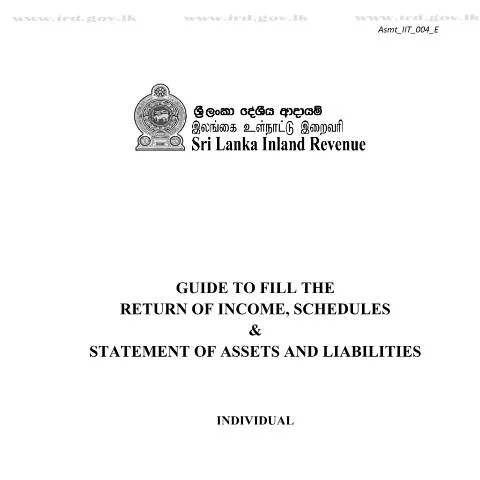
Navigating the Complexities of the Return and Schedules Guide: Asmt_IIT_004_2022
In the intricate landscape of Sri Lankan taxation, understanding the nuances of the Guide to filling the Return & Schedules (Asmt_IIT_004_E) is vital for individuals fulfilling their tax obligations. This official document serves as an essential beacon, particularly for those navigating the financial year of assessment 2022/2023. It provides comprehensive instructions on how to accurately declare income and assess one's financial standing through the Statement of Assets and Liabilities.
Target Audience: Who Needs This Guide?
The guide is primarily tailored for all individual taxpayers in Sri Lanka, encompassing both resident and non-resident individuals. Understanding who qualifies as a taxpayer underlines the necessity of this guide:
- Resident Individuals: Taxpayers with income sourced from employment, business, investment, or various other sources within or outside Sri Lanka.
- Non-resident Individuals: Taxpayers whose income is derived solely from sources within Sri Lanka.
For a resident taxpayer, it is imperative to declare all global income during the assessment period from April 1, 2022, to March 31, 2023. Non-residents, however, are required to report only Sri Lanka-sourced income. The understanding of residency status is crucial as it directly impacts tax rates and liabilities.
Understanding Tax Obligations
Every taxpayer must be aware of their obligations under the Income Tax Ordinance. The guide lays out clear instructions on completing the Return Form and mandatory schedules, along with the Statement of Assets and Liabilities. Essential elements include:
- Income Categories: Employment income, business income, investment income, and other income types are categorized distinctly.
- Mandatory Sections: Each section of the Return Form has pre-defined criteria that must be fulfilled to avoid penalties.
Document Structure: An Overview of Contents
This guide comprises three pivotal components:
- General Instructions: Outlining the overarching requirements for completing the Return Form.
- Instructions for the Return Form: Detailed directives on how to fill in income schedules accurately.
- Instructions for the Statement of Assets and Liabilities: Guidelines that clarify what information is necessary for the asset declaration.
By familiarizing oneself with these sections, taxpayers can streamline the process of income declaration and ensure compliance with the regulations set forth by the Inland Revenue Department (IRD).
Key Concepts for Accurate Reporting
In order to mitigate errors and misunderstandings during the filling process, several key concepts must be grasped:
- Assessable Income: This refers to the total income from all sources that is liable to be taxed. Understanding the parameters that define assessable income ensures that taxpayers do not overlook any income sources.
- Filing Status: Knowing the differences in filing requirements between residents and non-residents is crucial.
- Tax Period: The guide specifies the assessment period, which is essential for determining the tax obligations.
Understanding the Schedules
The Return of Income includes various schedules that categorize income sources:
| Schedule Number | Income Type |
|---|---|
| Schedule 1 | Employment Income |
| Schedule 2 | Business Income |
| Schedule 3 | Investment Income |
| Schedule 4 | Other Income |
Each schedule is designed to capture specific types of income accurately. Understanding where to declare each type prevents underreporting or overreporting, which can lead to penalties.
Frequently Encountered Procedural Issues
As taxpayers embark on the journey of filling out their returns, certain procedural issues tend to recur, such as:
- Data Entry Errors: Mistakes in inputting figures can occur frequently. The guide advises against writing "not applicable" in empty fields; instead, a hyphen should be used.
- Missing Documentation: Failing to attach necessary documents can delay processing. Taxpayers should ensure they have all required paperwork ready for submission.
- Language Preferences: Taxpayers can submit their returns in their preferred language; understanding how to update language preferences is essential for accurate communication.
Timelines and Submission Guidelines
A pivotal aspect of compliance is understanding deadlines. The completed Return, including the required schedules and documents, must be submitted by November 30, 2023. Submission can be done either in person at any Regional Office or via the online portal provided by the IRD.
Payment Structures
Tax payment obligations extend beyond mere submission of returns. Taxpayers must also adhere to quarterly installment payments as outlined in the guide:
| Installment | Due Date | Payment Code |
|---|---|---|
| 1 | 15th August 2022 | 22231 |
| 2 | 15th November 2022 | 22232 |
| 3 | 15th February 2023 | 22233 |
| 4 | 15th May 2023 | 22234 |
| Final | 30th September 2023 | 22230 |
Each installment must be paid on time to avoid penalties, as failure to comply can result in significant financial repercussions.
Understanding Penalties for Non-compliance
It is critical for taxpayers to recognize the penalties associated with late filings or inaccuracies:
- Late Filing Penalty: Taxpayers who fail to file by the deadline face a penalty equal to at least 5% of the outstanding tax, increasing by 1% for each subsequent month of delay.
- False Statements: Submitting misleading information can incur severe penalties, potentially leading to fines or legal repercussions.
Familiarity with these penalties encourages taxpayers to maintain accuracy and timeliness in their income reporting.
Enhancing Compliance through Digital Services
The IRD’s commitment to digital services simplifies the tax filing process. Taxpayers are encouraged to take advantage of the online submission facilities. These digital platforms offer several benefits including:
- Efficient submission and faster processing times.
- The ability to check the status and receive confirmations immediately.
- Access to guidelines and support through the IRD’s digital resources.
By utilizing these online services, taxpayers can alleviate the stress associated with physical submissions while ensuring compliance with regulatory requirements.
In Conclusion: Staying Informed and Prepared
Equipped with the knowledge from the Guide to filling the Return & Schedules, individual taxpayers in Sri Lanka can navigate their tax obligations with confidence. Understanding the significance of each section, adhering to deadlines, and utilizing digital resources will serve to enhance compliance and minimize errors. As the financial year progresses, staying informed and diligent will yield positive outcomes for all taxpayers.
Understanding the Different Types of Returns and Schedules
When it comes to filling out the Return and Schedules under the Assessment of Income Tax (Asmt_IIT_004_E) in Sri Lanka, it's essential to understand the various types of returns you may encounter. Typically, individual taxpayers are required to submit the following returns: the Individual Income Tax Return, Schedule of Income from Employment, Schedule of Business Income, and Schedule of Investment Income.
The Individual Income Tax Return form captures your total income, deductions, and tax liabilities. The Schedule of Income from Employment must detail your salary and any overtime or bonuses received during the year. Business owners will have to fill out the Schedule of Business Income to provide information about their earnings and expenses, while the Schedule of Investment Income records any interest or dividends earned from investments.
Each type of return has its specific requirements and details that need to be filled in accurately. It is advisable to keep comprehensive records throughout the year to ensure you have all necessary data at hand when these forms are due. This meticulous approach not only streamlines the filing process but also minimizes the risk of errors that could lead to inconveniences or penalties from the Sri Lankan tax authorities.
Common Mistakes to Avoid When Filling the Return & Schedules
Filing your Return and Schedules can be complex, and several common mistakes can hinder your compliance with Sri Lankan tax regulations. One of the most prevalent errors is failing to report all sources of income. Taxpayers often overlook income from freelance work or investments, which can lead to significant discrepancies and potential audits.
Another frequent mistake is incorrect calculation of deductions. Taxpayers sometimes misinterpret the criteria for allowable deductions or mistakenly omit eligible ones. It is vital to familiarize yourself with the list of allowable expenses as specified under the Income Tax Ordinance. Furthermore, ensuring that you provide accurate NIC numbers is crucial as discrepancies can delay the processing of your Return.
Additionally, deadlines are non-negotiable. Missing the deadline can result in penalties or interest charges. To avoid this, it is recommended to mark the filing deadline on your calendar and begin preparing your documentation well in advance. Finally, double-checking your forms before submission can prevent minor errors that might lead to major issues.
Utilizing E-Services for Enhanced Filing Experience
In Sri Lanka, the advent of digital government services has significantly transformed the filing process for tax returns. The e-Services provided by the Information and Communication Technology Agency (ICTA) allow taxpayers to fill out and submit their tax returns online, making the process much more straightforward and efficient.
By accessing online platforms such as forms.gov.lk, individuals can find the necessary forms, fill them in digitally, and submit them directly to the relevant authorities. This not only saves time but also reduces the risks of errors associated with manual filling. The platform also provides features such as automated calculations for tax liabilities, which further simplify the process.
Moreover, using e-services means that taxpayers will receive instant acknowledgment of their submission, which is an essential aspect of maintaining a clear record of compliance. The digital format also allows for easier access to historical filings and communication with tax authorities, which can be crucial during audits or disputes. To make the most of these services, familiarize yourself with the digital platforms and their features, ensuring you have a smooth filing experience.