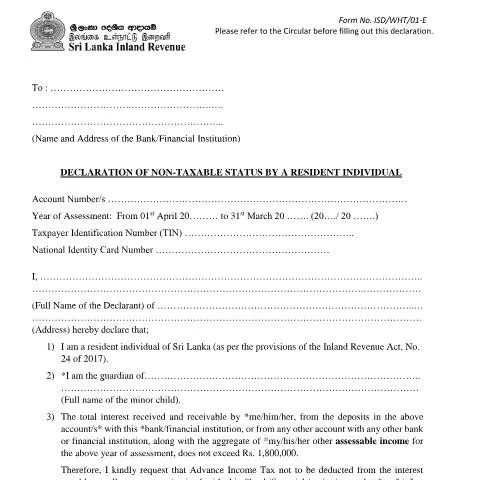
Navigating the ISD/WHT/01-E: A Key Document for Resident Individuals
In the intricate landscape of Sri Lankan tax compliance, the Declaration of Non-Taxable Status by a Resident Individual, designated as Form ISD/WHT/01-E, emerges as a critical instrument for individuals seeking advantageous treatment concerning withholding tax. This document holds significant importance for those whose assessable income does not exceed the defined threshold, providing a pathway to a tax-free status on interest income. Understanding the nuances of this form is essential for residents aiming to manage their tax obligations effectively.Understanding the Legal Framework
To appreciate the significance of Form ISD/WHT/01-E, one must grasp the legal context in which it operates. Introduced under the provisions of the Inland Revenue Act, No. 24 of 2017, this form is intertwined with the principles of withholding tax aimed at ensuring tax compliance while alleviating the burden on low-income individuals. The Act delineates the parameters for resident individuals, defining who qualifies based on their income and residency status. The declaration is a direct result of a regulatory environment that encourages transparency and compliance, ensuring that individuals are not subjected to undue taxation when their income falls below Rs. 1,800,000 annually. Additionally, the Electronic Transaction Act bolsters the use of digital forms, aligning with the government’s vision for modernizing public administration and easing bureaucratic processes.Distinguishing the ISD/WHT/01-E from Similar Forms
While navigating tax-related documentation, individuals often find themselves confronted with a maze of forms, including those related to withholding tax and advance income tax. However, the ISD/WHT/01-E holds a distinct position. Unlike other withholding tax forms that may apply to a broader range of income categories, this declaration specifically targets resident individuals who qualify for non-taxable status due to their income limitations. The differentiation becomes crucial when assessing the purpose and implications of each form. For instance, while other forms may mandate tax payments or withholdings based on varying income levels, the ISD/WHT/01-E serves as a protective measure against unwarranted deductions for those whose income does not reach the taxable threshold. Understanding these distinctions allows residents to choose the appropriate forms and comply with tax obligations accurately.Decoding the Form: A Step-by-Step Analysis
The ISD/WHT/01-E is structured to capture critical personal and financial information necessary for the declaration. Each section of the form serves a specific purpose, and understanding these can significantly impact the outcome of your declaration.Section Breakdown
- Identification Details:
- Account Number: Enter the account number(s) held at the financial institution.
- Year of Assessment: Specify the relevant financial year, which stretches from April 1st to March 31st of the following year.
- Taxpayer Identification Number (TIN): Provide your TIN, a unique identifier for tax purposes in Sri Lanka.
- National Identity Card Number: Essential for verification, this links the declaration to your official identity.
- Declarant Information:
Complete the full name and address of the declarant. If you are the guardian, specify the minor's name and details accordingly.
- Income Declaration:
Here, you will assert that the total income (including interest) derived from all accounts does not exceed Rs. 1,800,000. It's crucial to ensure accurate calculations to avoid future complications.
- Signature and Date:
Conclude the form with your signature and the date of completion, affirming the truthfulness of the information provided.
| Section | Description | Common Pitfalls |
|---|---|---|
| Identification Details | Collecting personal and financial information. | Omitting account numbers or incorrectly stated TINs can lead to rejections. |
| Declarant Information | Details of the individual declaring non-taxable status. | Incomplete names or addresses may result in processing delays. |
| Income Declaration | Confirmation that total income is below the threshold. | Falsifications or errors in income reporting can attract penalties. |
The Submission Process: Ensuring Compliance
Once the form is complete, the next step involves its submission to the appropriate financial institution. The declaration must be presented to the bank or financial institution where the accounts are held. It is crucial to understand the specific submission protocols, as each institution may have varying procedures.Submission Steps
- Review: Ensure all details are accurate and complete to prevent delays.
- Present in Person: Depending on the institution’s policy, you may need to submit the form in person.
- Follow-Up: Keep a copy of your submitted form and inquire about the processing timeline. Institutions can provide specific timelines, usually in line with fiscal calendars.
Anticipating Outcomes: What Happens After Submission?
After the submission of Form ISD/WHT/01-E, individuals might wonder about the next steps and how to track the status of their declaration. Typically, the financial institution will process the declaration, and if everything aligns with the stipulated regulations, the withholding tax will be waived, allowing you to receive interest income without deductions.Tracking and Follow-Up
While the institution usually provides feedback within a specific period, it is prudent to maintain communication with them to track the status of your declaration. Here are the steps to effectively follow up:- Maintain Records: Keep a copy of your declaration and any correspondence.
- Inquire Periodically: Follow up with the bank, especially if you anticipate interest payments soon.
- Contact Tax Authorities: If there are delays or issues, reaching out to the Inland Revenue Department may provide clarity.
Addressing Challenges: What If There’s a Rejection?
Rejections can occur for various reasons, including discrepancies in the income declaration, incorrect identification information, or missing signatures. If the ISD/WHT/01-E is rejected, it is crucial to address the concerns promptly to minimize any potential tax liability.Steps to Take in Case of Rejection
- Identify the Issue: Review the feedback provided by the financial institution regarding the rejection.
- Rectify the Errors: Make the necessary corrections on the form. Ensure that all information is up-to-date and accurate.
- Resubmit: After addressing the issues, resubmit the corrected declaration to the bank along with any relevant documents.
Final Considerations: The Importance of Accurate Declarations
Submitting Form ISD/WHT/01-E is not merely a bureaucratic formality; it is a vital step towards ensuring compliance with Sri Lankan tax regulations while safeguarding one’s financial interests. As the government continues to push for digitalization and efficiency within the public administration framework, residents must familiarize themselves with such forms to navigate their tax obligations effectively. By understanding the intricacies of this declaration, individuals position themselves to benefit from the legal provisions that exempt them from withholding tax, ensuring that they retain more of their hard-earned income. Maintaining vigilance and attention to detail will ultimately facilitate a smoother experience when engaging with the tax system in Sri Lanka.Understanding Non-Taxable Status: Eligibility Criteria
In Sri Lanka, the declaration of non-taxable status is a critical process for resident individuals who wish to clarify their tax obligations. To qualify for non-taxable status, individuals must meet specific eligibility criteria as mandated by the Department of Inland Revenue (DIR). The primary considerations include the individual’s total annual income, which must fall below the threshold set by the government for that financial year.
As of recent fiscal years, individuals whose annual gross income does not exceed LKR 3 million may qualify for non-taxable status, provided they have no other sources of income that would elevate their taxable amount. Additionally, eligibility extends to individuals who are aged 65 and above, disabled, or otherwise unable to earn income due to valid reasons. It is paramount that applicants maintain accurate records of their income sources and provide supporting documentation when submitting Form ISD/WHT/01-E. This documentation may include bank statements, pay slips, and any other pertinent financial records.
The Application Process: Step-by-Step Guide
Submitting the declaration of non-taxable status via Form ISD/WHT/01-E requires careful adherence to a structured application process. Below is a step-by-step guide to ensure compliance and timely submission:
- Gather Necessary Documents: Before commencing the application, collate all required documents such as your National Identity Card (NIC), proof of income, and any other relevant financial statements.
- Complete Form ISD/WHT/01-E: Fill out the form accurately. Ensure that all sections are completed, particularly those that detail your income sources and any deductions claimed.
- Online Submission: Given the push for digitalization, the Department of Inland Revenue encourages online submissions through their portal. Navigate to the relevant section on tax.gov.lk to submit the form electronically. Ensure that you have registered for an account if required.
- Verification and Acknowledgment: After submission, you will receive an acknowledgment of your application. This acknowledgment is crucial as it serves as proof of submission. Ensure to keep it stored securely.
- Await Confirmation: The DIR will review your application and may request additional information or clarification. It is essential to respond promptly to any such requests to avoid delays.
- Receive Non-Taxable Status Certification: Once your application is approved, you will receive a certificate confirming your non-taxable status. This document must be retained for your records and presented when required.
Implications of Non-Taxable Status: Benefits and Responsibilities
Obtaining non-taxable status carries significant implications for resident individuals, both in terms of benefits and responsibilities. On one hand, individuals enjoying non-taxable status are relieved from the obligation of paying income tax, provided they adhere to the income threshold. This status allows individuals to allocate their disposable income towards savings, investments, or essential expenditures without the burden of taxation.
However, it is essential to recognize that non-taxable status does not absolve individuals from their responsibilities towards other forms of taxation, such as Value Added Tax (VAT) on consumables or property tax should they own real estate. Furthermore, recipients of non-taxable status are required to report any changes in their financial circumstances that may affect their eligibility. Failing to do so may result in penalties or revocation of their non-taxable status, underscoring the necessity of ongoing compliance with tax regulations.
Moreover, individuals who wish to maintain their non-taxable status should regularly review the government’s thresholds and guidelines, as these may be subject to annual revision based on economic conditions. Thus, proactive engagement with the Department of Inland Revenue and staying informed about fiscal policies ensures that individuals remain compliant and can fully benefit from their non-taxable designation.