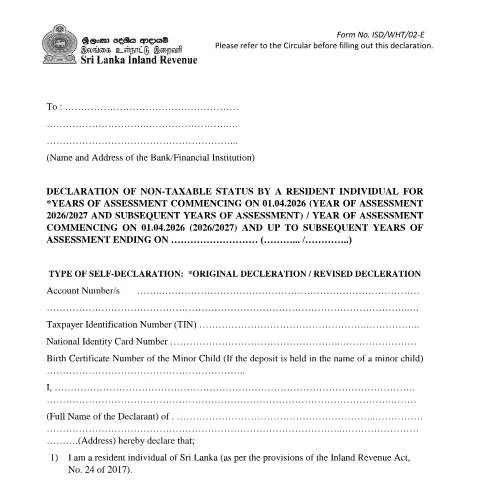
Navigating the ISD/WHT/02-E: A Critical Step for Resident Individuals in Sri Lanka
Experiencing the intricacies of the Sri Lankan tax system can be daunting, especially for resident individuals wishing to declare their non-taxable status. The Declaration of Non-Taxable Status by a Resident Individual (Form ISD/WHT/02-E) serves as a vital document for those who aim to avoid preemptive tax deductions from their interest income. This article unpacks the purpose and procedures regarding this essential form, ensuring clarity and actionable insights for its potential filers.
The Importance of the Declaration of Non-Taxable Status
Form ISD/WHT/02-E is critical for resident individuals, particularly those whose total assessable income falls below certain thresholds. By submitting this declaration, you can request the exemption of Advance Income Tax (AIT) on interest income generated from deposits. This declaration not only protects your financial rights but also aligns with the Inland Revenue Act, No. 24 of 2017.
Understanding Assessable and Taxable Income
The distinction between assessable income and taxable income is vital for accurate completion of the declaration:
- Assessable Income: This includes all income received or expected to be received during the year from various sources such as employment, business ventures, and investments.
- Taxable Income: This is the income remaining after eligible deductions, including personal reliefs. As of 2026/2027, the personal relief threshold is set at Rs. 1,800,000.
It is crucial to ensure that your total assessable income does not exceed the qualifying payments and reliefs to justify the declaration of non-taxable status.
Filing Procedure: Steps to Complete the ISD/WHT/02-E Form
Completing the ISD/WHT/02-E form involves several steps, each requiring attention to detail to avoid processing delays or rejections:
- Gather Necessary Documentation: Collect your National Identity Card (NIC), Taxpayer Identification Number (TIN), and any relevant documents if filing for a minor.
- Fill Out the Form: Provide complete and accurate information, including your full name, address, and bank account number.
- Declare Your Income Status: Accurately affirm your resident status and detail your income sources, ensuring to stay within the non-taxable limits.
- Signature and Date: Remember to sign and date the form; this asserts the accuracy of the information provided.
Detailed Breakdown of the Form Sections
The ISD/WHT/02-E form comprises several sections, each with its specific requirements and common pitfalls:
| Section | Details Required | Common Errors |
|---|---|---|
| Personal Information | Full name, NIC, TIN | Inaccurate NIC or missing TIN can lead to rejection. |
| Account Details | Account number(s) | Omitting non-related accounts can mislead evaluators. |
| Income Declaration | Total assessable income | Misreporting income can lead to taxable status. |
| Signature and Date | Declarant’s signature | Missing signature or date can invalidate the form. |
Submission Channels: Where and How to Submit Your Declaration
Filing your ISD/WHT/02-E declaration can be done through various channels, each with unique advantages:
- Online Submission: Utilizing the digital platform available on forms.gov.lk expedites the process and allows you to track your submission status.
- Paper Submission: Alternatively, you can submit a physical copy at the relevant bank or financial institution. Ensure to keep a copy for your records.
- In-Person at Tax Offices: For those who prefer direct interaction, visiting a local tax office can provide detailed assistance and immediate feedback.
Timelines and Deadlines for Submission
Understanding the timeline for submission is crucial to avoid penalties. The declaration must be submitted before the commencement of the fiscal year, specifically:
- Initial Submission Deadline: Typically required by the end of March each year for the subsequent financial year.
- Subsequent Years: If your status changes or if you need to revise your declaration, a new submission must be made reflecting such changes.
Responding to Refusals or Missing Documents
If your declaration is rejected or if the processing office requests additional documents, it is essential to act promptly:
- Review the Feedback: Carefully read the notification explaining the refusal; this often contains specific reasons.
- Gather Missing Information: Compile any additional documentation requested or correct identified errors swiftly.
- Resubmit: Once you have rectified the issues, resubmit your ISD/WHT/02-E form along with any new documents.
Handling Complex Situations
Complex scenarios may arise, especially for expatriates or those with unusual income sources. Here are some tips for these situations:
- For Expatriates: Ensure you provide a comprehensive overview of your residency status and income sources, as tax obligations may differ based on international agreements.
- Minors: If filing for a minor, ensure that all required guardianship documentation is included.
- Income Variability: If your income fluctuates, maintain thorough records and consult with a tax professional to ensure compliance.
Anticipating Future Changes: The Longevity of Your Declaration
The validity of the ISD/WHT/02-E declaration is contingent on your financial status and potential revisions in tax legislation. Here’s how to stay ahead:
- Monitoring Legislative Changes: Keep abreast of updates to the Inland Revenue Act, as these may necessitate new declarations.
- Annual Reviews: Conduct yearly assessments of your income against the personal relief threshold to ensure continued non-taxable status.
- Proactive Communication: If your income status changes, promptly submit a new declaration to avoid tax liabilities.
Legal Implications of False Declarations
Submitting inaccurate information can have significant repercussions. Under the Inland Revenue Act, No. 24 of 2017, false declarations may lead to:
- Penalties: Financial penalties can be imposed, adding further burden to an already complex situation.
- Legal Action: In severe cases, legal consequences may ensue, potentially affecting your financial future and reputation.
With this in mind, it is imperative to ensure that all information provided in your declaration is not only accurate but also verifiable.
Concluding Thoughts on the ISD/WHT/02-E Process
Completing the ISD/WHT/02-E form is a significant step in managing your tax responsibilities in Sri Lanka. By understanding the nuances of this declaration, from necessary documentation to submission pathways and future implications, you empower yourself to make informed decisions that reflect your financial standing appropriately. It is always advisable to consult with a tax professional if you have any doubts or if your financial situation is complex. Keeping informed and proactive will mitigate risks and support your financial health.
Understanding the Criteria for Non-Taxable Status in Sri Lanka
In Sri Lanka, declaring non-taxable status as a resident individual involves meeting specific criteria set forth by the Department of Inland Revenue (DIR). This status is typically applicable to individuals whose total gross income does not exceed the basic income threshold established by the government each fiscal year. For the 2026 fiscal year, this threshold will need to be confirmed as updates are released annually.
To qualify for non-taxable status, an applicant must ensure that their income sources are carefully evaluated. It is essential to compile all sources of income, including salaries, rental income, and other earnings. If the total gross income is below the established threshold, the individual can proceed to fill out the Declaration of Non-Taxable Status Form (ISD/WHT/02-E). Additionally, certain categories of income may be exempt or subject to specific deductions, further influencing an individual’s tax liability and eligibility for non-taxable status.
It is important to note that if an individual’s status changes throughout the fiscal year, such as a significant increase in income, they must update their tax records and potentially pay the applicable taxes. Maintaining accurate records and documentation is critical throughout this process to ensure compliance with the Inland Revenue Regulations.
Step-by-Step Guide to Completing the Declaration Form ISD/WHT/02-E
Completing the Declaration of Non-Taxable Status Form (ISD/WHT/02-E) requires attention to detail and adherence to specific guidelines. Here is a step-by-step guide to assist residents in filling out the form accurately:
- Gather Necessary Documentation: Before starting the form, collect your National Identity Card (NIC), proof of income (such as pay slips and bank statements), and any other relevant financial documents. This information will help in providing accurate figures.
- Download the Form: The Declaration Form can be downloaded from the official website of the Department of Inland Revenue or obtained through the Electronic Services provided by the ICTA.
- Fill in Personal Details: Begin with personal information, including your NIC number, full name, contact details, and residency address. It’s crucial that these details match those on your NIC to avoid processing delays.
- List Your Income Sources: Clearly outline all sources of income. Be precise in categorizing each income type and provide supporting documentation where necessary. This section is vital in establishing your eligibility for non-taxable status.
- Provide Financial Figures: Indicate your total gross income for the preceding financial year. Ensure that you apply any deductions or exempt income correctly to reflect your net taxable income.
- Sign and Date the Declaration: After thoroughly checking your information, sign and date the form. This declaration acts as a formal assertion of your income status.
- Submit the Form: The completed form can be submitted electronically through the DIR’s digital portal or via mail to the appropriate tax office. Keep a copy of your submission and any correspondence for your records.
Common Mistakes to Avoid When Filing for Non-Taxable Status
Filing for non-taxable status can be straightforward, yet several common mistakes can hinder the process and may result in delays or penalties. Here are some pitfalls to avoid:
- Incomplete Information: Ensure that all sections of the form are filled out completely. Leaving out any required information can lead to rejection of the application.
- Incorrect Income Calculation: Miscalculating total gross income is a frequent error. Take time to review all your income sources and ensure accuracy in your figures.
- Failing to Update Changes: If any changes occur in your financial situation during the tax year, it’s crucial to update your declaration. Failure to do so can result in fines and legal implications.
- Missing Documentation: Ensure that you provide all necessary supporting documents. Incomplete submissions can lead to processing delays or rejection.
- Not Seeking Professional Help: If you are unsure about any aspect of your tax status or the filing process, do not hesitate to consult with a tax professional. They can provide valuable guidance and ensure compliance with current regulations.