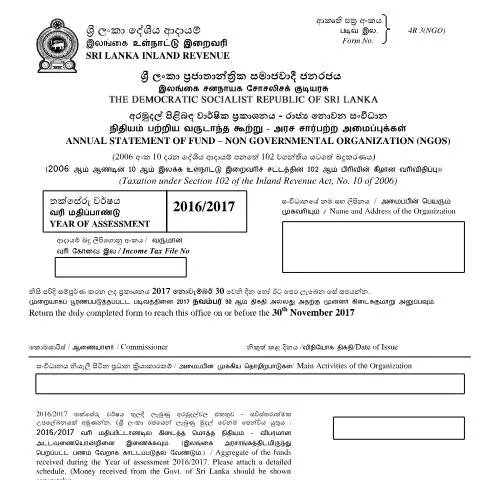
Understanding the Annual Statement of Fund - 4R3 (NGO)
The Annual Statement of Fund - 4R3 (NGO) serves as a critical document for Non-Governmental Organizations (NGOs) in Sri Lanka, ensuring transparency and compliance with the Inland Revenue Act. This form is not merely bureaucratic but a vital element that underscores the financial health and accountability of NGOs operating within the country. Organizations submit this document annually to detail their financial activities, including funds received and utilized over the previous year.
The Regulatory Framework Behind the 4R3 Form
To appreciate the significance of this document, one must first understand the regulatory landscape governing NGOs in Sri Lanka. The Inland Revenue Act, No. 10 of 2006, establishes the framework for taxation and financial reporting for organizations, including NGOs. Specifically, Section 102 of this Act mandates that NGOs submit the Annual Statement of Fund to facilitate the assessment of any tax obligations.
The act aims to ensure that organizations with public funding maintain accountability and transparency. This legal backdrop emphasizes the importance of accurate reporting, as discrepancies could lead to penalties or even revocation of the NGO's registration.
Positioning the 4R3 Form Within the NGO Lifecycle
The submission of the Annual Statement of Fund is a critical step in the broader lifecycle of an NGO. This form not only serves to disclose financial information but is also pivotal for:
- Securing Funding: Potential donors often require up-to-date financial reports before committing funds.
- Compliance and Legal Status: Submitting the 4R3 form is essential for maintaining legal standing and operational legitimacy.
- Tax Assessment: The data provided in this form influences tax obligations and potential benefits or remissions under the law.
Preparation for Completing the 4R3 Form
Completing the Annual Statement of Fund necessitates meticulous preparation. Organizations must gather various financial records that accurately reflect their income and expenditure over the fiscal year. Key components to prepare include:
- Financial Statements: These should include income statements and balance sheets for the relevant year.
- Fundraising Records: Document all sources of funding, with specific attention to government and private contributions.
- Expenditure Reports: Detail all expenses incurred during the fiscal year, categorized by project or operational costs.
It is advisable for NGOs to maintain organized records throughout the year, which simplifies the completion of the 4R3 form when the time comes.
Submitting the 4R3 Form: Channels and Procedures
Once the form is completed, NGOs have multiple avenues for submission. Understanding the available channels can help an organization choose the most efficient method:
| Submission Method | Description | Pros | Cons |
|---|---|---|---|
| Online Submission | Through the ICTA's digital platforms (forms.gov.lk). | Faster processing, immediate confirmation. | Requires internet access and technical knowledge. |
| Paper Submission | Filling out the form manually and mailing it to the relevant office. | Accessible for all, no technical skills needed. | Longer processing time, risk of postal delays. |
| In-Person Submission | Delivering the form directly to the relevant government office. | Opportunity to clarify doubts immediately. | Time-consuming, potential for long queues. |
Regardless of the method chosen, the form must reach the Inland Revenue Department by the specified deadline, typically on or before November 30 each year.
What Happens After Submission?
After submitting the Annual Statement of Fund, organizations should anticipate a review process conducted by the relevant authorities. This process involves:
- Verification of Data: The Inland Revenue Department will cross-check the provided figures against previous submissions and available records.
- Request for Additional Information: If discrepancies are found, the organization may be requested to provide additional documentation.
- Tax Assessment: Based on the data submitted, the organization will be informed about any tax obligations or potential remissions.
Maintaining open lines of communication with the Inland Revenue Department during this period can aid in addressing any queries promptly.
Navigating Challenges: Handling Errors and Discrepancies
Despite best efforts, NGOs may encounter challenges post-submission, such as errors in the form or missing documentation. Should this occur, organizations should take the following steps:
- Review Submission: Double-check all entries against original financial records.
- Prepare Corrective Documentation: If errors are found, draft a correction letter and gather necessary supporting documents.
- Contact the Inland Revenue Department: Reach out directly to clarify the issue and understand the next steps.
It is crucial to address these discrepancies as soon as possible to avoid penalties and ensure continued compliance with local laws.
The Impact of the 4R3 Form on NGO Operations
Subsequent to the submission and processing of the Annual Statement of Fund, NGOs often observe several outcomes that can influence their operations:
- Improved Financial Management: The process of preparing the form encourages better financial oversight and planning.
- Enhanced Credibility: Successfully navigating the reporting requirements bolsters an organization's reputation with stakeholders and donors.
- Access to Future Funding: A clear track record of compliance can facilitate access to grants and donations, vital for organizational sustainability.
Thus, the Annual Statement of Fund is a cornerstone of operational integrity and can significantly affect an NGO's ability to function effectively and sustainably.
Staying Informed: Keeping Up with Regulatory Changes
The regulatory environment for NGOs in Sri Lanka is constantly evolving, influenced by economic and political factors. It is imperative for organizations to remain informed about any changes that may affect their reporting requirements. This can be achieved through:
- Regular Consultation with Legal Experts: Engaging with professionals who specialize in NGO law can provide valuable insights.
- Participation in Workshops and Seminars: Many NGOs and associations host informative sessions that cover changes in regulations and reporting standards.
- Monitoring Official Announcements: Keeping an eye on announcements from the Inland Revenue Department and other relevant authorities ensures organizations don’t miss critical updates.
Remaining proactive not only aids in compliance but also positions NGOs to adapt swiftly to new legal landscapes.
Understanding the Annual Statement of Fund Requirements for NGOs in Sri Lanka
The Annual Statement of Fund is a crucial document that Non-Governmental Organizations (NGOs) in Sri Lanka must prepare and submit as part of their compliance with the legal frameworks governing their operations. This document serves to provide transparency regarding the financial operations of the NGO, detailing both incoming and outgoing funds over the fiscal year. The importance of the Annual Statement cannot be overstated; it not only fulfills statutory obligations but also enhances the credibility and trustworthiness of the organization among stakeholders, including donors, governmental bodies, and the communities they serve.
The Annual Statement must adhere to specific guidelines set forth by the relevant authorities, particularly the NGO Secretariat and the Ministry of Finance. This includes compliance with the financial reporting standards recognized in Sri Lanka, which adhere to the principles of English common law. NGOs must ensure that their statements are accurate, comprehensive, and prepared in a timely manner, typically aligning with the fiscal calendar that runs from April to March.
Moreover, NGOs should note that the Annual Statement of Fund encapsulates various financial components, including but not limited to operational expenses, funding received from donors, contributions from members, and any other income sources. Specific attention should be given to the categorization of expenses, which may include direct program costs, administrative expenses, and other indirect costs. It is advisable for NGOs to consult with financial professionals who are well-versed in the local legal requirements to ensure compliance and accuracy in their reporting.
Navigating the Submission Process: A Step-by-Step Guide
The submission process for the Annual Statement of Fund can be quite intricate, and understanding the necessary steps is essential for smooth compliance. The process typically involves several stages, including preparation, review, and submission to the relevant authorities.
Preparation of the Statement: The first step is to prepare the Annual Statement based on the financial records maintained throughout the fiscal year. This includes gathering all relevant financial documentation such as receipts, invoices, and bank statements. It is critical for NGOs to ensure that all financial transactions are correctly recorded and classified according to their nature.
Internal Review: Before submission, it is advisable to conduct an internal review of the document. This could involve cross-referencing the statement against the organization's budget and financial forecasts, as well as ensuring compliance with all statutory requirements. Engaging an external auditor can further bolster the integrity of the statement, providing additional assurance that it meets all legal obligations.
Finalization and Submission: Once the internal review is complete, the NGO can proceed to finalize the Annual Statement of Fund. The submission must be made to the NGO Secretariat along with any required supporting documentation, such as the auditor's report if applicable. It is important to note that the submission must be made within the stipulated deadline, generally mandated by the NGO Secretariat. Failure to adhere to these timelines may result in penalties or sanctions against the organization.
Acknowledgment of Receipt: After submission, NGOs should ensure they receive an acknowledgment of receipt from the NGO Secretariat. This serves as proof that the statement has been submitted in compliance with the required timelines. Organizations should keep this acknowledgment in their records for future reference.
Follow-up and Monitoring: After submission, NGOs should monitor the status of their Annual Statement. In case of any discrepancies or requests for further information from the NGO Secretariat, it is essential to respond promptly and accurately to facilitate a smooth review process.
By meticulously adhering to these steps, NGOs can ensure that their Annual Statement of Fund is not only compliant with regulatory requirements but also serves as a valuable tool for financial planning and transparency.
Common Challenges in Preparing the Annual Statement of Fund
While the preparation and submission of the Annual Statement of Fund are essential for NGOs, numerous challenges can arise throughout this process. Understanding these potential obstacles is crucial for organizations to navigate them effectively.
Complexity in Financial Reporting: NGOs often deal with a wide range of funding sources and types of expenditures. This complexity can make it challenging to categorize and report financial transactions accurately. It is vital for NGOs to develop a robust accounting system that can handle diverse funding streams and financial transactions.
Lack of Financial Expertise: Many NGOs operate with limited resources, and as a result, may lack access to financial expertise. This can hinder the quality of the Annual Statement of Fund. Seeking professional assistance, such as hiring a part-time finance officer or consulting with local accountants familiar with NGO regulations, can greatly enhance the quality and accuracy of financial reporting.
Time Constraints: The preparation of the Annual Statement requires extensive time and effort, particularly for smaller organizations that may lack dedicated finance staff. Balancing this task with ongoing programmatic activities can be challenging. NGOs should consider establishing a financial calendar, allocating specific periods during the year for financial reporting tasks, and training staff in financial management to streamline the process.
Ensuring Compliance with Legal Standards: With the evolving legal landscape regarding NGO operations in Sri Lanka, staying updated on the latest requirements and ensuring compliance can be quite taxing. Organizations should actively engage with the NGO secretariat and participate in workshops or training sessions that may be offered on compliance and reporting requirements.
Communicating Financial Information: Effectively communicating financial information to stakeholders can also pose a challenge. NGOs need to ensure that their Annual Statement is not only compliant but also clear and understandable to a non-financial audience. This can be achieved by using simple language, visual aids, and summaries that highlight key financial data.
Addressing these challenges involves strategic planning, capacity building, and seeking external support when necessary. By proactively identifying and overcoming these hurdles, NGOs can enhance the reliability and integrity of their Annual Statements of Fund, ultimately contributing to their operational success and sustainability.