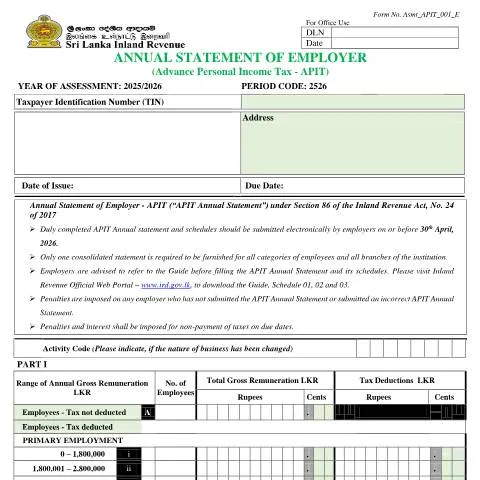
Understanding the Annual Statement of Employer - APIT 2025/2026
The Annual Statement of Employer - APIT 2025/2026 (Form Code: Asmt_APIT_001_E) serves as a crucial document within the framework of the Pay As You Earn (PAYE) system in Sri Lanka. Its importance cannot be overstated as it not only reflects the employer’s compliance with the tax legislation under the Inland Revenue Act, No. 24 of 2017 but also impacts the employees’ tax obligations. The due date for submission of this statement is set for 30th April 2026.
The Distinction of the APIT Annual Statement
Employers in Sri Lanka may often encounter various forms related to taxation. However, the APIT Annual Statement distinguishes itself with its specific focus on the Advance Personal Income Tax obligations. Unlike other documents that may cater to different tax categories, this statement consolidates information regarding all employees under one framework. The salient features that set the APIT Annual Statement apart include:
- Consolidation Requirement: Employers are mandated to submit a single comprehensive statement for all employee categories and branches.
- Advance Payment Structure: This form specifically deals with advance personal income tax, requiring an accurate estimation of tax liabilities for employees throughout the financial year.
- Legislative Compliance: Submission of this document is a legal requirement, with severe repercussions for non-compliance or errors.
The Practical Implications for Employers
Filing the APIT Annual Statement is not merely a bureaucratic formality; it carries significant consequences for employers who fail to adhere to the guidelines. Employers must grasp not only their obligations but also the potential fallout of neglecting this requirement:
- Rights and Obligations: Employers gain a clear understanding of their tax responsibilities while ensuring that employees are taxed correctly, thereby avoiding future disputes.
- Penalties for Non-Compliance: The Inland Revenue Department can impose stringent penalties for late submissions, including interest on unpaid taxes and fines for incorrect information.
- Impact on Employee Relations: Proper management of tax deductions fosters trust and transparency between employers and employees, while failures can lead to dissatisfaction.
Navigating the Completion of the Form
The process of completing the APIT Annual Statement requires meticulous attention to detail. Employers must follow specific steps to ensure accuracy:
- Gather Employee Data: This includes total gross remuneration and tax deductions applicable across different salary ranges.
- Refer to Guides: Employers are advised to consult the Inland Revenue’s official guides to assist in filling out the various schedules associated with the APIT Annual Statement.
- Declare Accuracy: The declaration part of the form requires the employer to ensure that all information is true and complete, as inaccuracies can have legal repercussions.
Employers should also note the importance of accurately calculating tax deductions based on employee earnings, as this forms the basis of compliance with the revenue regulations.
The Administrative Processing of the APIT Annual Statement
Once submitted, the APIT Annual Statement enters a processing phase where the Inland Revenue Department (IRD) conducts a thorough review. Understanding this process can help employers monitor the status of their submissions:
- Initial Assessment: The IRD verifies the information against tax records and employee data. Employers may be contacted for clarification on any discrepancies.
- Status Monitoring: Employers can keep track of their submissions via the IRD’s online portal, which provides updates regarding acceptance or requests for additional information.
- Feedback and Corrections: If issues arise, employers will receive notifications detailing necessary corrections or adjustments that must be made to the statement.
Understanding the Role of the APIT Annual Statement in Broader Tax Compliance
The APIT Annual Statement serves as a cornerstone in the broader tax compliance framework in Sri Lanka. Its role extends beyond mere submission; it also facilitates:
- Employee Tax Compliance: Accurate reporting promotes compliance among employees, reducing the risk of underpayment or overpayment of taxes.
- Institutional Accountability: It allows the IRD to monitor employer compliance rates and subsequently enforce tax law effectively.
- Integration with Digital Services: The push for electronic submissions via platforms like forms.gov.lk enhances efficiency and reduces human error.
Contingencies: What to Do in Case of Errors or Issues
Errors in the APIT Annual Statement can lead to serious consequences, including penalties and interest on unpaid taxes. Employers must be prepared to handle such situations effectively:
- Correcting Errors: If an employer discovers an error after submission, it is essential to file a corrected statement promptly. The IRD has procedures in place for amendments.
- Addressing Penalties: Employers are encouraged to discuss any penalties imposed with the IRD, as certain circumstances may allow for waivers or reductions.
- Maintain Records: Keeping detailed records of all submissions, communications, and corrections will assist in case of disputes or further inquiries from the IRD.
Conclusion: Navigating Compliance with Confidence
Successfully managing the Annual Statement of Employer - APIT is an integral part of fulfilling tax obligations in Sri Lanka. By understanding its importance, adhering to completion guidelines, and knowing how to address potential issues, employers can navigate the complexities of tax compliance with greater confidence. Staying informed and proactive in managing these responsibilities can help cultivate a compliant and efficient workplace.
Understanding the Annual Statement of Employer - APIT 2025/2026
The Annual Statement of Employer, designated as APIT 2025/2026 (Asmt_APIT_001_E), is a crucial document for organizations operating in Sri Lanka. It serves as a comprehensive report that outlines an employer's contributions towards the Pay As You Earn (PAYE) tax system, along with other statutory obligations. The APIT is not merely a formality; it is an essential tool for ensuring compliance with the regulations set forth by the Inland Revenue Department (IRD) and other pertinent authorities. It encompasses various components including, but not limited to, payroll data, employee contributions, and employer liabilities for the specified fiscal year.
Employers are required to submit this statement annually to provide a detailed account of all deductions made from employees’ salaries, including income tax, Employees' Provident Fund (EPF), and Employees' Trust Fund (ETF) contributions. The significance of the APIT cannot be overstated, as it impacts both the financial obligations of the employer and the tax status of employees. Hence, meticulous attention must be given to the preparation and submission of this document to avoid penalties and discrepancies.
Process for Preparing the APIT 2025/2026
When preparing the Annual Statement of Employer - APIT 2025/2026, employers must adhere to a systematic approach to ensure accuracy and compliance. The process generally follows these key steps:
- Reviewing Payroll Records: Employers should conduct a thorough review of all payroll records for the financial year. This includes verifying that all salary payments, bonuses, and other remuneration have been properly documented.
- Calculating Deductions: It is imperative to accurately calculate all deductions from employees’ salaries. This includes PAYE tax calculations based on the income tax slabs stipulated by the IRD, as well as contributions to EPF and ETF. Employers should refer to the latest tax guidelines issued by the IRD to ensure compliance with current rates.
- Filling Out the Form: Using the official APIT form (Asmt_APIT_001_E), employers must input the detailed calculations and ensure that all necessary sections are completed. The form can be accessed digitally via the ICTA's platform, which promotes the use of e-services and reduces paperwork.
- Verification of Information: Before submission, employers should verify all entered information for accuracy. This may involve cross-checking against employee records, tax calculations, and confirming that all required signatures are in place.
- Submission of the APIT: Employers must submit the completed APIT to the IRD by the specified deadline. The current fiscal year’s deadline can usually be found on the IRD’s official website or via their digital forms portal. Failure to submit on time can result in penalties or interest charges.
Additional Considerations: Depending on the size of the organization and the complexity of payroll, some employers may opt to engage the services of a certified accountant or payroll service provider to ensure compliance and accuracy in the preparation of the APIT. This can mitigate risks associated with incorrect submissions and help navigate the intricacies of tax laws and employee benefits.
Common Challenges and Solutions in Submitting APIT
While the process of preparing and submitting the Annual Statement of Employer - APIT 2025/2026 is fundamentally straightforward, several challenges may arise. Here are some common issues employers face and potential solutions:
- Data Entry Errors: Mistakes in data entry can lead to discrepancies, which may trigger audits or penalties. To mitigate this risk, employers should implement a double-check system where a second individual reviews the data entered before submission.
- Changes in Tax Legislation: Tax laws can change frequently, which may impact payroll calculations. Employers should stay informed about any legislative changes by regularly consulting the IRD’s communications or subscribing to updates through official channels.
- Technological Issues: Employers may encounter issues with digital submissions, including system outages or difficulties accessing the ICTA's e-service platforms. Having a contingency plan, such as access to alternative systems or manual submission of forms, can alleviate these problems.
- Employee Disputes: Occasionally, employees may dispute the deductions made from their salaries. Employers should maintain open lines of communication and have a clear policy in place for addressing such disputes promptly and fairly.