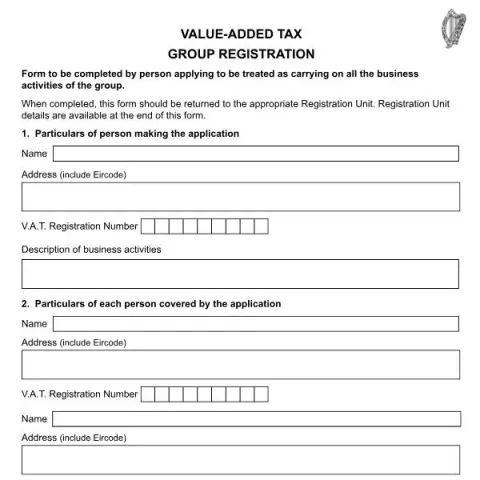
Understanding the VAT Group Registration Form (VAT52) in Ireland
The VAT52 form is an essential document issued by the Office of the Revenue Commissioners in Ireland. It is used by businesses seeking to be recognized as a VAT group, allowing multiple entities to be treated as a single taxable person for VAT purposes. This registration simplifies VAT compliance for groups of related companies, partnerships, or entities operating closely together. Below, we explore the purpose of this form, who should complete it, how to fill it out correctly, and important considerations to keep in mind.
What is the Purpose of the VAT52 Form?
The primary objective of the VAT52 form is to enable a group of persons or entities to be registered as a VAT group. When approved, this means that all members of the group are regarded as a single entity for VAT registration, reporting, and payment. This arrangement is particularly advantageous for companies with interconnected operations, such as subsidiaries or associated businesses, as it allows for simplified VAT accounting and potential cash flow benefits.
The form is also used to specify the effective date from which the VAT group status applies. This date is crucial because it determines when the group’s VAT obligations commence or cease, impacting VAT returns and compliance deadlines.
Who Needs to Complete the VAT52 Form?
Any person or entity wishing to be treated as part of a VAT group must complete this form. This includes:
- Business owners or operators seeking to consolidate VAT liabilities across multiple related entities.
- Partnerships or companies aiming to streamline their VAT reporting processes.
- Representatives authorized to act on behalf of the entities involved, such as company secretaries or designated officers.
It is important to note that each person or entity included in the group must be identified on the form, along with their VAT registration number and address. The application must be signed by an authorized individual, such as the company secretary or a partner, depending on the legal structure.
How to Complete the VAT52 Form Correctly
Filling out the VAT52 form requires careful attention to detail to ensure the information provided is accurate and complete. The form is divided into several key sections:
Part 1: Applicant Details
- Provide the full name of the applicant or main contact person.
- Include the full business address, including the Eircode.
- Enter the existing VAT registration number if applicable.
- Describe the business activities carried out by the applicant.
Part 2: Details of Each Group Member
- List each entity or person to be included in the VAT group.
- For each, provide the name, address (including Eircode), and VAT registration number.
- Repeat as necessary for all members to be included in the group.
Part 3: Effective Date
- Specify the date from which the VAT group status should take effect.
Declaration and Signature
- Confirm the accuracy of the information provided by signing the declaration.
- Indicate the signatory’s status (owner, partner, or authorized officer).
- For companies, the form must be signed by a company secretary or an authorized person under the Companies Act 2014.
Additional Documentation and Submission
While the VAT52 form itself is the primary document, it is advisable to prepare supporting documentation that verifies the relationship between the entities, such as group organizational charts or legal agreements, although these are not explicitly required at the initial registration stage.
Fill in your form directly online
No printing: type your details into the boxes of the official form, tick, then download the PDF ready to send.
- 1Type into the form boxes
- 2Tick in one click
- 3Save and download the PDF
Once completed, the form must be submitted to the appropriate Registration Unit of the Revenue Commissioners. Submission can be made via post or email, depending on the division handling the case. Contact details and addresses are specified on the form, with divisions catering to different types of groups, such as financial institutions, real estate investment trusts, or other companies.
Common Errors to Avoid
- Providing incomplete or inaccurate addresses, especially missing or incorrect Eircodes.
- Failing to sign the application by an authorized person.
- Not specifying the correct effective date, which can lead to delays or misalignment of VAT obligations.
- Omitting details of any group members or including incorrect VAT registration numbers.
Final Considerations
Applying for VAT group registration via the VAT52 form is a strategic decision that can streamline VAT compliance for related entities. It is vital to ensure all information is accurate and complete to avoid processing delays or compliance issues. For further guidance or specific questions, applicants can contact the Revenue Commissioners directly using the contact details provided on the form or consult with a tax professional familiar with Irish VAT regulations.