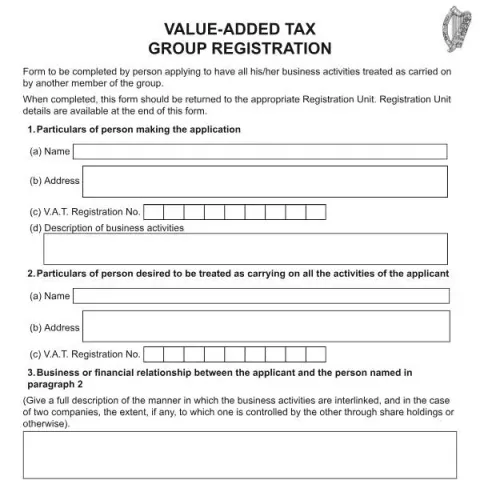
Understanding the VAT Group Registration Form (VAT 53) in Ireland
The VAT Group Registration form, identified as VAT 53, is an official document issued by the Office of the Revenue Commissioners in Ireland. It is designed for businesses seeking to have their multiple activities treated as a single taxable entity under the VAT system. This process, known as VAT group registration, allows related companies or entities to consolidate their VAT obligations, simplifying administration, and potentially reducing VAT liabilities.
Purpose and Scope of the VAT 53 Form
The primary purpose of the VAT 53 form is to enable a business or individual to apply for VAT grouping, whereby all the VAT-registered activities of the applicant are considered as carried on by another specified member of the group. This is particularly relevant for corporate groups, subsidiaries, or entities with close financial ties, aiming to streamline their VAT compliance.
Once approved, the VAT group registration means that the entire group is treated as a single taxable person for VAT purposes, with one VAT registration number covering all activities. This can facilitate intra-group transactions without the need for multiple VAT filings, and may offer cash flow advantages.
Eligibility Conditions for VAT Grouping
To qualify for VAT group registration via the VAT 53 form, certain conditions must be met:
- The entities involved must be closely related, such as subsidiaries of a parent company or companies under common control.
- The applicant and the entity to be treated as carrying out all activities must have a business or financial relationship that interlinks their operations.
- The applicant must be registered or eligible to register for VAT in Ireland.
- The applicant must demonstrate that the entities operate within the same economic or operational group, often evidenced by shareholdings or control structures.
It is important to note that the Revenue Commissioners assess each application on a case-by-case basis, considering the nature of the relationship and the structure of the group.
Step-by-Step Procedure for Completing the Form
1. Filling Out the Particulars of the Applicant
Begin by providing the applicant’s full name, address, VAT registration number, and a description of the business activities. Accurate and complete information ensures proper processing.
2. Providing Details of the Member to Be Treated as Carrying Out All Activities
Next, supply the name, address, and VAT registration number of the person or entity that will be deemed to carry on all the group’s activities. This is typically the parent company or the main operational entity.
3. Describing the Business or Financial Relationship
Offer a comprehensive description of how the applicant and the designated member are interconnected. Include details such as shareholdings, control mechanisms, or other relevant relationships that justify grouping.
4. Specifying the Effective Date
Indicate the date from which the VAT grouping should take effect. This date is crucial for VAT reporting and compliance, as it determines the start of the group’s consolidated VAT obligations.
5. Declaration and Signature
The application must be signed by an authorized person, such as the company secretary or a partner, confirming that the details provided are correct. The signatory also declares that the application aligns with the relevant legal provisions under Irish VAT law.
Submission and Processing
Once completed, the VAT 53 form should be submitted to the appropriate Registration Unit of the Revenue Commissioners. The address varies depending on the applicant’s sector or specific circumstances, such as financial services or real estate investments.
Fill in your form directly online
No printing: type your details into the boxes of the official form, tick, then download the PDF ready to send.
- 1Type into the form boxes
- 2Tick in one click
- 3Save and download the PDF
The Revenue will review the application, and if approved, will issue a notification indicating the date from which the VAT group status applies. This process can take several weeks, depending on the complexity of the case and the completeness of the submission.
Post-Approval Considerations
After successful registration, the entire group must adhere to VAT obligations as a single entity. This includes submitting consolidated VAT returns, maintaining proper records of intra-group transactions, and complying with Irish VAT legislation.
In case of changes within the group, such as the addition or removal of members, or changes to control structures, the Revenue Commissioners should be notified, and adjustments to the VAT grouping may be required.
Overall, the VAT 53 form is a vital tool for businesses aiming to optimize their VAT management through grouping, provided all legal and operational criteria are satisfied and properly documented.