Understanding the Section 57 Application Form for Dublin City Council
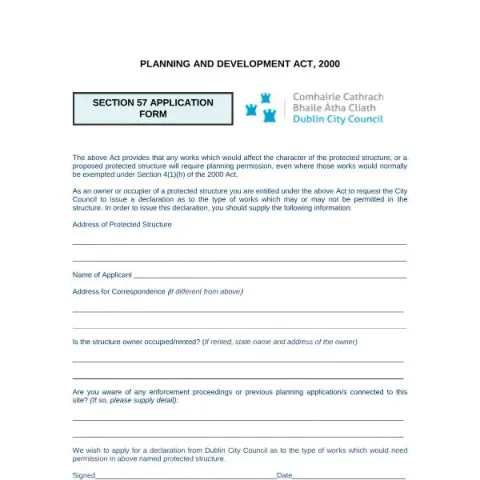
If you own or occupy a protected structure within Dublin, you may need to submit a Section 57 Application Form to Dublin City Council. This process is essential for obtaining clarity on what types of works can be carried out without breaching planning regulations, especially when such works could affect the character of the protected structure. This guide aims to help you understand the purpose of the form, how to prepare your application, and the steps involved in submitting it.
Purpose of the Section 57 Application Form
The Section 57 Application Form is a formal request for a declaration from Dublin City Council regarding the types of works that may or may not require planning permission for a protected structure. Under the Planning and Development Act, 2000, any modifications that could impact the character of a protected or proposed protected structure are subject to planning control, regardless of exemptions that might normally apply under Section 4(1)(h).
This form is particularly useful for owners or occupiers who seek to understand the scope of permissible works, ensuring they stay compliant with planning laws while undertaking renovation or maintenance activities.
Preparing Your Application
Gathering Necessary Information
Before filling out the form, you should prepare the following details:
- Address of the Protected Structure: Clearly specify the full address, including Eircode if available.
- Name of the Applicant: The individual or organization submitting the application.
- Address for Correspondence: If different from the property address, provide a mailing address.
- Ownership Status: Indicate whether the structure is owner-occupied or rented. If rented, include the owner's name and address.
- Previous Planning or Enforcement Proceedings: Disclose any past planning applications or enforcement actions related to the site.
Supporting Documents
The application must be accompanied by a site location map at a scale of 1:1000. This map should clearly outline:
- The structure itself, outlined in red.
- The overall landholding boundaries, outlined in blue.
Additionally, a detailed survey of both internal and external features of the structure is required to facilitate an accurate assessment by Dublin City Council.
Submitting the Application
Where and How to Submit
Completed applications should be returned to the Conservation Section of the Planning and Property Development Department at Dublin City Council. The physical address is:
Conservation Section, Planning and Property Development Department, Dublin City Council, Block 3, Floor 3, Civic Offices, Wood Quay, Dublin 8.
Applicants can also contact the department by phone at 01-222-6458 or via email at [email protected].
Important Considerations
When submitting your application, ensure that:
Fill in your form directly online
No printing: type your details into the boxes of the official form, tick, then download the PDF ready to send.
- 1Type into the form boxes
- 2Tick in one click
- 3Save and download the PDF
- All sections of the form are completed accurately.
- The site location map is included and correctly scaled.
- A detailed internal and external survey accompanies your application.
Processing and Follow-up
Once received, Dublin City Council will review your application, considering the specific features of your protected structure. The council may request additional information or clarification during this process.
It is advisable to keep a copy of your submitted application and all supporting documents for your records. The processing time can vary depending on the complexity of the case and the current workload of the conservation team.
Contact and Support
For any questions or assistance during the application process, contact the Conservation Section directly. They can provide guidance on the necessary documentation, survey requirements, and any other procedural matters.
Understanding and correctly completing the Section 57 Application Form ensures that your intended works are in compliance with Dublin's planning regulations, helping to preserve the city's architectural heritage while allowing for appropriate modifications.