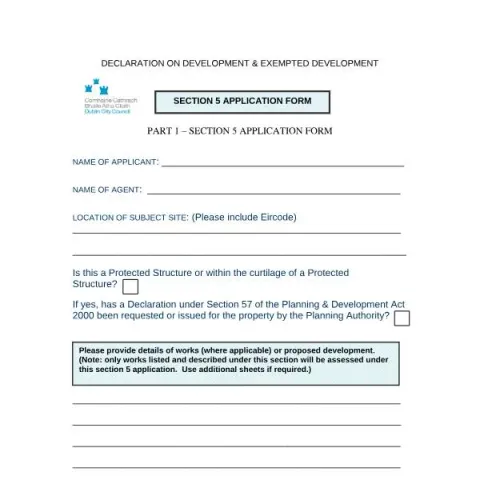
Understanding the Section 5 Application Form for Dublin City Council
The Section 5 Application Form is an essential document used by applicants seeking approval for specific development works on protected structures or properties within Dublin City. Managed by Dublin City Council's Planning Registry, this form facilitates a structured process to assess proposed modifications that could impact historic or protected buildings, ensuring conservation standards are maintained.
Purpose and Scope of the Form
The primary objective of the Section 5 Application Form is to provide detailed information about proposed works to a protected structure or within its curtilage. It is designed for property owners, developers, architects, or agents who intend to undertake alterations, renovations, or repairs that might affect the historic fabric of a building. The form ensures that the council receives all relevant details upfront, enabling a thorough evaluation of the potential impact on the site's architectural significance.
Preparing Your Application
Gathering Necessary Documentation
Applicants must compile a comprehensive package that includes the completed application form, a fee of €80, and supporting plans and reports. Critical documents include:
- Two copies of an Ordnance Survey (OS) Map at a scale of 1:1000, with the site outlined in red.
- A photographic record of the existing historic fabric and general views of the building, with annotations explaining the proposed works.
- An outline statement justifying the proposed works and assessing their impact on the protected structure.
- A detailed method statement describing the construction process, including the materials to be used.
- Elevation, plan, and detail drawings where relevant.
Understanding the Application Content
The form requires detailed information about the applicant and, if applicable, the agent acting on their behalf. It includes:
- Name and contact details of the applicant and agent.
- Location of the subject site, including the Eircode.
- Details of ownership interest, especially if the applicant is not the owner.
- Information on previous planning applications or enforcement proceedings related to the site.
- Declaration regarding the protected status of the structure, if relevant.
Submission Process and Important Considerations
How to Submit Your Application
Applications should be forwarded to Dublin City Council's Planning Registry located at the Civic Offices, Wood Quay, Dublin 8. It is advisable to submit two copies of all documents, including the OS map and supporting reports, along with the application fee. Submissions can be made via postal mail or in person.
Compliance and Supporting Guidance
Applicants are encouraged to consult the Department of Housing, Local Government and Heritage’s advice series for best practices in conservation work. These publications provide guidance on repairing historic brickwork, wrought iron, windows, roofs, and other elements. Demonstrating adherence to conservation principles is crucial for the approval process.
Follow-Up and Decision-Making
Once submitted, Dublin City Council reviews the application to ensure compliance with conservation standards and planning policies. The process involves assessing the impact of proposed works on the historic fabric, the method of implementation, and the appropriateness of materials used. The applicant may be contacted for additional information or clarification during this period.
Fill in your form directly online
No printing: type your details into the boxes of the official form, tick, then download the PDF ready to send.
- 1Type into the form boxes
- 2Tick in one click
- 3Save and download the PDF
Contacts and Further Information
For queries or assistance, applicants can contact the Planning Registry by phone at 01 222 2149 or via fax at 01 222 2675. It is recommended to keep a copy of all submitted documents and correspondence for future reference.
In summary, the Section 5 Application Form is a vital step in ensuring that development works on protected structures are carefully considered and aligned with conservation best practices. Proper preparation and understanding of the process help facilitate a smooth application experience and support the preservation of Dublin’s historic built environment.