Navigating the DIR-CR Bank Mandate: A Vital Resource for Veterinary Practices
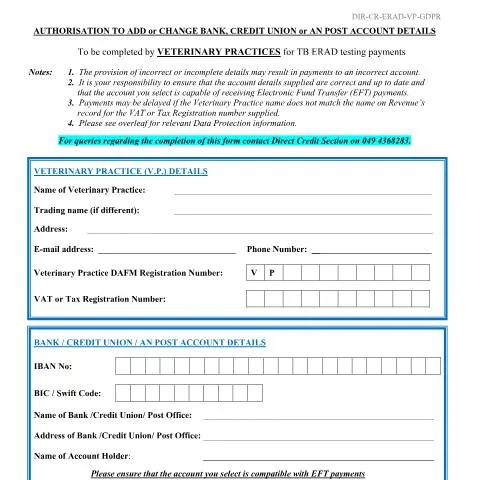
The DIR-CR Bank Mandate form is a pivotal document for veterinary practices in Ireland, specifically designed for those involved in tuberculosis (TB) eradication testing payments. This mandate enables veterinary practitioners to manage their bank account details effectively for receiving payments from the Department of Agriculture, Food and the Marine (DAFM). Whether you are adding a new account or updating existing details, understanding the nuances of this form can streamline the payment process associated with essential veterinary services.
Understanding the Role of the DIR-CR Bank Mandate
At its core, the DIR-CR Bank Mandate is an authorization tool that allows the DAFM to process payments directly to specified bank accounts for veterinary practices participating in TB eradication testing programmes. The form ensures that payments are accurately directed to the correct accounts, thereby avoiding potential delays or errors that could arise from incorrect banking details.
The importance of this document cannot be overstated. Given the nature of TB eradication efforts, timely payments are critical for the operational efficiency of veterinary practices. This form is not merely a procedural requirement; it is a lifeline that facilitates the financial transactions necessary for ongoing veterinary services.
Who Needs to Complete the Mandate?
- Veterinary practices registered with the DAFM.
- Practices participating in TB eradication testing procedures.
- Entities looking to update their banking information for efficient payment processing.
Regardless of the specifics of your practice, if you fall into one of these categories, the DIR-CR Bank Mandate is an essential piece of documentation you will need to manage promptly.
Decoding the Form: Line-by-Line Breakdown
Completing the DIR-CR Bank Mandate involves a series of straightforward yet critical steps. Each section of the form is designed to capture important information that will facilitate accurate payment processing.
Veterinary Practice Details
- Name of Veterinary Practice: Ensure this matches the name registered with the DAFM.
- Trading Name: If applicable, provide the name under which you conduct business.
- Address: Include the complete address, ensuring it is up-to-date.
- Email Address: Provide a valid email for further correspondence.
- Phone Number: Include a contact number for any queries.
- DAFM Registration Number: This unique identifier is crucial for processing payments.
- VAT or Tax Registration Number: Make sure this number is linked to your practice.
Bank Account Information
Accurate bank account details are essential for the successful processing of payments.
- IBAN No: This is your International Bank Account Number and must be correct to avoid delays.
- BIC/Swift Code: Include the Bank Identifier Code for international transactions.
- Name of Bank/Credit Union/Post Office: Keep this consistent with official documentation.
- Account Holder’s Name: As it appears on your bank statement.
Submitting the DIR-CR Bank Mandate
Upon completing the form, it must be returned to the Direct Credit Section at the DAFM. The address to which the form should be sent is:
Direct Credit Section Department of Agriculture, Food and the Marine Farnham St., Cavan Co. Cavan H12 D459It's advisable to retain a copy of the completed form for your records, as this can serve as a reference in case of discrepancies or inquiries.
Processing and Follow-Up: How to Ensure Your Submission is Handled
Once your DIR-CR Bank Mandate is submitted, it is crucial to monitor the processing status actively. The DAFM encourages practices to reach out to the Direct Credit Section for confirmation that your account details have been successfully updated and payments will proceed as scheduled.
If you have not received confirmation within a reasonable timeframe, it may be prudent to follow up via phone at 049 436 8283. Proactive communication can mitigate potential payment delays that could impact your practice.
What Happens If There Are Issues with Your Submission?
In the event of an error or missing information in your submission, the DAFM may not process your mandate effectively. Here are steps to rectify common issues:
- Incorrect Bank Details: If you provided wrong IBAN or BIC details, immediately contact the DAFM to rectify this discrepancy.
- Missing Information: If any required field is left blank, you may receive a notification requesting the missing details. Respond promptly to avoid delays.
- Submission Confirmation: If you do not receive a confirmation email after submitting your form, reach out to the Direct Credit Section to ensure that your submission was received.
Being attentive to these areas can help prevent administrative setbacks and ensure the smooth operation of your financial activities.
Legal Framework and Data Protection Considerations
The DIR-CR Bank Mandate operates within the framework of the General Data Protection Regulation (GDPR). When you submit your banking details, you are also providing personal data, which the DAFM is obligated to protect under data protection legislation.
Some important considerations regarding data privacy include:
- Your personal data is processed under Article 6(1)(c) of the GDPR, ensuring compliance with legal obligations.
- Data collected will only be retained as long as necessary for the purposes for which it was collected.
- You hold rights under GDPR, including the right to access, correct, or request the erasure of your personal data.
For any concerns regarding data protection, you can reach the DAFM’s Data Protection Unit via email at [email protected].
Final Thoughts on the DIR-CR Bank Mandate
The DIR-CR Bank Mandate is more than just a formal requirement; it is a crucial component that supports the financial transactions necessary for veterinary practices involved in TB eradication efforts. By following the proper procedures and ensuring accuracy in your submissions, you can facilitate a more efficient payment process.
As you navigate this documentation, remember that the DAFM is there to support you; do not hesitate to reach out if you encounter any challenges. Your proactive engagement will help ensure that your practice operates smoothly and that you continue to receive the necessary payments for your vital services.
Understanding DIR-CR Bank Mandate Forms: Purpose and Importance
The DIR-CR Bank Mandate Forms are essential documents used in Ireland for managing direct debit and direct credit transactions between individuals or organizations and their banks. Understanding the purpose of these forms is crucial for anyone looking to streamline their financial operations, whether for personal banking or in a business context. These forms serve as an authorization mechanism that allows a bank to act on behalf of the account holder to process transactions, ensuring that payments are made reliably and timely.
In practical terms, when a bank mandate is established using DIR-CR, it allows for automated transfers of funds, which can significantly reduce administrative burdens associated with manual payments. For businesses, this means improved cash flow management and a reduction in late payment penalties while for individuals, it means the peace of mind that comes with knowing bills are paid on time without the need for constant oversight.
Additionally, it’s important to recognize the legal framework governing these transactions. Ensuring compliance with the Payments Services Directive (PSD2) and the relevant sections of the Central Bank of Ireland’s regulations is vital. Non-compliance could lead to financial penalties or disruptions in service. Therefore, one should familiarize themselves with the implications of signing the DIR-CR forms, especially regarding how they impact one's banking relationships and account management practices.
Completing the DIR-CR Bank Mandate Form: Step-by-Step Guidance
Completing the DIR-CR Bank Mandate Form might seem straightforward, but it is essential to pay careful attention to detail to avoid any errors that could cause delays in processing. Below is a step-by-step guide to help users accurately fill out the form:
- Gather Necessary Information: Before starting, ensure you have all the necessary details on hand. This includes your Personal Public Service Number (PPSN), Eircode, bank account details, and any other required identifiers, such as the Business Registration Number (if applicable).
- Access the Form: You can obtain the DIR-CR Bank Mandate Form from the appropriate financial institution's website or by visiting a local branch. Ensure you are using the most up-to-date version of the form to avoid any issues.
- Fill in Personal Details: Clearly enter your name, address, and contact information as they appear on your bank records. It's crucial that this information matches your bank’s records to avoid processing issues.
- Specify Account Information: Provide accurate bank account details, including the account number and sort code. Double-check these numbers as errors here can lead to failed transactions.
- Define Transaction Type: Indicate whether this mandate is for direct debits, direct credits, or both. Be specific about the nature of these transactions, including the frequency (e.g., monthly, quarterly) and the amount where applicable.
- Agreement and Signature: Read through the terms and conditions associated with the mandate carefully. You will need to sign and date the form to authorize your bank to act on your behalf.
- Submission: Finally, submit the completed DIR-CR Bank Mandate Form to your bank, either in person or electronically, depending on what options your bank provides. Retain a copy for your records for future reference.
Taking the time to accurately complete this form is vital, as even minor inaccuracies can lead to delays in processing or complications in transaction execution. Should you have any doubts during completion, don’t hesitate to reach out to your bank’s customer service for assistance.
Common Issues and Troubleshooting Tips for DIR-CR Bank Mandate Forms
Despite the straightforward nature of the DIR-CR Bank Mandate Forms, users often encounter common issues that may impede the smooth processing of authorizations. Identifying these issues in advance can save both time and frustration.
One prevalent problem is mismatched personal information. It is crucial for the names, addresses, and account numbers provided on the form to match exactly with the records held by the bank. If discrepancies exist, such as a misspelled name or an outdated address, the bank will likely reject the form and request a correction. Always double-check your details or consult your bank's records beforehand.
Another issue arises from the lack of clarity regarding transaction types. Users sometimes fail to specify whether they are authorizing direct debits, direct credits, or both. If this step is ambiguous or left unchecked, banks may postpone processing until clarification is provided, which can disrupt payment schedules.
Additionally, it is essential to be aware of any limitations imposed by your bank. For example, certain banks may have restrictions on the amount or frequency of transactions that can be processed under a single mandate. Verify these conditions beforehand to ensure your financial activities are not impeded.
If you encounter difficulties, it’s advisable to act quickly—contact your bank’s support team as they can provide specific guidance tailored to your situation. Remember, proactive communication can often resolve issues before they escalate, allowing for a smoother banking experience.