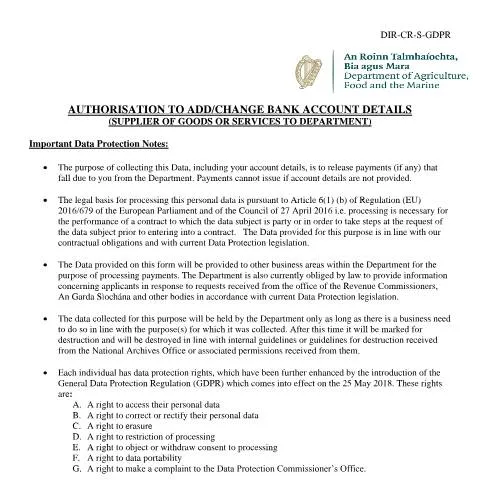
Understanding the Animal Welfare Bank Form: A Key Document in Supplier Transactions
For suppliers delivering goods or services to the Department of Agriculture, Food and the Marine, the Animal Welfare — Dircrsgdpr Bank Form plays a critical role in ensuring prompt and accurate payments. This form is not just a bureaucratic necessity; it safeguards the financial interactions between suppliers and the department. Understanding its requirements, implications, and processes is essential for a smooth transaction flow.
Establishing Your Supplier Profile: Key Information Required
As a supplier, certain data points are mandatory to fulfil the form’s criteria and initiate or alter your bank account details for payment processing. Careful attention to detail is crucial here. The required information includes:
- Name of Sole Trader or Company Supplier: Clearly state your business name.
- Address: Provide a complete and current address for correspondence.
- Contact Information: Accurate phone numbers are essential for any follow-up or clarification needed.
- VAT or Tax Reference Number: Obligatory for transparency and tax purposes.
These details form the foundation of your supplier profile within the department’s system.
The Importance of Accurate Bank Account Information
Completing the section on bank account details is vital. Incorrect information can result in delayed payments or, worse, payments directed to the wrong account. The required details include:
- Name on Bank Account: Must match the name provided as the supplier.
- Bank Account Number and Sort Code: Essential for payment processing.
- Name and Address of Bank: Ensures the department knows where to route funds.
- IBAN and Swift/BIC Code: Required for international transactions and to meet banking standards.
Provide these details meticulously to avoid future complications.
Navigating the Submission Process: From Completion to Delivery
Once the form is accurately filled out, the next step involves its submission. Suppliers can send the completed Animal Welfare Bank Form to the department in two ways:
- Via Email: You can submit the form electronically to [email protected]. Ensure all scanned signatures are clear to avoid processing delays.
- By Post: If you prefer traditional methods, send the form to the following address:
Direct Credit Section, Department of Agriculture, Food and the Marine, Farnham St., Cavan, Co. Cavan, H12 D459
Choose the method that best suits your operational capabilities.
Follow-Up Protocol: Ensuring Your Submission is Processed
After sending your form, tracking its progress is essential. The department does not routinely provide updates unless issues arise, but you can proactively check by contacting:
- Tel: 049 4368283
Clear communication can help resolve any potential issues promptly.
The Regulatory Framework: Ensuring Compliance and Confidentiality
The Animal Welfare Bank Form operates within the framework of the General Data Protection Regulation (GDPR) and other pertinent laws. The collection of personal data, including bank account details, is governed by strict compliance regulations to protect supplier information.
Key aspects include:
- The processing of your data is essential for fulfilling a contract.
- Your data will be handled with confidentiality and only shared with necessary departments for payment processing.
- Post-processing, data is retained only for as long as required for business needs.
Awareness of these regulations not only protects you but also fosters trust between you and the department.
Potential Consequences of Inaccuracies: What Suppliers Must Know
Submitting incorrect information on the Animal Welfare Bank Form can lead to significant ramifications. Understanding these potential issues will help you mitigate risks:
- Delayed Payments: Errors in bank account details can postpone your payments indefinitely.
- Misrouted Funds: There is a risk of payments being incorrectly deposited into another account, leading to potential financial loss.
- Administrative Hassles: Rectifying mistakes may require additional paperwork or correspondence with the department.
It is paramount that each detail is filled out accurately to avoid these pitfalls.
Your Rights under GDPR: Empowering You as a Data Subject
As a supplier, you have specific rights concerning your personal data outlined under GDPR. Familiarising yourself with these rights can empower you in your interactions with the department:
- Right to Access: You can request to see what data is held about you.
- Right to Rectification: If inaccuracies are found, you have the right to have them corrected.
- Right to Erasure: In certain circumstances, you can request that your data be deleted.
Feel free to contact the department's Data Protection Unit for any concerns regarding your rights at:
Data Protection Unit, Department of Agriculture, Food and the Marine, Pavilion A, Grattan Business Park, Dublin Road, Portlaoise, Co. Laois
Email: [email protected]
Recap of the Submission Journey: A Step-by-Step Overview
To clarify the overall process, let's outline the journey from form completion to payment delivery:
| Step | Action Required | Details |
|---|---|---|
| 1 | Complete the Form | Accurately fill out all required fields with precise information. |
| 2 | Submit the Form | Send via email or post to the appropriate department address. |
| 3 | Follow-Up | Contact the department to confirm receipt and check the status. |
| 4 | Receive Payment | Await payment to the specified bank account upon processing. |
This structured approach ensures clarity and aids in avoiding potential delays or complications.
Conclusion: A Critical Document for Suppliers
Ultimately, the Animal Welfare — Dircrsgdpr Bank Form is a crucial tool for suppliers engaging with the Department of Agriculture, Food and the Marine. By understanding its requirements, ensuring accurate completion, and following the correct submission channels, suppliers can safeguard their financial transactions. With an emphasis on compliance and data protection, this form embodies the necessary protocols for smooth interactions with the department.
Take the time to understand this document fully; it serves not only as a means for payment processing but also as a gateway to a professional relationship grounded in transparency and trust.
Understanding the Animal Welfare Legislation in Ireland
The Animal Welfare Act 2013 is the cornerstone of animal protection legislation in Ireland, establishing a comprehensive framework for the welfare of domesticated animals. Under this act, the Department of Agriculture, Food and the Marine (DAFM) is tasked with ensuring that animals are provided with adequate care and protection. The act emphasizes the responsibilities of pet owners, farmers, and businesses concerning the treatment of animals. Key provisions include the requirement for all individuals responsible for animals to ensure their welfare in terms of the five freedoms: freedom from hunger and thirst, discomfort, pain, injury, and disease, and freedom to express normal behavior.
The act applies to both domestic and wild animals and includes specific regulations pertaining to the care of animals in various contexts—including agriculture, research, and companionship. It is crucial for businesses involved in the supply of goods or services to the DAFM to understand these regulations, as compliance with animal welfare standards is often a prerequisite for conducting business with the government.
Completing the DIRCRSGDPR Bank Form: Best Practices for Suppliers
The DIRCRSGDPR Bank Form is essential for suppliers of goods or services to the Department of Agriculture, Food and the Marine, ensuring compliance with data protection regulations under the General Data Protection Regulation (GDPR). When filling out this form, it is imperative to provide accurate and complete information, as any inaccuracies could lead to delays in processing payments or even complications with your contractual obligations.
To successfully complete the DIRCRSGDPR Bank Form, follow these best practices:
- Use Clear and Concise Language: While the form may require specific technical details about your banking information and personal or business identifiers, clarity is paramount. Use straightforward language to reduce the risk of misunderstandings.
- Double-Check Your Information: Before submitting the form, verify all the details. Ensure that your IBAN (International Bank Account Number) is correct, as errors here can disrupt financial transactions.
- Consult Relevant Guidelines: The DAFM provides guidelines on completing the DIRCRSGDPR Bank Form. Familiarize yourself with these guidelines to ensure compliance with both administrative and legal standards.
- Utilize Secure Channels: Since the form contains sensitive financial information, always submit it through secure means. If submitting electronically, ensure that you are using an encrypted platform to protect your data.
Completing the DIRCRSGDPR Bank Form accurately will not only expedite your transactions but also establish a trustworthy relationship with the Department, which can lead to future opportunities.
Challenges in Animal Welfare Compliance for Suppliers
Suppliers working with the DAFM face several challenges related to compliance with animal welfare standards. The regulations can be complex, and keeping abreast of the latest amendments to legislation can be daunting. Suppliers must ensure that their products and services adhere to the highest standards of animal welfare, affecting sourcing, manufacturing, and distribution practices.
One major challenge is the verification of compliance. Suppliers are often required to provide proof that their products meet animal welfare standards, which may include third-party certifications or audits. This process can be resource-intensive and may require investments in training staff or modifying operational practices.
Additionally, the evolving nature of animal welfare legislation poses another challenge. Regulations are continuously updated to reflect new scientific understandings and societal expectations regarding animal treatment. Suppliers must be agile, adapting their practices to remain compliant. Engaging with industry groups and regulatory bodies can help suppliers stay informed about these changes.
Moreover, the pressure from consumers for ethically sourced products is rising. This demand necessitates transparency in supply chains, whereby suppliers must document and communicate their commitment to animal welfare effectively. Businesses that fail to align their operations with these expectations risk losing market access and customer trust.
To overcome these challenges, suppliers should conduct regular reviews of their compliance practices, invest in training and education about animal welfare standards, and actively participate in dialogues with the DAFM and other stakeholders. Ensuring compliance with animal welfare regulations is not just about meeting legal obligations; it is also about fostering an ethical approach to business that aligns with consumer values.