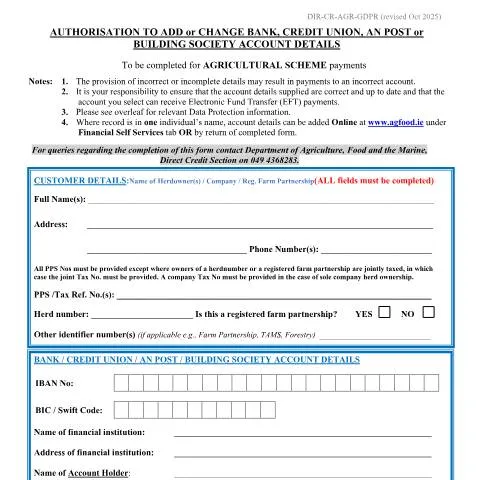
Navigating the DIR-CR Bank Mandate Form: A Practical Guide for Farmers
In the intricate world of agricultural payments in Ireland, efficient financial transactions are paramount. The DIR-CR Bank Mandate Form, formally entitled Authorisation to Add or Change Bank, Credit Union, An Post, or Building Society Account Details, serves as a crucial tool for farmers and agricultural businesses to manage their payment preferences. Understanding the nuances of this form can make all the difference in ensuring that payments from the Department of Agriculture, Food and the Marine (DAFM) are processed smoothly and on time.
The Stakeholders: Who Needs to Engage with the DIR-CR Form?
This mandate form is tailored for various stakeholders within the agricultural sector. Here’s a breakdown of the profiles that typically require this documentation:
- Individual Farmers (Herdowners): Individual farmers operating under a herd number will primarily use this form to update or establish their bank account details for direct payments.
- Registered Farm Partnerships: Partnerships registered with DAFM will also need to submit this form, particularly when changes to bank account details are necessary.
- Companies: Sole companies that own herds or operate in agricultural sectors must provide their company tax number to authorize payments.
Additionally, understanding the specific requirements for each stakeholder can help prevent delays. For instance, if a payment is to be directed to a joint account, all parties listed under the herd number must sign the form. This ensures accountability and compliance with the regulations set forth by the DAFM.
Key Considerations Before Submission: Accuracy is Imperative
When filling out the DIR-CR Bank Mandate Form, precision is non-negotiable. The details must be correct, as any inaccuracies can lead to payments being directed to the wrong account, causing potential financial setbacks. Here are critical elements to focus on:
PPSN and Tax Numbers
All Personal Public Service Numbers (PPSNs) must be included unless the owners are jointly taxed, in which case the joint tax number suffices. Companies must provide their unique tax identifications to facilitate accurate processing.
Bank Account Details
It’s essential to provide complete bank account details, including:
- IBAN Number: This international bank account number must be accurately filled to ensure that funds are transferred correctly.
- BIC/Swift Code: This code identifies the bank during transactions and must be double-checked for accuracy.
- Name and Address of Financial Institution: Providing this information ensures DAFM can verify the legitimacy of the bank account.
Submission Channels: Online Versus Paper Options
Understanding the available submission channels for the DIR-CR Form is crucial for expedience. The form can be submitted in two primary ways:
- Online Submission: Utilizing the Financial Self Services tab on the Agfood.ie website allows for quicker processing. Farmers can log in using their MyGovID to securely submit their forms.
- Paper Submission: Alternatively, completed forms can be sent to the Direct Credit Section at DAFM, located at Farnham Street, Cavan, Co. Cavan H12 D459. Ensure that the form is mailed promptly to avoid payment delays.
While online submission is often more efficient, having a paper option provides flexibility for those unfamiliar with digital processes or lacking online access.
Data Protection: Your Rights and Responsibilities
As a farmer or business owner submitting their bank account details, it’s vital to understand the implications of data protection regulations. The completion of the DIR-CR Bank Mandate Form involves the processing of personal data, governed by the General Data Protection Regulation (GDPR). Here are key points to keep in mind:
Data Collection Purpose
The DAFM collects this data to facilitate payments. It is your responsibility to ensure that all the information provided is correct and up to date. Incorrect details could lead to missed payments or financial discrepancies.
Retention and Access Rights
The data collected will be held only as long as necessary for processing payments. If you wish to access your personal data or request corrections, you can contact the Data Protection Unit at the DAFM via email. Furthermore, you are entitled to:
- Access your personal data.
- Request correction or erasure of personal data.
- Object to or restrict processing of your data.
- Submit a complaint to the Data Protection Commissioner.
What If Things Go Awry? Handling Errors and Refusals
While the submission process is relatively straightforward, issues may arise that necessitate prompt action. Here’s how to address potential problems:
Insufficient Information
If your submission is incomplete or missing necessary details, you may receive a notification from the DAFM indicating the specific issues. It is crucial to respond swiftly by providing the requested information, as delays could impact your payment schedule.
Payment Refusals
Occasionally, payments may be refused due to discrepancies found during the review process. In such instances:
- Contact the Direct Credit Section immediately at 049 436 8283 to clarify the reason for refusal.
- Ensure that all provided details are accurate and correspond with the bank’s records.
Special Cases: International Applicants and Minors
There are scenarios where the usual processes may not apply, particularly for international applicants or minors. Here’s how to navigate these unique situations:
International Applicants
For applicants outside of Ireland, the process remains largely the same, but additional verification may be required. Ensure that bank accounts can receive Electronic Fund Transfer (EFT) payments internationally. Contact the DAFM for guidance on international banking requirements.
Minors and Guardians
In the case of minors, a parent or legal guardian must complete the form on their behalf. Both the child’s and guardian’s details will need to be provided, ensuring that the parent signs the form to authorize payments directly to the minor’s account.
Understanding the Regulatory Framework: The Bigger Picture
The DIR-CR Bank Mandate Form is not just an isolated document; it operates within a broader regulatory context that governs agricultural payments in Ireland. The framework includes:
- Constitution of Ireland: Ensures that payment processes adhere to constitutional rights.
- Taxes Consolidation Act 1997: Outlines the legal obligations regarding taxation and payments.
- GDPR Compliance: Enforces standards for data protection and personal privacy, especially relevant to sensitive financial information.
This regulatory backdrop is vital to comprehend, as it emphasizes the significance of compliance and the responsibilities of both the DAFM and the applicants.
A Distinct Tool in the Agricultural Payment Landscape
While it may be easy to conflate the DIR-CR Bank Mandate Form with other forms related to agricultural schemes, it serves a distinct purpose. Understanding how this form differs from others, such as:
- Single Payment Scheme (SPS) Applications: The DIR-CR form specifically addresses bank mandate authorizations, while SPS applications involve eligibility and area-based payments.
- Direct Payment Applications: These applications concern payment claims rather than account management.
Each form has its operational focus, making it essential for users to engage with the correct documentation to ensure compliance and timely payments.
Practical Implications for Users: The Cost of Neglect
Failing to submit the DIR-CR Bank Mandate Form correctly can have significant repercussions. Here’s what’s at stake:
Payment Delays
Without an accurate mandate, payments can be delayed, impacting cash flow and financial planning. Agricultural businesses can face challenges meeting operational costs if payments are not received on time.
Legal Responsibilities
Submitting incorrect information doesn’t just risk payment delays; it may also lead to compliance issues with the DAFM and potential legal ramifications if incorrect payments are made.
Long-Term Financial Consequences
Over time, persistent issues with payment submissions can strain relationships with financial institutions and regulatory bodies, complicating future transactions. Maintaining accurate and up-to-date banking information is therefore crucial.
Understanding the DIR-CR Bank Mandate Forms
The DIR-CR Bank Mandate Forms are essential tools for businesses and individuals looking to establish or revise existing bank mandates in compliance with the regulations set forth by the Central Bank of Ireland. These forms facilitate the authorization of bank transactions and ensure proper management of accounts. Understanding the nuances of these forms is critical for anyone engaged in business activities that rely on seamless banking operations.
When filling out the DIRCRAGRGDPRRevisedBankFormOCT2025091025, it is vital to accurately provide all requested information, including the names of the authorized signatories, their respective roles, and the specific limitations of their authority, if any. Failing to do so can lead to complications in processing transactions and may result in delays or miscommunication with your banking institution.
It’s also important to note how GDPR (General Data Protection Regulation) implications can influence the handling of personal data within these forms. Any personal information disclosed in the DIR-CR forms must be managed respectfully and in adherence to data protection principles. Businesses should consider drafting a clear privacy notice for stakeholders indicating how their data will be handled, especially if the form contains sensitive information.
Common Mistakes When Completing DIR-CR Forms
Despite the straightforwardness of the DIR-CR Bank Mandate Forms, several common mistakes can arise during completion, jeopardizing the processing of mandates and the smooth operation of banking procedures.
Firstly, one common error is the omission or incorrect entry of the PPSN (Personal Public Service Number) of authorized signatories. The PPSN serves as a primary identifier in numerous Irish administrative processes, and its correctness is paramount in establishing the identity of signatories involved in a mandate.
Another frequent issue occurs when businesses fail to specify the extent of authority granted to each signatory. For example, if one signatory is intended to have full transactional capabilities while another is limited to specific actions (like withdrawals only), this must be clearly delineated on the form. Inadequate specifications can lead to confusion and disputes down the line, which could hinder business operations.
Moreover, it is advisable to double-check the format of any required signatures. Often, institutions may have specific standards related to how signatures should be presented, especially for those representing legal entities. This could include the use of official stamps or seals in addition to personal signatures. Not adhering to these requirements can result in the bank rejecting the form altogether.
Maintaining Updated Bank Mandates
In the fast-paced world of business, it’s essential to keep bank mandates updated. Changes in personnel, business structure, or even the nature of financial transactions can necessitate a revision of existing mandates. Failing to update bank mandates can lead to unauthorized access to funds or miscommunication with banking authorities.
To maintain updated mandates, businesses should implement a regular review process, ideally every 12 months. This review should assess current signatories, their roles, and whether their powers align with the company's operational requirements. Should a change occur, such as the resignation of a signatory or a shift in management, it is critical to fill out and submit the DIRCRAGRGDPRRevisedBankFormOCT2025091025 promptly. This ensures that all financial movements within the organization are secure and authorized by the appropriate individuals.
Additionally, businesses may want to consider keeping a record of previous mandates for reference purposes. Having access to historical documents can clarify what changes were made and why, which can be beneficial during audits or in case of disputes. Moreover, working closely with a financial advisor or legal expert can ensure that updates are compliant with current regulations and best practices.