The Multilingual Standard Form (MSF): Your Gateway to Smooth Cross-Border Transactions
Imagine you’re about to embark on a new journey abroad—perhaps a job opportunity or a marriage in another EU country. Amidst the excitement, there’s a crucial detail you cannot overlook: the necessity for certain official documents to be recognized internationally. This is where the Multilingual Standard Form (MSF) comes into play. Officially facilitated by the Department of Social Protection in Ireland, the MSF is not just a piece of paper; it represents a streamlined approach to managing public documents across EU borders.
Navigating the Regulatory Framework: MSF Within the EU Context
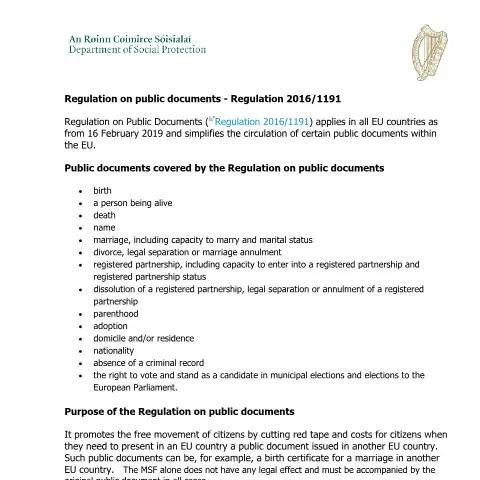
The inception of the MSF aligns with the Regulation on Public Documents (Regulation 2016/1191), effective from February 16, 2019. This regulation aims to reduce bureaucracy for EU citizens by allowing certain public documents to be presented across member states without the traditional hurdles. It covers vital documents such as:
- Birth certificates
- Marriage certificates
- Death certificates
- Criminal record verification
- Proof of residency
Under this regulation, the MSF acts as a translation aid for these documents, easing their acceptance in other EU nations. However, it’s important to note that the MSF does not replace the original document; rather, it complements it and provides the necessary translations to facilitate understanding.
Legal Significance of the MSF
The legal backing for the MSF stems from the desire to promote free movement among EU citizens. The regulation eliminates the requirement for an apostille—a validation stamp that was previously needed for authenticity. This means that Irish citizens can now present their official documents in any EU country without incurring additional costs or lengthy procedures associated with obtaining an apostille.
Understanding Who Needs the MSF: Tailoring to Different Profiles
Not everyone will require the MSF in the same manner. Understanding the specific profiles of users is crucial to navigating the processes smoothly. Here are some scenarios:
1. Individuals Moving Abroad for Work
If you're relocating for employment, you may need to present various documents, including your birth certificate and proof of residence. The MSF will assist in ensuring these documents are recognized by your new employer or local authorities.
2. Couples Planning to Marry in Another EU Country
Couples intending to marry abroad often face stringent documentation requirements. In this scenario, obtaining an MSF with your marriage certificate can prevent potential delays and ensure smooth processing in the foreign jurisdiction.
3. Citizens Seeking Residency or Citizenship
For those applying for residency or citizenship in another EU nation, comprehensive documentation is essential. The MSF simplifies the submission of required documents, thus facilitating a quicker transition.
4. Families with Multinational Ties
Families with members residing in different EU countries might need to undertake various legal procedures. The MSF helps ensure that documents concerning parenthood, marriage, and other family matters are readily acceptable across borders.
Completing the MSF: Steps for a Successful Application
Obtaining the Multilingual Standard Form (MSF) involves a straightforward process, but attention to detail is vital. Here’s how to navigate the application:
Step 1: Determine Eligibility
Before you can request an MSF, ascertain whether your documents are covered under the regulation. Only specific public documents qualify. Check if your birth, marriage, or death certificate is among them.
Step 2: Request the MSF during Certificate Application
The MSF must be requested contemporaneously with obtaining the original document at a Civil Registration Office. When applying for a birth, marriage, or death certificate, explicitly state your need for the MSF.
Step 3: Complete the Application Form
While the MSF itself does not have a standalone application form, ensure that you provide all necessary details on the application for the original document. This includes:
- Your name and contact information
- The details of the document you are applying for
- Any additional identifiers like your PPSN
Step 4: Submit Application and Await Processing
Once your application is submitted, it will be reviewed by the Civil Registration Office. Keep in mind that processing times may vary, so it’s prudent to apply well in advance of any deadlines you may have.
Potential Consequences: Rights and Obligations of Users
Understanding the implications of obtaining an MSF is essential for any citizen. Here’s a closer look at the rights and obligations tied to this document:
1. Rights Granted by the MSF
The MSF allows for:
- Recognition of your documents without the need for additional translations.
- Simplified bureaucratic processes when dealing with public authorities in other EU countries.
- Reduced costs associated with document authentication and translation services.
2. Obligations When Presenting Documents
While the MSF simplifies many processes, users must also uphold certain obligations:
- Ensure that the original document accompanies the MSF at all times.
- Provide accurate and truthful information in the original document application.
- Be aware that misrepresentation or falsified documents can have severe consequences, including legal action.
3. Repercussions of Non-Compliance
Failure to adhere to these obligations could lead to:
- Rejection of your documents by authorities in the receiving country.
- Pursuit of legal consequences arising from fraudulent documentation.
- Increased processing times due to the need for additional verification.
In Case of Issues: Addressing Refusals and Errors
Should you encounter challenges during your application process or once you've submitted documents abroad, knowing the next steps can alleviate stress. Here’s what to do:
Refusals and Rejections
If your MSF is rejected or your documents face issues upon presentation in another EU country, follow these steps:
- Contact the relevant authority in the country where you submitted your documents to understand the reasons for refusal.
- Gather any additional documents or evidence they may require to rectify the situation.
- Consider consulting legal advice if you believe the refusal was unjustified.
Addressing Errors in Documents
In cases where you discover errors within your original documents or the MSF itself, it is crucial to act promptly:
- Contact the Civil Registration Office in Ireland where you obtained the document.
- Request corrections and provide any necessary documentation that supports your claim.
- Be prepared for additional processing time as corrections are made.
Missing Documentation
If you find that you did not receive the MSF or the original document after application, it’s essential to:
- Reach out to the Civil Registration Office immediately to inquire about the status.
- Keep a record of your application details, including application date and any reference numbers.
- Consider following up regularly until the issue is resolved.
Exploring Additional Resources: Where to Find Help and Information
For individuals navigating the complexities of obtaining an MSF, various resources are available to assist you:
1. Official Government Websites
The Department of Social Protection provides comprehensive information regarding the MSF and its application process. Ensure that you check for updates regarding any potential changes in regulations or procedures.
2. EU Justice Portal
The EU Justice Portal offers guidelines and resources on the Regulation 2016/1191, including specifics about MSFs issued across different EU countries. This can provide clarity on what to expect when presenting documents abroad.
3. Local Civil Registration Offices
Engaging directly with your local Civil Registration Office can also provide tailored assistance. They can help clarify any doubts regarding document preparation and submission.
The Path Ahead: Embracing the Future of Document Mobility in the EU
As the world becomes increasingly interconnected, the need for robust systems facilitating cross-border document acceptance grows. The Multilingual Standard Form stands as a testament to the EU's commitment to easing the administrative burdens on its citizens. By understanding the significance and processes surrounding the MSF, individuals can fully leverage this tool to make their cross-border movements seamless and efficient.
Entering a new chapter in life, whether through work, marriage, or family matters, should be a time of excitement and anticipation—not a stressful venture through bureaucratic red tape. With the MSF, that journey becomes profoundly simpler, opening doors to new opportunities across the EU.
Understanding the Multilingual Standard Form (MSF)
The Multilingual Standard Form (MSF) is a document designed to facilitate communication between Irish authorities and non-English speakers. While English and Irish are the official languages of Ireland, the country has become increasingly multicultural, necessitating the need for documentation that can be understood by a diverse population. The MSF is essential for ensuring that everyone, regardless of their primary language, has access to vital information and services without facing language barriers.
The MSF serves several key purposes, such as enabling access to public services, ensuring compliance with legal requirements, and promoting inclusivity within communities. By providing essential forms in multiple languages, Irish public authorities are making significant strides in accommodating the needs of all residents, particularly those whose first language is not English. This form is particularly useful for immigrants, temporary workers, and international students who may require assistance when interacting with various government bodies.
It is essential to comprehend the different contexts in which the MSF is utilized. For instance, the MSF can be crucial when applying for a Personal Public Service Number (PPSN), enrolling in the healthcare system, or when engaging with institutions like the Department of Social Protection or Revenue. With the MSF, non-English speakers can navigate these processes with greater ease, ensuring that they can access the support and resources they need. Moreover, this approach fosters a sense of belonging and inclusion, reinforcing Ireland’s commitment to diversity and multiculturalism.
How to Access and Use the Multilingual Standard Form (MSF)
Accessing the Multilingual Standard Form is a straightforward process. The MSF is typically available on government websites, such as the official websites of the Department of Social Protection or Revenue, where it can be downloaded or filled out online. It's important to note that the availability of the form in multiple languages can vary depending on the specific service or department; however, efforts are being made to ensure that the most commonly spoken languages in Ireland are represented.
When using the MSF, it is crucial to follow these steps:
- Identify the Relevant Form: Determine which specific government service you need to access and find the corresponding MSF. For instance, if you are applying for housing assistance, look for the MSF associated with that service.
- Fill Out the Form Accurately: Complete the form carefully, ensuring that all required fields are filled in according to the instructions provided. If you need assistance with translation or understanding the form, consider seeking help from community organizations or support groups that cater to non-English speakers.
- Submit the Form: Follow the submission guidelines provided for your specific department. This may involve online submission, mailing the form, or submitting it in person at designated offices.
- Keep Copies for Your Records: Always retain copies of the submitted forms and any documentation you provide. This will help in case of any inquiries or issues that may arise later in the process.
It is also worth noting that while the MSF aims to simplify processes for non-English speakers, understanding the nuances of the Irish administrative system is still essential. Familiarizing yourself with terms and requirements specific to your situation can significantly enhance the experience.
Challenges and Considerations for the Multilingual Standard Form (MSF)
While the introduction of the Multilingual Standard Form marks a significant step toward inclusivity, there are challenges and considerations that both authorities and users must bear in mind. One major challenge is the quality and accuracy of translations. Misinterpretations due to poor translations can lead to confusion during application processes, which may ultimately affect the outcome. Thus, authorities must ensure that translation services are professional and accurate to maintain clarity and understanding.
Another consideration is the ongoing need for public awareness regarding the availability and use of the MSF. Many non-English speakers may not be aware that these resources exist, or they may lack the necessary information on how to access them. To address this, local councils and community organizations play a vital role in disseminating information and providing support to individuals who may benefit from the MSF.
Additionally, there are administrative implications for the governmental bodies that implement the MSF. Authorities must continuously evaluate the effectiveness of the form in practice, gathering feedback from users to improve both the form itself and the processes associated with it. This can involve assessing the most commonly sought-after services and ensuring that the MSF is available in the languages that are most relevant to the local population.
In conclusion, while the Multilingual Standard Form is a positive development for enhancing communication and accessibility within Irish administrative processes, it is essential to address the challenges it presents. Continuous improvement and community engagement will ensure that the MSF fulfills its purpose in supporting a more inclusive Ireland.