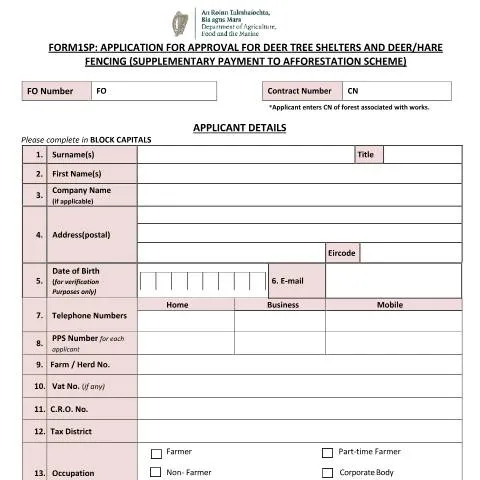
Navigating the Deer Tree Shelter and Fencing Scheme: A Comprehensive Guide to FORM1
As Ireland continues to advance its afforestation initiatives, the Deer Tree Shelter, Hare and Deer Fencing Scheme represents a vital component for landowners and farmers wishing to safeguard their forestry investments. This scheme encourages the sustainable management and enhancement of woodlands by providing financial assistance for the establishment of protective measures. Central to this process is FORM1, the official document required for approval under this scheme. Understanding its nuances is essential for applicants to successfully navigate the application process.
The Allure of Afforestation: Why FORM1 Matters
With environmental concerns on the rise, afforestation plays a pivotal role in combating climate change, enhancing biodiversity, and improving rural landscapes. However, to fully leverage the financial benefits and protections provided by the Deer Tree Shelter and Fencing Scheme, it is crucial for applicants to fill out FORM1 accurately. The form not only initiates the application for financial assistance but also ensures compliance with regulations that govern this sector.
What Lies Ahead: The Application Process
Once you’ve decided to embark on the afforestation journey, filling out FORM1 is your gateway to funding approval. The process can be broken down into several key stages:
- Preparation: Gather all necessary documentation, such as maps of the proposed site and previous forestry contracts.
- Completion of FORM1: Provide accurate information regarding personal details, site location, and proposed fencing measures.
- Submission: Submit the completed FORM1 to the Department of Agriculture, Food and the Marine through one of the allowed channels, be it online, by post, or in person.
- Waiting for Approval: Post-submission, applicants must wait for written approval before commencing any work related to the scheme.
Understanding the Intricacies of FORM1
For those unfamiliar with the Irish agricultural system, FORM1 might appear daunting. However, breaking it down into manageable sections can help clarify its purpose. The form comprises several key sections:
- Applicant Details: Fill in personal and business-related information, including your PPS Number, which serves as your primary identifier in Irish bureaucracy.
- Site Location: Specify the county, townland, and area of the proposed site using Eircode for precise location identification.
- Ownership and Use: Detail the ownership status of the lands you wish to develop, including consent from any co-owners or partners.
- Project Details: Describe the specifics of the deer tree shelters and fencing you plan to install, including area measurements and materials.
The Importance of Accuracy
Errors or omissions in FORM1 can lead to delays or even rejections. It’s crucial to double-check the following:
- Correct spelling of names and addresses
- Accurate Eircode and postal details
- Consistent information across related documents, especially concerning land ownership
Submission Pathways: Decoding the Channels
Applicants have multiple options for submitting FORM1, each with its own conveniences and drawbacks. Here's a detailed overview:
| Submission Method | Pros | Cons |
|---|---|---|
| Online via MyGovID | Fast processing; secure; direct access to additional resources | Requires prior registration and digital ID |
| Postal Submission | Allows for physical records; no tech requirements | Longer processing time; risk of lost mail |
| In-person at Local Office | Immediate feedback; personal assistance available | Time-consuming; limited office hours |
What Happens After Submission? Tracking Your Application
Once you’ve submitted FORM1, the subsequent steps involve:
- Review Process: The Department will review your application for completeness and correctness.
- Site Inspection: Depending on your application, a site visit may be scheduled to evaluate the proposed project.
- Approval Notification: You’ll receive written confirmation of approval or rejection. If approved, this document is essential for claiming any associated funding.
Understanding the Timeline
The processing time for FORM1 can vary based on several factors, including the volume of applications received and the complexity of your submission. While no definitive timeline is published, applicants are encouraged to allow several weeks for processing, particularly during peak application periods.
The Regulatory Framework: Underpinning FORM1’s Importance
Understanding the legal landscape surrounding the Deer Tree Shelter and Fencing Scheme is pivotal for applicants. The Constitution of Ireland and various sector-specific regulations, including the Taxes Consolidation Act 1997, lay the groundwork for these initiatives. These regulations not only govern the implementation of forestry projects but also outline the obligations of landowners and the Department.
EU Regulations and National Compliance
As part of the EU’s commitment to sustainable agriculture and forestry, the guidelines set forth by the European Union play an essential role in shaping the Deer Tree Shelter scheme. Compliance with these standards is mandatory, thereby making FORM1 a critical document for accountability within this framework.
Addressing Unique Situations: Special Cases with FORM1
Not all applications are straightforward. Several unique circumstances may affect your submission:
- Foreign Applicants: Non-Irish nationals wishing to apply must ensure they have a valid PPS Number and comply with all Irish regulations.
- Minors or Dependents: If the applicant is under eighteen, a guardian must complete the form, ensuring all legal requirements are met.
- Complex Ownership Structures: For partnerships or joint management arrangements, clear consent and documentation from all parties involved are essential.
- Urgent Needs: In cases of emergency, such as imminent damage to existing forestry, applicants may request expedited processing. However, justification must be provided.
Documentation for Special Cases
Additional documentation may be required depending on your situation, including:
- Proof of identity (passport, driver's license)
- Partnership agreements or joint ownership documentation
- Evidence of need for urgent processing (e.g., photographs, reports from experts)
Final Thoughts on Navigating FORM1 in the Deer Tree Shelter Scheme
Utilizing FORM1 effectively can lead to significant benefits for landowners and farmers committed to sustainable forestry practices in Ireland. While the process may initially seem overwhelming, being thorough and diligent in your application can pave the way for financial support and successful project implementation.
Ultimately, engaging with the Department of Agriculture, Food and the Marine, leveraging their resources, and maintaining compliance will enhance your chances of success in this vital initiative. With the right preparation and understanding, you can contribute to Ireland's afforestation efforts while protecting your lands and investments.
Understanding the Deer Tree Shelter and Hare and Deer Fencing Scheme
The Deer Tree Shelter and Hare and Deer Fencing Scheme is a vital initiative implemented by the Department of Agriculture, Food and the Marine (DAFM) in Ireland. The primary objective of this scheme is to mitigate the negative impacts of deer and hare on forestry and agricultural crops. This programme supports landowners and farmers by providing financial assistance for the establishment of protective fencing and the planting of deer tree shelters, which are essential for the successful growth of young trees and crops.
Under this scheme, participants can apply for funding to cover the costs of constructing robust fencing systems designed to deter deer and hare from accessing sensitive areas. In addition, funding is available for the planting of tree shelters that provide a protective environment for young saplings, enhancing their chances of survival and growth. The scheme is particularly relevant in regions where deer populations are high and pose a significant threat to sustainable land management practices.
To effectively engage in this scheme, applicants must familiarize themselves with its eligibility criteria. These include the ownership of agricultural or forestry land, adherence to good farming practices, and compliance with environmental regulations. Landowners should also consider the long-term maintenance of fencing and tree shelters, as these structures require ongoing care to remain effective.
Application Process for Form 1 of the Scheme
Applying for the Deer Tree Shelter and Hare and Deer Fencing Scheme involves a systematic approach that ensures all necessary documentation and compliance measures are met. Form 1 is the essential application form that initiates the process. It is essential for applicants to accurately fill out this form, as incomplete or incorrect submissions can lead to delays or rejection of the application.
Firstly, applicants should gather all required information, including details about their land, the intended area for fencing and tree shelters, and their farming or forestry practices. It is recommended to prepare a map indicating the proposed locations, which will help streamline the application process. The form also requires the applicant's Personal Public Service Number (PPSN) and relevant details about their MyGovID or Revenue Online Service (ROS) access, as this facilitates faster processing of the application.
Once Form 1 is completed, applicants should submit it to their local DAFM office. It is advisable to keep a copy of the submitted form for personal records. The review process typically includes an assessment of the proposed plans, and applicants may be required to undergo a site visit from DAFM representatives to evaluate the project’s feasibility and compliance with the scheme’s guidelines.
Funding and Financial Assistance Details
The financial assistance available under the Deer Tree Shelter and Hare and Deer Fencing Scheme can significantly alleviate the burden of fencing and shelter establishment costs for landowners. Funding is designed to cover a substantial proportion of the eligible expenses associated with the project. This includes the cost of materials, labour, and, in some cases, maintenance for an initial period.
It is important to note that funding levels can vary based on specific circumstances such as project scale, geographical location, and existing land conditions. The scheme typically implements a co-funding model, where applicants are expected to contribute a certain percentage of the total project costs. Understanding this model is crucial for applicants to accurately budget for their projects.
Additionally, successful applicants must adhere to strict guidelines on expenditure. Receipts and invoices need to be meticulously maintained and submitted for reimbursement. As part of the funding stipulations, any deviation from the agreed plan may result in a reduction or loss of funding, which underscores the importance of careful planning and adherence to the project outline approved by the DAFM.
Landowners are also encouraged to consider the long-term benefits of participating in the scheme. Beyond the immediate financial assistance, the establishment of proper fencing and tree shelters can lead to enhanced biodiversity, improved crop yield, and a more sustainable farming practice. Consequently, the initial investment can lead to future financial savings and ecological rewards.