Navigating the Deer Tree Shelter and Hare and Deer Fencing Scheme
The Deer Tree Shelter, Hare and Deer Fencing Scheme — Form 2 serves a pivotal role in Ireland's forestry management landscape. This official document is integral to landowners who seek financial assistance for establishing protective measures against deer and hare damage in their afforested areas. Successfully completing and submitting this form can lead to significant financial support, thus facilitating sustainable forestry practices. The importance of understanding its sections, requirements, and the overall submission process cannot be overstated, especially for those who are directly involved in maintaining Ireland’s natural resources.
Decoding Form 2: Key Sections and Their Significance
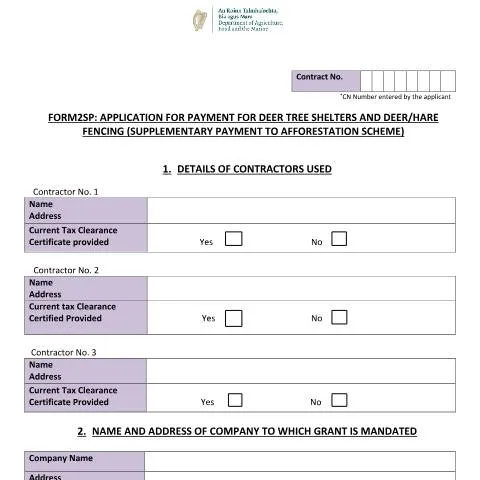
Form 2 comprises several sections, each designed to gather essential information about your project and the resources utilized. Here's a breakdown of the crucial components:
Contractor Information
Beginning with the section titled Details of Contractors Used, you are required to provide information about the contractors who executed the fencing and tree shelter works:
- Include the Name and Address of each contractor.
- Confirm whether a Current Tax Clearance Certificate has been provided.
Each contractor must be listed separately, promoting transparency and ensuring compliance with tax regulations. Failure to provide this information accurately may delay the processing of your application.
Applicant Information
In the For Completion by Applicant section, you must indicate the date when your works were completed and whether you are registered for VAT. This information is vital as it confirms your business status and compliance with tax obligations.
Declarations and Supporting Documents
The Applicant Declaration and Undertaking section demands your commitment to the correctness of your application. Essential supporting documents include:
- Location Map
- Certified Species Map
- Fencing/Tree Shelter Map
- Invoices for all direct costs incurred
- Current Tax Clearance Certificates for all contractors
- A valid mandate, if applicable
Every document listed must be carefully prepared and attached. This not only legitimizes your claim but also expedites the evaluation process.
Understanding the Broader Context: The Regulatory Framework
The Deer Tree Shelter and Hare and Deer Fencing Scheme is anchored in Ireland’s commitment to sustainable agriculture and forestry management. Its foundation lies in various acts, including the Forestry Act 2014 and directives from the Department of Agriculture, Food and the Marine. These regulations ensure that financial support is delivered in a manner that aligns with ecological and community goals.
Moreover, this scheme falls under the broader European Union guidelines for state aid, specifically those applicable from 2023 to 2027. This alignment with EU regulations ensures that funds are allocated efficiently, while also promoting accountability and transparency.
What Happens After Submission? Processing Your Application
Upon submission of Form 2, your application will undergo a rigorous review process conducted by the Department of Agriculture, Food and the Marine. Understanding this process can alleviate uncertainty regarding timelines and expectations.
Review and Processing Timeline
Typically, applications are assessed based on:
- Completeness of the application (all sections filled, supporting documents attached).
- Compliance with the scheme’s regulations and standards.
The processing time may vary, but applicants can generally expect to receive feedback within a month after submission. During this period, it is prudent to keep track of the application status. Regular follow-ups can be conducted via the contact details provided by the Department.
In Case of Issues: Refusals and Appeals
If your application encounters issues, such as incomplete documentation or non-compliance with regulations, you’ll be notified in writing. In such cases, it’s crucial to address the identified problems promptly.
- Review the feedback provided by the Department carefully.
- Gather any additional documentation or clarifications needed.
- Resubmit your application, addressing all concerns.
If your application is refused, you have the right to appeal the decision. The appeal process must be initiated within a specific timeframe, typically outlined in the correspondence from the Department. It is advisable to seek assistance or advice from local agricultural advisors when navigating this process.
Preparing Justifications: Essential Documentation
Document preparation is a critical step in ensuring your application is successful. Each type of supporting document must adhere to specific requirements:
Maps and Visual Documentation
- Location Map: Clearly identify the afforested area and ensure all boundaries are precisely marked.
- Certified Species Map: This should illustrate the species planted and demonstrate the ecological plan.
- Fencing/Tree Shelter Map: This visual should indicate the extent of fencing and shelter deployed.
Invoices and Tax Certificates
Invoices must detail all costs incurred during the project:
- Ensure they are addressed to the applicant and contain relevant tax information.
- Current Tax Clearance Certificates for all contractors are mandatory. Ensure these are up to date to avoid delays.
Target Profiles: Who Can Apply?
The Deer Tree Shelter and Hare and Deer Fencing Scheme is designed for various stakeholders in the forestry industry, including:
Private Forest Owners
Individuals or companies that own private forest land are eligible to apply. They must demonstrate a commitment to sustainable forestry management practices.
Community Groups
Local community groups engaged in forestry initiatives may also benefit from this scheme, especially if they contribute to maintaining biodiversity and local ecosystems.
Exceptions and Special Cases
While the scheme is inclusive, there are specific conditions that may affect eligibility:
- Land must meet certain ecological criteria.
- Applicants who have previously received funding from other EU schemes for the same project area may not be eligible for additional support.
Final Considerations: Long-Term Commitments and Responsibilities
When applying for this scheme, it’s crucial to understand your long-term obligations. The Applicant Declaration and Undertaking section outlines critical commitments:
- Maintaining the plantation for a minimum of 20 years.
- Following all management instructions provided by the Department.
- Notifying the Department of any ownership changes or if you intend to sell the plantation.
These commitments are not merely formalities; they ensure the sustainability of the investment made through the scheme and contribute to broader environmental goals.
Ultimately, the Deer Tree Shelter and Hare and Deer Fencing Scheme — Form 2 plays an essential role in promoting sustainable forestry practices in Ireland. Understanding its structure, requirements, and the obligations it entails is key for all applicants. Through diligence and compliance, stakeholders can secure vital funding and contribute to the ecological health and sustainability of Ireland’s forests.
Understanding the Deer Tree Shelter and Hare and Deer Fencing Scheme
The Deer Tree Shelter, Hare and Deer Fencing Scheme is an initiative designed to support landowners in protecting their forestry and agricultural lands from damage caused by deer and hares. Through this scheme, participants can apply for financial assistance to establish effective fencing solutions and tree shelters, which are critical in promoting sustainable land management practices. The scheme not only aims to protect crops and young trees but also contributes to the overall biodiversity of the area, supporting ecological balance.
To be eligible, applicants must demonstrate how their projects align with sustainable agricultural practices and biodiversity enhancement. The scheme is administered by the Department of Agriculture, Food and the Marine, which outlines specific criteria for participation. This includes the requirement of proper planning and consideration of local wildlife habitats, ensuring that tree shelters and fencing do not impede the natural movement of native fauna.
Application Process for the Scheme
The application process for the Deer Tree Shelter, Hare and Deer Fencing Scheme involves several crucial steps that must be adhered to for a successful submission. First and foremost, potential applicants should access and complete the designated form, commonly known as Form 2. This form requires detailed information regarding the project's scope, including the size of the area to be fenced, the type of deer being managed, and the specific tree species under protection.
Next, it is essential to prepare a project plan that outlines the methodology for the fencing installation and tree shelter establishment. This plan should include timelines, material specifications, and anticipated ecological benefits, reinforcing the project's alignment with national environmental standards. Once the form and project plan are complete, applicants must submit them to their local Department of Agriculture office before the specified deadline, which typically aligns with the funding cycle established by the department.
After submission, applications undergo a review process, where officials assess eligibility based on criteria such as project feasibility, ecological impact, and compliance with existing agricultural regulations. If approved, participants will receive funding, which can cover up to a specified percentage of the total project costs, subject to limits outlined by the department.
Comparative Analysis of Fencing Options and Their Benefits
When considering participation in the Deer Tree Shelter and Hare and Deer Fencing Scheme, applicants may weigh various fencing options to determine the best approach for their properties. Common fencing types include electric fencing, stock fencing, and deer fencing, each possessing unique advantages and suitability depending on the site conditions.
Electric fencing is often viewed as a cost-effective option due to its flexibility and ease of installation. However, it requires regular maintenance and can be less visually appealing. Stock fencing, while effective for containing livestock, may not provide an adequate barrier against determined deer, necessitating supplementary measures.
On the other hand, deer fencing is specifically designed to withstand the challenges posed by deer, ensuring a robust and durable solution. Typically constructed from taller panels to prevent jumping and designed to be sturdy against pushing, this option can yield the best long-term protection for young trees and crops. While initial installation costs may be higher, the benefits in terms of crop yield and reduced damage can far outweigh these expenditures in the long run.
Furthermore, incorporating tree shelters in conjunction with fencing can optimize protection. Tree shelters, made from durable materials like polypropylene or biodegradable alternatives, serve to create a microhabitat for young plants, enhancing their chances of survival against browsing pressure. This dual approach not only secures the financial viability of agricultural operations but also contributes to ecological sustainability by promoting forest growth and habitat diversity.