Understanding the Appeal Decision on Sea Fishing Boat Licensing in Ireland
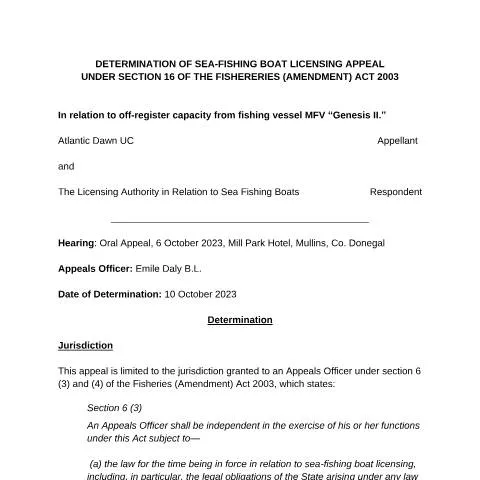
The Department of Agriculture, Food and the Marine has issued a formal determination concerning an appeal related to sea fishing boat licensing, specifically involving the vessel MFV “Genesis II.” This decision, made by Appeals Officer Emile Daly BL, provides clarity on the application of licensing regulations and the consequences of capacity removal and re-registration within Irish fisheries law.
Context and Legal Framework
The appeal is grounded in the provisions of the Fisheries (Amendment) Act 2003, notably under section 16, which empowers an independent Appeals Officer to adjudicate disputes related to sea-fishing boat licensing. The decision emphasizes the importance of compliance with both national legislation and European Union (EU) regulations, reflecting Ireland’s obligations under international agreements and EU directives.
Specifically, the case pertains to the application of Policy Directive 2 of 2003, which states that capacity removed from the Fishing Register must be reintroduced within two years, or it will be forfeited. This policy aims to promote sustainable fishing practices by preventing the indefinite off-register removal of capacity, thereby encouraging timely re-registration.
Details of the Dispute
The core issue involved the removal of 1,107 gross tonnage (GT) of capacity from the vessel MFV “Genesis II” on 7 October 2020. The owner, Atlantic Dawn UC, intended to re-register this capacity before the deadline of 7 October 2022, in accordance with the two-year rule. However, complications arose due to the timing of the vessel’s safety certification.
On the same day as the removal, the respondent—the Licensing Authority—received a license application for the vessel MFV “Lauren,” which required the capacity to be reintroduced. The re-registration was contingent upon two conditions: first, that the capacity be re-registered on 7 October 2020; and second, that a Certificate of Compliance issued by the Marine Survey Office (MSO) certifying the vessel’s safety was provided.
While the applicant submitted the application and indicated that the certificate would be issued shortly, the certificate was only received on 10 October 2022—after the capacity had already expired on 7 October 2022. Despite the MSO confirming that the survey had been completed in June 2022 and that there was no reason the certificate could not be issued on the expiry date, the delay meant the capacity could not be re-registered within the two-year window.
Key Findings of the Determination
The Appeals Officer’s decision underscores that the two-year “use it or lose it” rule is strictly applied, and the capacity cannot be reintroduced retrospectively. The authority emphasized that, although the delay in issuing the Certificate of Compliance was minimal and beyond the owner’s control, the capacity was lost because the certificate was not presented on the expiry date.
The decision clarifies that the licensing authority has no discretion to extend the two-year period once the deadline has passed, even if the delay is due to administrative or procedural reasons outside the owner’s influence. The capacity associated with the vessel MFV “Genesis II” was therefore forfeited in accordance with the policy directive.
Implications for Fishery Stakeholders
This determination highlights the importance for vessel owners and operators to ensure timely compliance with certification and licensing requirements. It illustrates that delays, even minor ones, can have significant legal and operational consequences, especially under the strict application of the two-year re-registration rule.
Stakeholders involved in Irish sea-fishing licensing should be aware that adherence to deadlines is crucial, and proactive planning for certification processes can prevent the loss of valuable fishing capacity. The decision also reaffirms the role of the Department of Agriculture, Food and the Marine in enforcing sustainable fishing practices through clear regulatory standards.
Conclusion
The case of the MFV “Genesis II” serves as a reminder of the procedural rigor associated with Irish fisheries law. While administrative delays are acknowledged, the legal framework prioritizes timely re-registration of capacity to support sustainable and responsible fishing. Fishery operators should maintain close communication with licensing authorities and survey offices to ensure compliance and avoid unintended forfeitures of fishing rights.