Understanding the Irish Geographical Indications Spirit Drinks Label Assessment Application Form
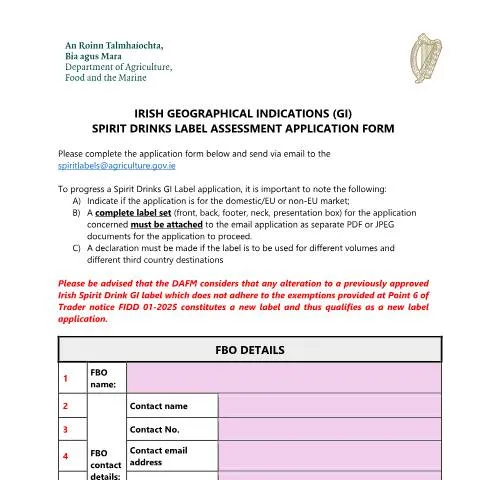
For businesses looking to market their spirit drinks in Ireland, compliance with the Geographical Indications (GI) regulations is essential. The Geographical Indications - Spirit Drinks label assessment application form plays a critical role in ensuring that products adhere to the necessary standards. This document is not just an administrative hurdle; it’s a gateway to maintaining the integrity and reputation of Irish spirits.
The Significance of Geographical Indications in Irish Spirits
Geographical indications serve as a mark of quality and authenticity, signifying that a product possesses certain qualities or enjoys a certain reputation due to its geographical origin. In the realm of Irish spirits, this means that consumers can trust that what they are purchasing is genuinely produced within the designated areas of Ireland, adhering to specific criteria.
The Irish GI label assessment form is designed specifically for spirit drinks, which include Irish whiskey, poitín, and Irish cream liqueurs. Each of these categories has its own unique characteristics and legal definitions, which are crucial for maintaining the high standards associated with Irish spirits.
Who is Eligible to Submit the Application?
Submissions of the GI spirit drink label assessment application form are primarily the responsibility of Food Business Operators (FBOs). These individuals or entities must hold the necessary rights to the product and must ensure that they comply with the relevant regulations. The form requires detailed information about the producer, the product itself, and its intended market.
Key Responsibilities of Food Business Operators:
- Accurate disclosure of product details including brand name, alcohol by volume (ABV), and relevant production processes.
- Submission of a complete set of labels as separate PDF or JPEG documents.
- Adhering to regional and international market regulations based on the product's destination.
Diving into the Application Form: Sections to Complete
The application form is divided into several sections, each designed to capture specific data that the Department of Agriculture, Food and the Marine (DAFM) requires to assess the label accurately.
Section Breakdown
| Section | Description |
|---|---|
| FBO Details | Includes the name and contact information of the Food Business Operator. |
| Product Details | Specifies the type of spirit drink, brand name, and any previous label assessments. |
| Production Details | Indicates the GI verified premises for distillation, maturation, and bottling processes. |
| Intended Marketplace | Identifies whether the product is for the domestic, EU, or non-EU markets. |
| FBO Declaration | A declaration confirming the accuracy of the information provided and compliance with GI regulations. |
Completing and Submitting the Application
Completing the application form requires attention to detail and adherence to the guidelines set forth by the DAFM. Failure to complete any section correctly can lead to delays or even rejection of the application.
What to Include in Your Submission
- A completed application form, ensuring all sections are filled accurately.
- A complete label set: front, back, footer, neck, and any additional packaging details.
- Declarations related to the product’s market and compliance with GI standards.
Once the form is completed, it should be submitted via email to [email protected]. Be sure to attach all required documents in the specified format.
What Happens After Submission?
Upon submission, the DAFM will review the application to ensure that all information complies with the relevant regulations. Here are the potential outcomes:
Possible Outcomes of the Application Review
- Approval: If the application meets all criteria, the label will be approved for use in the specified markets.
- Request for Further Information: The DAFM may reach out for additional details or clarifications.
- Rejection: If the application does not comply with the requirements, it may be rejected.
Monitoring Your Application Status
After submission, FBOs are encouraged to maintain communication with the DAFM. This can be done via email or telephone to ensure timely updates on the application's status.
Common Pitfalls to Avoid
Filling out the form may seem straightforward, but there are nuances that can trip up applicants. Here are some critical areas to focus on:
Specific Areas of Concern
- Label Completeness: Ensure all components of the label set are included.
- Market Clarity: Clearly indicate whether the product is aimed at the domestic/EU or non-EU markets.
- Declaration Accuracy: The FBO Declaration must genuinely reflect the product's compliance and not misrepresent any details.
In Case of Rejection or Missing Information
If the application is rejected or if there is a request for additional information, it is crucial to understand the next steps. The DAFM will provide a clear explanation of the reasons for rejection, which can include:
- Insufficient documentation.
- Failure to comply with GI regulations.
- Errors in the application form.
Steps to Rectify the Situation
- Review the feedback provided by the DAFM carefully.
- Gather the necessary documentation to address the concerns raised.
- Resubmit the application or the required documents promptly.
What to Do When Altering Approved Labels
It’s vital to understand that any alterations to previously approved labels are treated as new applications. The DAFM outlines specific exemptions under Point 6 of Trader notice FIDD 01-2025; however, alterations outside these exemptions necessitate a new submission. This can be crucial for businesses looking to adapt their products for different markets or in response to consumer preferences.
When are Changes Considered Minor?
- Changes that do not alter the product’s nature or geographical origin.
- Updates that comply with existing legal requirements without changing the label's essential characteristics.
In such cases, consulting with the DAFM ahead of time can provide clarity on whether the planned changes fall within acceptable limits.
Special Circumstances: Considerations for Non-Residents and Minors
For non-residents or those operating from outside Ireland, there are additional considerations when submitting the application. This includes understanding the local legal framework for importing products into the EU and navigating the complexities of international trade.
Additional Guidance for International FBOs
- Familiarize yourself with the Irish import regulations and GI requirements.
- Consider legal representation or consultation with a trade expert in Ireland.
For minors or individuals operating as part of a youth enterprise, restrictions may apply regarding responsible alcohol marketing and sales. In such cases, ensure compliance with both local laws and international trade agreements.
Engaging with the DAFM: Building a Productive Relationship
Effective communication with the DAFM can significantly streamline the application process. Engaging with officials can provide insights into best practices for application submissions and updates on evolving regulations.
Practical Tips for Successful Engagement
- Keep a record of all communications, including emails and discussion notes.
- Prepare specific questions or concerns prior to contacting the department.
- Request meetings or consultations if you foresee complexities in your application.
By fostering a good relationship with regulatory authorities, businesses can navigate the bureaucratic landscape more effectively, ensuring that their products can reach consumers while upholding the esteemed reputation of Irish spirit drinks.
Understanding Geographical Indications (GIs) for Irish Spirit Drinks
Geographical Indications (GIs) represent a pivotal aspect of food quality and authenticity, especially in the spirits sector. In Ireland, GIs are used to designate products that possess certain qualities or a reputation attributable to their geographical origin. These can include specific attributes derived from the location, such as traditional production methods or unique environmental conditions. For spirit drinks, this means that a drink can leverage its connection to a geographical area to enhance its marketability and authenticity.
In Ireland, the Department of Agriculture, Food and the Marine (DAFM) oversees the registration and protection of GIs for spirit drinks. The process for obtaining a GI is multifaceted and involves thorough documentation that showcases how the spirit adheres to the established guidelines. This encompasses everything from the ingredients used and production methods to how it is marketed. The assessment of these applications is rigorous, as it ensures that only authentic products receive the GI label, thus protecting both consumers and producers.
Examples of successful Irish spirit drinks with GIs include Irish Whiskey and Irish Cream Liqueur. Each of these products has specific criteria that must be met, emphasizing the importance of adhering to traditional practices and the geographical links that enhance their quality.
The Application Process: Step-by-Step Guide
The application for a Geographical Indication for spirit drinks is streamlined yet detailed. Here’s a step-by-step breakdown of the key components involved in the application process:
- Preparation of the Technical File: The first step involves compiling a comprehensive technical file, which serves as the backbone of the application. This file must include detailed information about the production process, the geographical area, and the specific qualities of the spirit drink that are attributable to that area. It should also outline the methods of production, raw materials, and any traditional practices that are relevant.
- Consultation with Stakeholders: Engaging with local producers and stakeholders is crucial. It ensures that there is a consensus regarding the characteristics and qualities of the spirit that will be associated with the GI. This collaboration can enhance the application’s credibility and foster community support.
- Submission of the Application: Once the technical file is prepared and stakeholder consultation is complete, the next step is to submit the application to the DAFM. The application must be accompanied by a completed assessment form, known specifically for spirit drinks.
- Assessment Phase: After submission, the DAFM conducts a thorough assessment of the application. This includes verifying the authenticity of the claims made in the technical file, ensuring that all criteria are met, and possibly conducting on-site inspections of the production facilities.
- Publication of the Application: If the application is approved, it is published for a period during which third parties may raise objections. This transparency is essential in maintaining the integrity of the GI system.
- Final Decision: Following the objection period, a final decision is made. If approved, the GI is registered, and the spirit drink can then be marketed as such, lending it significant value in both domestic and international markets.
Throughout this process, it is crucial for producers to maintain accurate records and ensure compliance with all legal requirements stipulated under the applicable Irish regulations and the European Union regulations on GIs.
Market Implications and Consumer Awareness
The introduction of Geographical Indications in the spirits market in Ireland has profound implications for both producers and consumers. For producers, a GI label can significantly enhance the marketability of their products. It not only distinguishes their offerings from others but also provides a guarantee of quality and authenticity. This distinction can be particularly beneficial in highly competitive markets, where consumers are increasingly interested in the provenance of their products.
Moreover, the GI label aids in the preservation of local traditions and practices, as producers are encouraged to adhere to traditional methods to maintain their designation. This, in turn, fosters a sense of pride and identity within local communities, as they can share their heritage through their products.
For consumers, understanding the significance of a GI label adds value to their purchasing decisions. It assures them that they are buying a product that is authentic and has been produced in accordance with specific standards which are closely tied to its geographical origin. As the global market continues to evolve, consumer awareness and education around GIs will become increasingly important, driving a demand for authentic products and supporting local economies.
To further aid in this transition, marketing campaigns and educational programs can play a pivotal role in informing both producers and consumers about the value and significance of GIs. This can help bolster the reputation of Irish spirits worldwide and ensure that the unique qualities associated with these products are preserved for future generations.