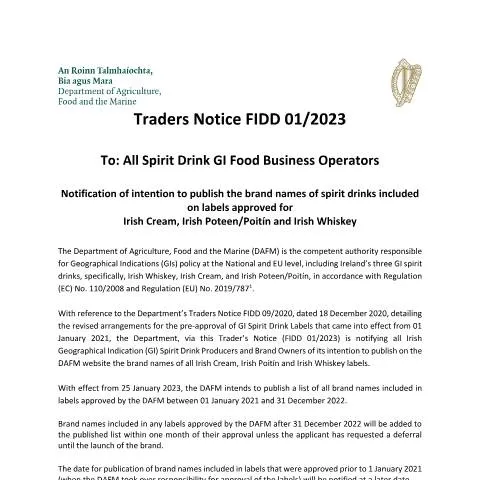
Navigating the Geographical Indications for Irish Spirits
The world of spirit drinks is deeply intertwined with national heritage, especially in Ireland where brands like Irish Cream and Irish Poteen/Poitín hold significant cultural value. For producers and brand owners, understanding the administrative requirements surrounding Geographical Indications (GIs) is essential. One vital document in this context is the notification regarding the intention to publish brand names of these spirit drinks as issued by the Department of Agriculture, Food and the Marine (DAFM).
The Importance of Brand Name Publication
On 13 January 2023, the DAFM announced its intention to publish a list of brand names associated with Irish Cream, Irish Poteen/Poitín, and Irish Whiskey, which had been approved between 01 January 2021 and 31 December 2022. This publication is significant for several reasons:
- Transparency: It ensures that consumers can access accurate information regarding the brands behind these traditional products.
- Protection: It aids in the protection of authentic products against counterfeiting, preserving the integrity of Irish spirit drinks.
- Brand Recognition: For producers, being listed helps to build brand recognition and consumer trust.
Who Needs to Act?
This notification primarily impacts all Spirit Drink GI Food Business Operators involved in the production of Irish spirits. Whether you are a small distillery or a large brand owner, understanding your obligations and rights concerning the publication is crucial.
Specifically, you should take action if you:
- Have had labels approved for your spirit drinks within the specified timeframe.
- Are planning to launch new brands or products in the near future.
Understanding the Submission Process
To ensure that your brand name is published, you must comply with the established procedures set forth by the DAFM. The process involves:
- Label Approval: First, ensure that your product labels comply with Regulation (EC) No. 110/2008 and Regulation (EU) No. 2019/787. This encompasses the definition, description, and labelling of spirit drinks.
- Notification: Once your label has been approved, you will receive notification from DAFM regarding the publication of your brand name.
- Deferrals: If you wish to defer the publication until your product launch, you must explicitly request this during the approval process.
What Happens Next?
After the publication on the DAFM website, the implications for your brand can be substantial. The publication list will be updated regularly, reflecting new approvals and any deferrals requested. Observing this process is essential for:
- Keeping Up-to-Date: Staying informed about competitor brands and market dynamics.
- Consumer Engagement: Engaging with consumers who may seek to verify the authenticity of your products.
If your label was approved after 31 December 2022, it will be added to the public list within one month of approval, provided no deferral has been requested. For labels approved prior to this date, an announcement regarding their publication will be made in due course.
Channels for Submission and Inquiry
The DAFM facilitates multiple channels for submitting inquiries regarding the publication process. You can reach out via:
- Email: [email protected] - Ideal for sending queries and receiving guidance.
- Official Website: Regular updates and information are posted on the DAFM website, offering resources for producers.
For physical submissions or consultations, visiting the DAFM offices can provide direct access to administrative support.
Consequences of Non-Compliance
Failing to adhere to the publication and notification processes can result in various repercussions for producers:
- Loss of Recognition: If your brand name is not published, it may be perceived as less credible, affecting consumer trust.
- Legal Implications: Non-compliance with the regulations may expose you to legal challenges, especially concerning trademark rights.
It's imperative to manage your submissions carefully and follow the DAFM guidelines to avoid these pitfalls.
The Way Forward: Embracing Geographical Indications
The DAFM announcement highlights the increasing significance of GIs in the global market. For Irish spirit drinks, this is an opportunity to leverage Irish heritage in branding. By understanding the administrative framework, producers can not only protect their products but also enhance their market positioning.
As a producer in this domain, staying proactive about your submissions and leveraging the information provided by the DAFM will empower your brand’s growth and authenticity in an evolving marketplace.
Understanding Geographical Indications in Ireland
Geographical Indications (GIs) are a cornerstone of protecting the reputation and authenticity of Irish products, especially when it comes to spirit drinks. Under EU law, GIs signify that a product comes from a specific place and possesses qualities, reputation, or characteristics that are essentially attributable to that geographical origin. In the spirit drinks category, Irish cream and poitín are prime examples where GIs are applied to ensure the authenticity and quality associated with these products.
The protection of GIs not only helps safeguard traditional methods of production but also enhances the marketability of these products both domestically and internationally. The EU regulation on GIs requires that producers meet strict quality standards and follow specific production methods to use these designations. In Ireland, the Department of Agriculture, Food and the Marine oversees the registration and protection of GIs, providing guidance to producers on complying with the relevant regulations and standards.
For instance, Irish cream must be produced using a minimum of 34% cream and must adhere to specific production methods within the geographic boundaries defined. This ensures that consumers are receiving a product that meets their expectations for quality and authenticity. The case of poitín is equally significant as it is a uniquely Irish spirit that has seen a revival in recent years. To qualify for GI status, producers must adhere to historical and traditional methods of distillation that reflect the heritage of this spirit.
Notification and Publication Process
The notification of intention to publish brand names related to Irish cream and poitín is part of the transparency and regulatory compliance that the Irish government emphasizes in the GI framework. Once a producer or association intends to register a brand name under the GI status, they must submit a comprehensive application to the Department of Agriculture, Food and the Marine, outlining how their product meets the necessary criteria.
Upon submission, the Department conducts a thorough examination of the application, assessing all claims made in relation to the product's origin, methods of production, and quality standards. Following this, a notification is published to inform stakeholders and the public of the intention to grant GI status. This notification plays a crucial role in allowing other producers to raise any objections or provide insights that may affect the approval process.
It is important to note that there are specific timelines associated with this notification process. Once published, there is a designated period during which stakeholders can submit their comments or objections. After this period, the Department will make a final decision regarding the registration of the brand name, taking into consideration any feedback received. This process not only fosters accountability but also reinforces the integrity of the GI system, ensuring that only products adhering to the stipulated standards are recognized.
The Economic Impact of GIs on the Irish Spirits Industry
The economic implications of GIs on Ireland's spirits sector cannot be overstated. With the rise in global demand for premium products, Irish cream and poitín have carved out significant niches in international markets, bolstered by their GI status. The assurance of quality and authenticity associated with these designations has positioned Irish spirits favorably among discerning consumers worldwide.
Research indicates that products with GI status often achieve higher market prices compared to their non-GI counterparts. This economic advantage is a direct result of consumer confidence in the quality and heritage of the products bearing the GI label. For Irish cream, sales figures have consistently shown robust growth, not only in traditional markets like the United Kingdom and the United States but also in emerging markets across Asia and South America.
Poitín, while historically a lesser-known spirit, has witnessed a remarkable resurgence, with modern craft distilleries taking up the mantle of traditional production methods. The GI status has enabled these producers to market poitín effectively, emphasizing its cultural significance and artisanal production methods. As a result, the spirit has gained traction in cocktail culture and premium spirit markets, contributing positively to the local economy and enhancing tourism in regions known for their poitín production.
Moreover, the success of GIs has prompted further investment in the Irish spirits industry, with many producers seeking to innovate while respecting traditional practices. This dynamic landscape reflects a broader trend towards supporting local economies and sustainable practices, ensuring that the heritage of Irish spirits is preserved for future generations.