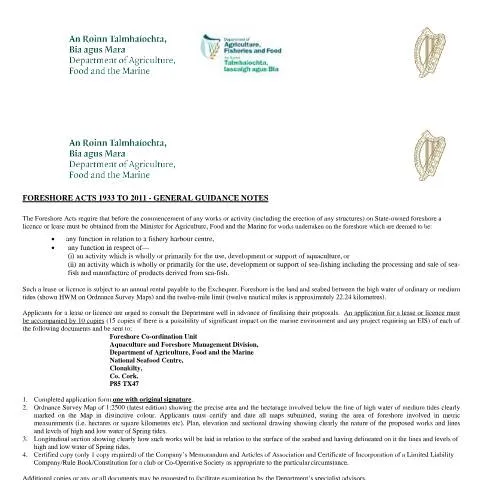
Navigating the Aquaculture & Foreshore Management Guidance Document
For stakeholders involved in aquaculture and other coastal activities, understanding the Aquaculture & Foreshore Management — foreshore application form and guidelines from the Department of Agriculture, Food and the Marine is crucial. This document serves as a comprehensive roadmap for navigating the complexities of obtaining necessary licenses and approvals to conduct operations on the foreshore, an area that is legally defined as the land and seabed extending from the high water mark to a twelve nautical mile limit.
Understanding the Foreshore: Key Concepts and Definitions
Before diving into the application process, it's essential to familiarize oneself with specific terminology and the conceptual framework outlined in the document.
Defining the Foreshore
- Foreshore: The land and seabed located between the high water mark (HWM) and the twelve-mile limit.
- Licenses and Leases: Required for any activities that affect fisheries, aquaculture, and marine environments.
- Environmental Impact Statement (EIS): An assessment required for developments that may significantly impact the marine environment.
Additionally, applicants should note that any proposed works on foreshore land must comply with both national regulations and local planning permissions. Understanding these terms is vital to avoid common pitfalls during the application process.
Preparing Your Application: Steps to Follow
Embarking on the application journey for a foreshore license or lease may seem daunting, but breaking it down into manageable steps can ease this process. Here's a step-by-step guide:
Step 1: Initial Consultation
Before finalizing any proposals, reaching out to the Department of Agriculture, Food and the Marine is highly advisable. They can provide invaluable guidance tailored to your specific project.
Step 2: Compiling Required Documents
The application must include a variety of documentation to ensure thorough evaluation:
- A completed application form, signed and dated.
- An updated Ordnance Survey Map (1:2500) clearly marking the area proposed for development.
- Detailed plans, elevation drawings, and sectional views depicting the nature of the proposed works.
- A certified copy of your organization's Memorandum and Articles of Association or equivalent founding documents.
In scenarios where significant environmental impacts are anticipated, additional copies (15 instead of 10) must be submitted to facilitate comprehensive review by environmental specialists.
Engaging with the Community: Public Notification and Feedback
Once your application is complete and submitted, the next step involves community engagement. The process requires publishing your proposal in local newspapers, which the Department will assist with.
Public Consultation Period
The public will have a four-week window to submit objections or comments regarding your proposal. It's crucial to address any feedback constructively, as this can impact the final decision made by the Minister.
Environmental Considerations: Assessing Impact and Necessity
Environmental sustainability is a top priority within the framework of the Foreshore Acts. Thus, understanding the need for an Environmental Impact Statement (EIS) is critical. Here’s what you should know:
- Projects exceeding specific thresholds outlined in the European Communities (Environmental Impact Assessment) Regulations must include an EIS.
- Even if your project is below the threshold, the Minister may still require an environmental appraisal to assess potential impacts.
Engaging with the Department early in the EIS process can provide clarity and direction, ensuring compliance with regulations and expediting your application.
Understanding the Intersection of Local Planning Permissions
The importance of local planning cannot be overstated. All foreshore projects must obtain relevant permissions from local planning authorities. The relationship between foreshore licenses and local planning permissions is complex, requiring careful navigation.
Consulting Local Authorities
Before applying for a foreshore license, you should first consult your local planning authority. This step ensures that your project aligns with local policies and regulations.
Emergency Situations: Accelerated Application Process
In instances where emergency works are necessary, especially for the preservation of human life, the Department prioritizes these applications. Here are the conditions to facilitate an expedited process:
- Complete the application form and submit it, including all necessary documents and drawings.
- Communicate the urgency of your situation when applying.
- Be prepared for potential modifications as directed by the Department to ensure works meet safety and environmental standards.
Final Remarks: A Resource for Sustainable Development
Utilizing the Aquaculture & Foreshore Management guidelines effectively is essential for those looking to engage in sustainable development on the foreshore. The process may be intricate and layered with regulations, yet with thorough preparation, community engagement, and adherence to environmental standards, stakeholders can successfully navigate this landscape.
In sum, this guidance document is not merely a set of instructions; it represents a commitment to sustainable marine and coastal management in Ireland. By understanding the details outlined within it, applicants can contribute positively to the ecosystem while fulfilling their operational goals.
Understanding the Foreshore Management Framework in Ireland
The foreshore, which refers to the land between high and low water marks along the coastal areas of Ireland, is a critical zone that supports various activities including aquaculture, tourism, and environmental conservation. The management of this area falls under the jurisdiction of the Department of Housing, Local Government and Heritage. Understanding the intricate framework that governs foreshore management is essential for stakeholders, particularly those interested in aquaculture.
In Ireland, the Foreshore Act 1933 and subsequent amendments lay the foundation for the legal framework governing the foreshore. This legislation stipulates that any activity on the foreshore, including aquaculture, requires a foreshore licence or consent. This process is designed to ensure that all activities are carried out sustainably and with minimal adverse effects on the environment and local communities.
In addition to the Foreshore Act, several other environmental regulations must be adhered to when applying for a foreshore licence. The Environmental Impact Assessment (EIA) Directive and the Habitats Directive require that potential impacts on sensitive habitats and species are thoroughly assessed prior to the granting of any permissions. Therefore, applicants must be prepared to provide comprehensive documentation that meets these requirements.
Step-by-Step Guidance for Completing the Foreshore Application Form
Completing the foreshore application form can be a daunting task, especially for first-time applicants. It is crucial to approach this process methodically. Below are the steps to follow to ensure a complete and accurate submission:
- Gather Necessary Documentation: Before filling out the application form, ensure that you have all required documentation ready. This typically includes maps or drawings of the proposed site, details of the project, environmental assessments, and any relevant permissions from local authorities.
- Complete the Foreshore Application Form: The form can typically be found on the official website of the Department of Housing, Local Government and Heritage. Ensure that you fill out each section accurately—this includes your personal details, project specifics, and the anticipated timelines.
- Submit Supporting Documents: Alongside the application form, you must submit any supporting documents that could strengthen your case. This may include scientific studies, community engagement reports, or any previous correspondence with relevant authorities.
- Public Consultation: Depending on the nature of your project, you may need to engage in a public consultation process. This can involve holding meetings with local stakeholders to discuss your plans and address any concerns they may have. Document this process thoroughly, as it will be beneficial in your application.
- Pay Required Fees: There are usually application fees associated with submitting a foreshore application. Ensure that you check the latest fee structure on the Department’s website as these can change. Payment needs to be made at the time of submission.
- Follow Up on Your Application: After submitting the application, it is advisable to follow up with the department to confirm receipt and inquire about the expected timeline for a decision. This can also prevent any unnecessary delays.
By following these steps, you can ensure that your application for foreshore consent is processed smoothly, reducing the likelihood of delays or rejections due to incomplete information.
Best Practices for Sustainable Aquaculture on the Foreshore
As the demand for aquaculture continues to grow, so does the necessity for sustainable practices that protect marine ecosystems while fostering economic development. Here are best practices that operators should consider when engaging in aquaculture activities on the foreshore:
- Site Selection: Choose locations that minimize impact on sensitive habitats or existing marine life. Conduct thorough environmental assessments to evaluate the biodiversity and environmental conditions of the area.
- Implement Sustainable Feed Practices: The feed used in aquaculture can significantly influence local ecosystems. Opt for feed that is sustainably sourced and does not negatively impact wild fish populations.
- Regular Monitoring: Establish a monitoring regime that allows you to assess the health of the aquaculture operation continually. This includes monitoring water quality, growth rates of the cultured species, and impacts on the surrounding environment.
- Community Engagement: Building strong relationships with local communities can lead to better acceptance of aquaculture projects. Engage in open dialogues, listen to community concerns, and address them proactively.
- Comply with Regulatory Requirements: Ensure that all practices meet the standards set forth by local and international regulations. This includes adhering to the principles of the Marine Strategy Framework Directive, which aims to protect the marine environment.
By promoting sustainable practices, aquaculture operators can not only ensure compliance with regulatory frameworks but also enhance their reputation and viability in the long term.