Understanding the "Inventory to Support an Oral Customs Declaration for Temporary Admission" Form in Ireland
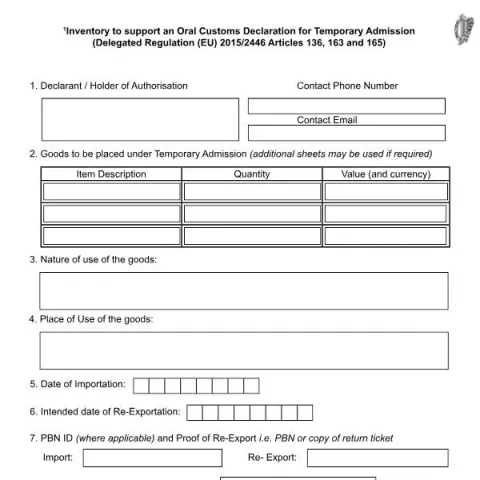
The Inventory to Support an Oral Customs Declaration for Temporary Admission is an official document issued by the Revenue Commissioners of Ireland. It facilitates the temporary importation of goods into Ireland, allowing the importer to declare certain items orally to customs officials, supported by a detailed inventory list. This process aligns with Delegated Regulation (EU) 2015/2446, specifically Articles 136, 163, and 165, which govern customs procedures for temporary admission within the European Union.
Purpose and Scope of the Form
This form serves as a supporting document for customs officials when goods are temporarily imported into Ireland. It is particularly relevant for specific categories of goods that are intended to be re-exported after a temporary stay, such as personal effects, professional equipment, medical devices, or relief materials. The primary goal is to streamline customs procedures by providing a comprehensive inventory that justifies the temporary importation without the immediate payment of duties or taxes.
Importers and their representatives use this form to ensure compliance with Irish customs regulations and to facilitate the smooth processing of goods at the point of entry. The form is especially useful for goods that do not require a full customs declaration but still need to be documented for legal and logistical reasons.
Preparing Your Inventory for Submission
Before submitting the form, it is essential to prepare a detailed inventory of the goods intended for temporary admission. This inventory should include:
- Item Description: A clear description of each item.
- Quantity: The number of units or amount of each item.
- Value: The monetary value, specifying the currency used.
If necessary, additional sheets can be attached to accommodate larger inventories. It is important to accurately record the nature of use and the place where the goods will be utilized in Ireland.
Filling Out the Form
The form requires comprehensive information, including:
- Declarant Details: Name, contact phone number, and email address.
- Goods Description: As outlined above, with additional details if needed.
- Intended Use and Location: Clarifies the purpose and destination of the goods.
- Import and Re-Export Dates: Planned dates for importation and re-exportation.
- Proof of Re-Export: Such as a PBN ID or a copy of the return ticket, along with the form of proof provided.
- Vehicle Registration: If applicable, details of the vehicle used for transport.
- Importer Details: Full name and address, along with EORI or PPSN where available.
- Signature and Date: The declarant must sign and date the form to validate it.
Submission and Record-Keeping
The completed inventory form should be submitted to the Irish customs authorities at the point of entry. It is crucial to keep a copy of the declaration for your records, as well as a copy that will be retained by customs. This documentation ensures transparency and facilitates any future inspections or audits.
In addition, customs officers may record remarks, inspect goods, and affix official stamps on the form. These procedures confirm the authenticity of the declaration and the compliance with Irish customs regulations.
Fill in your form directly online
No printing: type your details into the boxes of the official form, tick, then download the PDF ready to send.
- 1Type into the form boxes
- 2Tick in one click
- 3Save and download the PDF
Additional Considerations and Practical Tips
When preparing to use this form, consider the following:
- Accuracy is vital: Ensure all descriptions, quantities, and values are precise to prevent delays or issues during customs clearance.
- Supporting documentation: Attach relevant proof of re-export, such as return tickets or PBN IDs, especially if the goods are significant or complex.
- Legal compliance: Familiarize yourself with the types of goods eligible for temporary admission, as outlined by Irish regulations and EU directives.
Finally, remember that the form is a tool to facilitate customs clearance for goods that will be re-exported. Proper preparation and accurate completion will help ensure a smooth process, avoiding unnecessary delays or penalties.