Understanding the Application for Binding Origin Information (BOI) in Ireland
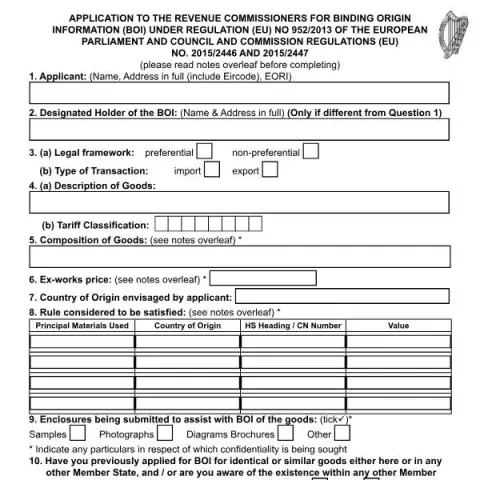
The Application to the Revenue Commissioners for Binding Origin Information (BOI) is an official form used by businesses involved in international trade to seek clarification on the origin of their goods. This process is governed by Regulation (EU) No 952/2013 of the European Parliament and Council, along with Commission Regulations (EU) Nos 2015/2446 and 2015/2447. The primary purpose of this application is to obtain a legally binding statement from Irish tax authorities regarding the country of origin for specific goods, which can influence customs duties, preferential trade agreements, and compliance obligations.
Who Should Complete This Form?
This form is intended for importers, exporters, or their authorized agents who require an official determination of the origin of goods for customs or trade purposes. The applicant must provide comprehensive details about the goods, including their description, composition, and the manufacturing process, to enable the Revenue Commissioners to assess the origin accurately. If the applicant is acting on behalf of another party, they must also complete the section regarding the designated holder of the BOI.
Key Sections and How to Complete the Form
1. Applicant Details
The applicant must clearly state their full name, complete address (including the Eircode), and EORI number. This information identifies who is requesting the BOI and facilitates communication with the Revenue Commissioners.
2. Designated Holder of the BOI
If the application is submitted by an agent or third party, details of the designated holder—such as the importer or exporter—must be provided. This ensures the legal binding applies to the correct entity.
3. Nature of the Transaction
Applicants must specify whether the application relates to preferential or non-preferential purposes, and whether it concerns import or export transactions. This distinction influences the legal and tariff implications of the BOI.
4. Description and Classification of Goods
The form requires a detailed description of the goods, including their tariff classification according to the European Union’s TARIC system (the 8-digit combined nomenclature code). Accurate classification is essential for a correct origin determination.
5. Composition and Price
Applicants should specify the materials used to manufacture the goods and their respective countries of origin. Additionally, the ex-works price (the value of goods at the factory or production site) should be provided if relevant.
6. Country of Origin and Rule Satisfied
The applicant must indicate the country they consider to be the origin of the goods and specify which rule (from EU regulations) they believe the goods satisfy. This involves explaining how the materials and manufacturing process meet the criteria for origin under the applicable trade rules.
7. Supporting Documents and Confidentiality
Applicants are encouraged to submit supporting materials such as samples, photographs, diagrams, or brochures that illustrate the goods’ composition or manufacturing process. Any information deemed confidential should be clearly marked to protect sensitive data.
Important Considerations When Filling Out the Form
- Ensure all questions are answered in black ink and in capital letters.
- The application should relate to a single type of good, classified under one customs code.
- Provide as much detail as possible to facilitate a precise origin assessment.
- Attach any relevant supporting documents, samples, or diagrams to strengthen your application.
- Be aware of previous applications or existing BOI or Binding Tariff Information (BTI) for similar goods, and include relevant details if applicable.
Submitting the Application
The completed form, along with any supporting documentation, should be sent to the Classification, Origin and Valuation Unit at the Revenue Commissioners’ office in Nenagh, County Tipperary. Contact details include a postal address, telephone number, and email address for electronic submissions or inquiries.
Fill in your form directly online
No printing: type your details into the boxes of the official form, tick, then download the PDF ready to send.
- 1Type into the form boxes
- 2Tick in one click
- 3Save and download the PDF
Legal and Practical Implications
Obtaining a BOI provides legal certainty regarding the origin classification of goods, which can affect tariff rates, preferential trade agreements, and compliance with customs regulations. It is particularly valuable for businesses engaged in complex supply chains or those exporting to markets with specific origin requirements.
It is important to note that the information provided in the application must be accurate and complete. Any false or misleading information could result in legal consequences or the revocation of the BOI.
Conclusion
The application for Binding Origin Information is a crucial tool for Irish businesses involved in international trade. By correctly completing this form and submitting supporting documentation, companies can secure a legally binding statement on the origin of their goods, facilitating smoother customs procedures and compliance with EU trade regulations.