Understanding the Inventory Form for Temporary Export and Re-Import in Ireland
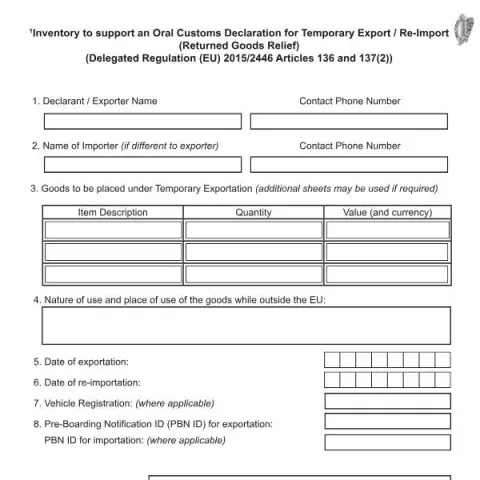
The Irish Revenue Commissioners provide a specific official form, identified by code RPC019326_EN_WB_D_7, designed to support oral customs declarations related to the temporary export and re-import of certain goods under the Returned Goods Relief scheme. This form is essential for individuals and businesses involved in the temporary movement of goods outside the European Union (EU) that are intended to be re-imported without incurring additional customs duties or VAT, provided specific conditions are met.
Purpose and Scope of the Form
This inventory form serves as a supporting document for customs declarations made orally at Irish border points. It details the goods being temporarily exported and subsequently re-imported, ensuring compliance with Delegated Regulation (EU) 2015/2446, specifically Articles 136 and 137(2). The primary aim is to facilitate the smooth processing of goods such as personal effects, tools of trade, sporting equipment, and certain medical or relief items, which are intended to return to Ireland after a temporary absence.
Preparing Your Inventory for Submission
Before completing the form, it is important to gather all relevant information about the goods and the parties involved:
- Details of the declarant or exporter, including full name and contact information.
- Information about the importer, if different from the exporter.
- A comprehensive list of goods, including descriptions and quantities.
- Details on the nature of use and location of the goods while outside the EU.
- Key dates: exportation and re-importation.
- Vehicle registration details, if applicable.
- Pre-Boarding Notification IDs for export and import, where relevant.
- Tax identifiers such as EORI or PPSN.
- Signatures confirming the accuracy of the information provided.
Additional sheets may be attached if the inventory exceeds the space available on the form.
Filling Out the Form
The form is divided into two main copies: one for the Irish customs office of exit and one for the office of entry. Each copy includes sections for:
- Goods details and inspection notes.
- Remarks from customs officers, including identification and inspection outcomes.
- Official stamps and dates confirming processing.
It is crucial to ensure that all information is accurate and complete, as the form acts as an official record supporting the customs declaration. The exporter or declarant must sign the form, affirming the correctness of the details.
Submitting and Retaining the Documentation
The completed inventory form should be submitted to customs authorities at the relevant border or customs office. A copy will be retained by the customs office of exit, while the other copy is given to the importer for their records. This documentation is vital in case of audits or further inquiries regarding the temporary export and re-import process.
Eligible Goods and Conditions
The form supports declarations for goods that qualify under specific categories, including:
Fill in your form directly online
No printing: type your details into the boxes of the official form, tick, then download the PDF ready to send.
- 1Type into the form boxes
- 2Tick in one click
- 3Save and download the PDF
- Personal effects and sporting goods.
- Means of transport, pallets, and containers, including spare parts and accessories.
- Tools of trade and professional equipment, such as portable musical instruments used by travelers.
- Medical and surgical equipment supplied on loan for emergencies.
- Welfare materials for seafarers.
- Animals, provided they are for seasonal grazing or work-related movement.
- Instruments for medical procedures, particularly for organ transplants.
- Disaster relief materials used in emergencies.
- Radio, television, and broadcasting equipment, including specially adapted vehicles.
It is important to note that relief from VAT applies only if the re-importing party is the same as the exporting party, ensuring compliance with Irish tax regulations.
Legal and Data Privacy Considerations
The use of this form involves the collection of personal and business data, including contact details, identifiers, and information about the goods. The Revenue Commissioners process this data in accordance with Irish data protection laws, and details about data handling are available on the Revenue’s privacy page. The form’s completion and submission are part of Ireland’s customs control procedures, aiming to facilitate lawful trade and movement of goods.
Conclusion
For individuals and companies involved in the temporary export and re-import of goods, the Inventory supporting an oral customs declaration form is a crucial document. Proper preparation, accurate completion, and adherence to customs procedures ensure compliance and help avoid delays or penalties. Always ensure you keep copies of all documents submitted, and consult the Irish Revenue Commissioners or customs officials if further clarification is needed.