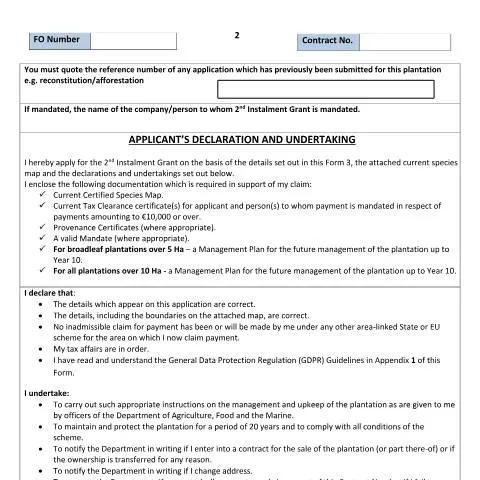
Understanding the Forestry Afforestation Scheme Form 3
Navigating the administrative landscape of afforestation in Ireland can be complex, especially when it comes to the specifics of the Forestry – Afforestation Scheme Form 3 Declarations, commonly referred to as Form 3. This document plays a crucial role for stakeholders within Ireland's forestry sector, particularly for applicants seeking to obtain the second instalment grant under the afforestation scheme. Understanding the nuances of this form, along with the responsibilities that come with it, is essential for ensuring compliance and securing funding.
Who Needs to File Form 3? A Closer Look at the Applicant Profile
The primary applicants for Form 3 are individuals or entities engaged in afforestation projects across Ireland. This includes both private landowners and commercial forestry companies. However, within these categories, there are specific nuances that merit attention:
- Private Landowners: Individuals who own land suitable for forestry and are looking to convert it for afforestation or reforestation purposes.
- Registered Foresters: Professionals who manage forestry operations on behalf of landowners. They play a pivotal role in assisting with the completion of Form 3 and ensuring that all forestry regulations are adhered to.
- Companies and Corporations: Entities engaged in large-scale forestry operations, which may require the expertise of a registered forester to navigate the complexities of the application process.
Each profile has unique requirements and must meet specific conditions to be eligible for the grants that Form 3 facilitates. For instance, private landowners may need to demonstrate compliance with previous grant approvals, while companies might have to submit additional documentation, such as a comprehensive management plan if they are applying for plantations exceeding 10 hectares.
The Role of Supporting Documentation: What to Prepare
Form 3 is not a standalone document; it requires several supporting documents that reinforce the applicant's claim for the second instalment grant. Below is a breakdown of the necessary documentation categorized by their relevance:
- Certified Species Map: This map should detail the species planted and the layout of the plantation. It must be current and accurately reflect the situation on the ground.
- Tax Clearance Certificate: Required if the payment amount is expected to be €10,000 or more. This certificate assures the Department of Agriculture, Food and the Marine (DAFM) that the applicant's tax obligations are met.
- Provenance Certificates: These are essential for demonstrating the origin of the tree species planted, especially for specific categories of species as outlined by forestry regulations.
- Management Plans: Particularly for plantations extending beyond 5 hectares, a management plan detailing the future upkeep of the plantation for up to ten years is necessary.
- Mandates: If payments are to be directed to someone other than the applicant, a valid mandate must be included.
Completing Form 3 without the required supporting documents can lead to delays or outright refusals, emphasizing the necessity of thorough preparation.
Embedding Form 3 within the Broader Administrative Process
The submission of Form 3 is not merely a step towards getting a grant; it's part of an ongoing dialogue and compliance framework with the DAFF. Here’s how it fits into the larger picture:
- Preceding Applications: Before submitting Form 3, applicants typically complete Form 2, which lays the groundwork for the initial grant application. The reference number of the initially submitted application must be included on Form 3.
- Field Assessment: Following the submission, a field assessment is conducted by a registered forester to verify the claims made in Form 3, ensuring compliance with specified forestry standards.
- Continuous Monitoring: Post-submission, the DAFF may conduct ongoing monitoring to ensure that conditions set out in the original grant approval are being met by the applicant throughout the lifespan of the project.
This interconnected process ensures that the afforestation projects align with national forestry policies and environmental standards.
The Distinctions: Form 3 vs. Other Forestry Forms
In the realm of forestry documentation, there are several forms that applicants may encounter. Understanding what sets Form 3 apart is essential to avoid confusion:
| Form | Purpose | Key Differences |
|---|---|---|
| Form 1 | Initial Afforestation Application | Focuses on the proposal stage; Form 3 follows after initial approval. |
| Form 2 | First Instalment Grant Application | Required for withdrawing the first payment; Form 3 is for the second instalment. |
| Form 4 | Felling License Application | Different purpose focused on tree removal; not directly related to grant payments. |
These distinctions are vital for applicants to understand, as filing the wrong form can lead to administrative setbacks and funding delays.
Addressing Refusals and Missing Information
In the event of a refusal or if additional information is requested by the DAFF after submission of Form 3, applicants must know how to respond effectively:
- Understanding Refusals: If your application is refused, it is essential to request feedback from the DAFF to understand the grounds of refusal. This feedback can aid in rectifying any issues for future applications.
- Correcting Missing Information: Should the DAFF highlight missing documents or information, applicants are advised to respond promptly with the correct information while referencing their original application to establish continuity.
- Communication: Maintaining open lines of communication with the DAFF can facilitate smoother resolutions to any issues that arise during the application process.
Being proactive in addressing refusals or missing documentation can significantly enhance the likelihood of a successful application.
Special Cases: Unique Situations Requiring Extra Attention
Certain applicants may face unique circumstances that necessitate additional considerations when submitting Form 3. These can include:
- Foreign Investors: Non-Irish residents or companies investing in Irish forestry may have to provide additional documentation demonstrating compliance with both Irish and EU regulations.
- Underage Applicants: In cases where an applicant is a minor, guardians will need to take on the responsibility of completing and signing the form on behalf of the applicant.
- Complex Ownership Structures: Entities with multiple owners or stakeholders must ensure that all parties consent to and understand the obligations set forth in Form 3, as detailed in the applicant's declaration and undertaking.
Understanding these special cases can help mitigate potential pitfalls in the application process.
Submission Channels and Their Practical Implications
When it comes to submitting Form 3, applicants have several options, each with its practical implications:
- Online Submission: The preferred method for many applicants, online submissions through the MyGovID platform can expedite processing times. Ensure that all documents are digital and submitted in the requested formats.
- Paper Submission: While still accepted, paper submissions can lead to longer processing times due to postal delays. It's crucial to ensure that all documents are correctly completed and included.
- In-Person Submission: Applicants can drop off their forms directly at the DAFF's offices in Wexford. This method allows for immediate confirmation of receipt but may require prior appointment scheduling.
Choosing the right submission channel can influence the speed and efficiency of the application process.
In conclusion, understanding the intricacies of Form 3 within the context of Ireland's afforestation schemes is essential for applicants seeking grants. From meticulous documentation preparation to navigating the administrative landscape, each step holds significance in achieving compliance and securing funding. Being well-informed and proactive is paramount in making the most of the opportunities that the afforestation scheme presents.
Understanding the Afforestation Scheme: Eligibility and Application Process
The Afforestation Scheme in Ireland aims to increase forest cover while promoting sustainability and carbon sequestration. To participate, applicants must adhere to certain eligibility criteria set forth by the Department of Agriculture, Food and the Marine (DAFM). Understanding these requirements is essential for a successful application.
Firstly, to qualify for the scheme, applicants must have a minimum land area of 1 hectare that is eligible for afforestation. The land should primarily consist of agricultural land or land that has been previously afforested. Additionally, applicants must possess the land for which they are applying for a minimum period of five years.
The application process begins by submitting Form 3, which includes declarations regarding the land's eligibility and the applicant's intentions for afforestation. Detailed maps and photographs must accompany the application to demonstrate the land’s condition. It is crucial to ensure that the maps are compliant with the specifications outlined by DAFM, especially regarding Eircode addresses and land boundaries.
Moreover, applicants should prepare to provide their Personal Public Service Number (PPSN) as part of the application process. This number is vital for tax and identification purposes in Ireland. Once the application is submitted, the DAFM will undertake a comprehensive assessment, which may involve site visits to confirm the details provided in the application.
Additional considerations include understanding the funding available through this scheme. Financial support often hinges on the type of trees to be planted and the sustainable practices employed. Upon approval, participants will receive annual premiums for maintenance over a specified period.
Maintaining Compliance: Responsibilities Post-Afforestation
Once the afforestation has been successfully established, compliance with the terms of the scheme is crucial. Participants must adhere to the conditions laid out in the application to maintain eligibility for continued funding and support. This includes responsible land management practices that align with environmental sustainability.
One of the primary responsibilities includes maintaining a minimum stocking density of trees, as stipulated in the original application. Participants must ensure that the forest grows healthily without exceeding the permissible limits of thinning or harvesting trees at an early stage. Regular assessments will be carried out by DAFM to ensure compliance, and failure to meet these guidelines can lead to penalties or the revocation of the afforestation grant.
Additionally, participants are required to submit annual reports detailing the progress of the afforestation project. These reports must include updates on tree growth, any incidents of disease or pest infestations, and descriptions of any additional management practices implemented. This ongoing dialogue with DAFM ensures that the afforestation scheme remains aligned with national forestry objectives.
Moreover, participants are also encouraged to engage in continuous learning about sustainable forestry practices. Various workshops and training sessions are often organized by local forestry services and organisations, providing essential knowledge on effective woodland management, biodiversity enhancement, and the ecosystem services that well-managed forests can provide.
The Role of Community and Collaboration in Afforestation Efforts
Community involvement plays a vital role in the success of afforestation initiatives across Ireland. Collaborative efforts can enhance both environmental outcomes and social acceptance of forestry projects. Engaging local communities is crucial for creating a shared vision and objectives for afforestation efforts.
Partnerships with local councils, environmental organizations, and community groups can facilitate knowledge sharing and resource pooling. These partnerships can help identify suitable lands for afforestation, recruit volunteers for planting activities, and organize educational workshops to raise awareness about the benefits of afforestation.
Furthermore, community-led afforestation projects often foster a sense of ownership among locals, leading to greater commitment to maintaining the newly established forests. For instance, local schools can participate in tree-planting events, aligning educational outcomes with environmental stewardship.
Additionally, community engagement can lead to the creation of community forests, which provide recreational spaces, promote biodiversity, and serve as carbon sinks. These initiatives not only contribute to national afforestation goals but also enhance local economies through eco-tourism and forest-based activities.
It is also important to consider how community forestry can be supported through local policy frameworks. Local authorities can play a significant role in facilitating afforestation initiatives by providing funding opportunities, technical guidance, and access to land management resources.
By fostering collaboration between various stakeholders, afforestation schemes can achieve greater success and sustainability, ultimately contributing to Ireland’s commitment to combating climate change and enhancing biodiversity.