Understanding the Ministerial Consent Notification Process for Monuments
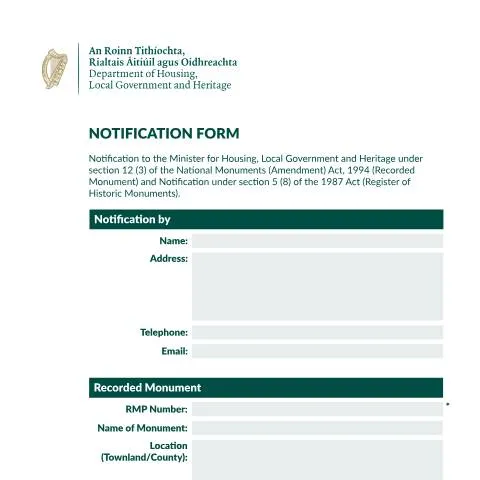
In Ireland, the preservation of national monuments is a matter of great significance, not only for cultural heritage but also for legal obligations that influence various sectors such as construction, archaeology, and local governance. If you are planning any works in relation to a recorded monument, the Ministerial Consent/Notification of Work at or in Relation to a Monument form is an essential document that needs to be understood in detail. This form is critical for ensuring that any intervention on these sites is conducted in compliance with national legislation, specifically the National Monuments (Amendment) Act, 1994. This article provides an in-depth exploration of this notification form, its requirements, and procedural steps necessary for submission to the Department of Housing, Local Government and Heritage.
Key Components of the Notification Form
The notification form itself is structured to capture detailed information about the proposed works and the monument in question. Below are the key components that must be completed:
- Name and Contact Information: This section requires the details of the applicant, including name, address, telephone, and email.
- Recorded Monument Details: It’s essential to provide the RMP Number and the specific name and location of the monument, along with the ITM reference. Note that ITM coordinates can be obtained from the National Monuments Service website.
- Owner Details: Specify whether the owner is a local authority or a private individual, along with their contact details.
- Proposed Works: Clearly describe the nature and purpose of the works planned at the site. This description can extend to a separate sheet if necessary.
A Step-by-Step Guide to Completing the Form
Filling out the Ministerial Consent/Notification of Work form requires attention to detail to ensure compliance with legal expectations. Here’s how to navigate the completion process:
- Gather Necessary Information: Collect all relevant details related to the monument and the proposed works. This includes the RMP number, ITM coordinates, and the identity of the project team, such as your architect or archaeologist.
- Complete the Form: Fill in each section accurately. Ensure that all contact information is current and verify the RMP number against the Record of Monuments and Places.
- Prepare Supporting Documents: Include an OS map indicating the site’s location, the name of the professional preparing the documents, and a letter of permission from the local authority or owner.
- Review your Submission: Double-check all entries for accuracy and completeness.
Timing and Relevant Deadlines
Understanding the timeline for this submission is crucial to avoid delays in your project. The notification must be submitted at least two months prior to any work commencing on the monument. This timeframe allows the National Monuments Service to assess the application and determine if any additional measures or permissions are necessary. Here’s a breakdown of the timeline:
| Action | Deadline |
|---|---|
| Submit Notification Form | At least 2 months before proposed works |
| Receive Confirmation from National Monuments Service | Varies; follow up if no response within a month |
The Importance of Getting Consent: Legal Context
The requirement to notify the Minister for Housing, Local Government and Heritage and to receive consent is anchored in section 12 (3) of the National Monuments (Amendment) Act, 1994. This legislation aims to safeguard Ireland's archaeological heritage by ensuring that any work done on or near recorded monuments is in line with protection measures. Here's why obtaining ministerial consent is vital:
- Legal Compliance: Undertaking works without proper notification can lead to legal penalties, including fines or restoration orders.
- Protection of Heritage: The consent process helps to mitigate damage to archaeological sites that could hold significant historical value.
- Community Engagement: By notifying authorities, you help promote transparency and civic responsibility concerning heritage sites.
What Happens After Submission?
Once you've submitted your notification form, the National Monuments Service takes several steps to process your application. Expect the following:
- Acknowledgment of Receipt: You should receive a written confirmation that your notification has been received. It’s important not to assume that the submission will be processed without this acknowledgment.
- Assessment Period: The service will evaluate the proposed works in relation to the monument. This may include consultations with archaeologists or other experts to assess potential impacts.
- Response: You will receive a decision outlining whether your proposed works can proceed. This may also include conditions that must be adhered to during the construction process.
Handling Refusals or Missing Documentation
In instances where the ministerial consent is denied or where your application lacks required documentation, it’s critical to understand the next steps:
- Review the Feedback: The National Monuments Service will provide reasoning for any refusals. Assess this feedback to understand the areas needing attention.
- Documentation Issues: If your application is incomplete, the service may outline what documents are missing. Promptly gather and resubmit these documents.
- Reapplication Process: In cases of refusal, you may need to revise your proposal. Consider consulting with heritage professionals to strengthen your case before reapplying.
Common Pitfalls to Avoid
Awareness of frequent mistakes can facilitate smoother processing of your notification. Here are common pitfalls applicants encounter:
- Inaccurate Information: Ensure all details, particularly concerning the monument’s designation and coordinates, are correct.
- Omitting Required Maps: Failure to include the necessary OS map can result in your application being returned or delayed.
- Ignoring Deadlines: Submitting your notification late can hinder project timelines, so keep a calendar to track essential dates.
Special Circumstances and Considerations
Each application may involve unique elements, particularly with foreign entities, minors, or urgent situations. When submitting the Ministerial Consent Notification Form, consider the following:
- Foreign Applicants: If you are outside Ireland, ensure that you have local representation who can act on your behalf in dealings with the National Monuments Service.
- Minor Involvement: If a minor is involved in the works, ensure compliance with all child protection regulations, especially if the activities are educational or community-oriented.
- Urgency and Emergencies: In cases where immediate work is necessary (e.g., emergency repairs), contact the National Monuments Service directly to discuss expedited processes or emergency procedures that may apply.
Final Thoughts on the Ministerial Consent Process
Engaging with the Ministerial Consent/Notification of Work at or in Relation to a Monument form is not just a procedural necessity; it’s a commitment to the preservation of Ireland’s rich heritage. By adhering to the proper channels and ensuring accurate submissions, you contribute to safeguarding structures that tell the story of our past. Such diligence not only ensures compliance with legislative requirements but also respects the cultural significance of the monuments we cherish.
Understanding Ministerial Consent for Works on National Monuments
In Ireland, the preservation of national monuments is governed by the National Monuments Acts, primarily the National Monuments (Amendment) Act 2004. When planning to carry out any work that may affect a national monument, it is crucial to obtain Ministerial Consent. This process aims to ensure that any alterations or developments respect the historical and cultural significance of these sites. The Department of Housing, Local Government and Heritage oversees this process, and their guidelines are designed to protect Ireland's rich archaeological heritage.
Ministerial Consent is required not only for construction works but also for activities such as archaeological excavations, restoration efforts, and other interventions that might affect the integrity of a monument. It is essential to understand that consent is not merely a formality; the process involves a detailed assessment of the proposed works, considering potential impacts on the monument and surrounding environment. Applicants must provide comprehensive documentation detailing the nature of the work, the methodologies to be employed, and the measures that will be taken to mitigate any adverse impacts.
Application Process for Ministerial Consent
The application process for Ministerial Consent is governed by specific criteria and involves several key steps. First, an applicant must complete the Notification of Works at or in Relation to a Monument form, which is available on the Department’s website. This form requires the submission of detailed information about the proposed works, including the precise location of the monument, the type of work intended, and the timeframe for the project.
Fill in your form directly online
No printing: type your details into the boxes of the official form, tick, then download the PDF ready to send.
- 1Type into the form boxes
- 2Tick in one click
- 3Save and download the PDF
Once the form is submitted, the Department will review the application. This review may involve consultations with several stakeholders, including local authorities, archaeological experts, and heritage organisations. If the proposed works are deemed to pose a risk to the monument, the Department may request additional information or suggest modifications to the project to ensure compliance with conservation standards.
Importantly, applicants should also consider the public interest and community engagement in the planning stage. Engaging with local communities and heritage groups can provide valuable insights and support, making the application process smoother and more transparent. After thorough evaluation, the Department will issue a decision, which may include conditions that must be adhered to during the execution of the works.
Implications of Non-Compliance and Appeal Processes
Failing to obtain Ministerial Consent for works affecting a national monument can lead to serious consequences under Irish law. Non-compliance can result in penalties, including fines or orders to cease work. In severe cases, individuals or entities may face prosecution if they carry out unauthorised works that damage or alter a national monument. Therefore, it is imperative that all stakeholders involved in developmental projects involving such monuments thoroughly understand their legal obligations.
If an application for Ministerial Consent is denied, the applicant has the right to appeal the decision. The appeal process involves submitting a request for reconsideration, which must be done within a specified timeframe following the notification of the decision. The appeal will be assessed by a different team within the Department, ensuring an impartial review. It is advisable for applicants to seek professional advice when navigating the appeal process, as there may be specific requirements that need to be met to enhance the chances of a successful outcome.
Moreover, maintaining open communication with the Department and providing any requested additional documentation promptly can aid in both the initial application and any subsequent appeals. Understanding the nuances of the legislative framework surrounding national monuments is essential for compliance and successful project management.