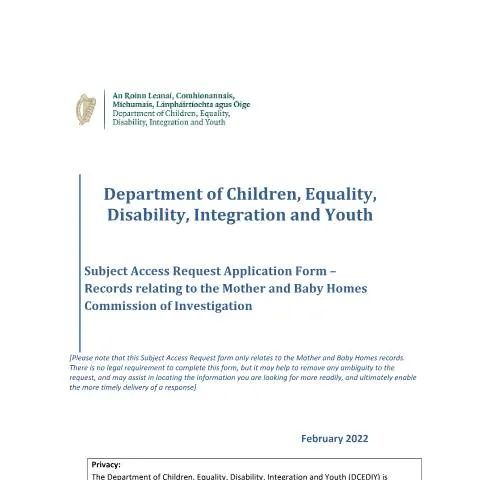
Navigating the Subject Access Request: Understanding the Application Form for Records Relating to Mother and Baby Homes
For many, the journey to reclaim personal narratives woven through the intricate fabric of Irish history often begins with a simple form—one that holds the key to accessing personal data kept in the records of Mother and Baby Homes. The Subject Access Request Application Form (14a424eb) is not merely a document; it is a lifeline for those seeking clarity, closure, and connection to their past. This article delves into the nuances of this essential form, guiding you through its completion, submission, and the aftermath of your request.
The Landscape of Personal Data Access: Why This Form Matters
Understanding the significance of this form involves grasping the broader context of data protection under Irish law, particularly the General Data Protection Regulation (GDPR) and the Data Protection Acts of 1988-2018. For individuals who resided in these homes, accessing personal data can offer insights into their origins, identity, and life events that may have been obscured for years.
While the form is not a legal requirement, its structured approach markedly enhances the accessibility of the requested information. By detailing specific aspects of one’s identity and circumstances, the applicant can expedite the search process, allowing for a more timely response from the Department of Children, Equality, Disability, Integration, and Youth (DCEDIY).
Demystifying the Submission Process: Online, Postal, or In-Person?
When it comes to submitting the Subject Access Request Application Form, applicants have multiple channels at their disposal. Each method has distinct implications for processing times and accessibility.
1. Online Submission via MyGovID
The online option via MyGovID offers a streamlined approach for those comfortable with digital communication. Here are some key points to consider:
- Speed: Online submissions are typically processed faster than postal ones.
- Confirmation: Receivers can often obtain instant confirmation of their submission.
- Accessibility: Users can include electronic copies of supporting documents, reducing the likelihood of delays.
2. Postal Submission
Alternatively, applicants may choose to submit the form via traditional postal methods. This approach requires careful consideration to avoid potential issues:
- Proof of Posting: It is advisable to send the application via registered post to obtain a tracking number.
- Processing Time: Expect longer waiting periods due to mail handling and processing.
- Document Integrity: Ensure that all required documents are included to prevent back-and-forth communication.
3. In-Person Submission
For those who prefer a face-to-face interaction, visiting DCEDIY offices can be both reassuring and informative:
- Direct Interaction: Applicants can ask questions and seek clarification about their submissions.
- Immediate Feedback: Any missing documents or issues can be addressed right away.
- Verification: Identity can be confirmed on-site, ensuring no delays related to incomplete paperwork.
A Step-by-Step Breakdown of the Form: What to Expect
Completing the Subject Access Request Application Form can be daunting, particularly given the personal nature of the information involved. Here’s a detailed look at the various sections of the form, along with practical tips to avoid common pitfalls.
Part I: Data Subject Details
This section gathers essential personal information to substantiate your identity. The following details are critical:
- First Name and Last Name: Ensure these match the official documents to avoid discrepancies.
- Previous Names: If you’ve changed your name, provide this as it may affect record accessibility.
- Date of Birth: This is a key identifier; double-check for accuracy.
Identity Verification
To bolster your request's credibility, you must attach proof of identity, which can be a photocopy of:
- Passport
- Driver’s License
- Any other government-issued ID that includes your date of birth.
If you prefer to receive responses by post, you will also need to provide proof of current address—this can be a utility bill or a government letter. If you opt for electronic communication, this step is not necessary.
Part II: Specifics of Your Request
In this section, accuracy is paramount. The more details you provide, the easier it is for the Department to locate your records:
- Institution Names: List all Mother and Baby Homes where you were resident.
- Relevant Time Frames: Specify the time range for your stay, which will aid in narrowing down searches.
Don’t overlook potential mixed personal data scenarios. If you’re seeking records involving other individuals (e.g., family members), indicate whether they are living or deceased. If deceased, including a death certificate may be necessary.
The Administrative Response: What Happens Next?
Once your application is submitted, it enters the administrative workflow at the DCEDIY. Understanding this process can alleviate anxiety for applicants eager to reconnect with their histories.
1. Acknowledgment of Receipt
After submission, you should receive an acknowledgment of your request, typically within a week. This confirmation will provide information on expected timelines for responses, which can vary based on the complexity of requests.
2. Processing Your Request
During processing, the Department will:
- Verify your identity against submitted documents.
- Assess the scope of your request to determine possible data holdings.
- Consider any third-party rights (especially in cases of mixed personal data) and comply with GDPR regulations.
3. Response Formats
Your response may take a few forms:
- Full Access: You receive all requested data.
- Partial Access: Some data may be withheld if it involves third parties’ rights.
- No Access: In certain circumstances, such as when the records do not exist or cannot be disclosed.
Addressing Challenges: Handling Refusals and Missing Documentation
Receiving a refusal or an incomplete response can be disheartening. However, knowing the next steps can empower you to take action:
1. Understanding Refusals
If your request is denied, the Department must provide a reason, often rooted in data protection legislation. The refusal notice will contain guidance on how to appeal the decision.
2. Missing Documents
In cases where documents are missing or if the response is incomplete, follow these steps:
- Contact the DCEDIY: Reach out via the contact details provided in the acknowledgment to seek clarification.
- Provide Additional Information: If necessary, submit further data or identity verification documents promptly to avoid delays.
3. Appeals Process
Should you wish to contest a refusal, you can file an appeal directly with the Office of the Data Protection Commissioner (ODPC). This process involves:
- Submitting a formal complaint indicating the grounds for your appeal.
- Providing any documentation that supports your case.
The Bigger Picture: Integrating Your Request into Broader Contexts
This form exists within a wider framework of governmental initiatives aimed at addressing historical injustices related to Mother and Baby Homes. Understanding these connections can provide a sense of empowerment and community:
- Support Networks: Engage with organizations offering support for those affected by Mother and Baby Homes.
- Legislative Changes: Remain informed about ongoing discussions related to the legacy of these homes and how they affect current and future records access.
Final Thoughts: Empowering Yourself Through Knowledge
Filling out the Subject Access Request Application Form can be a profound step in reclaiming your narrative. By understanding each aspect of the process, from submission to response, you can approach the journey with confidence. Whether it's seeking personal closure, understanding family dynamics, or simply piecing together your past, this form serves as a pivotal link to your identity and history.
As the landscape of data protection continues to evolve, staying informed and proactive will ensure that your quest for information is met with clarity and support.
| Submission Method | Advantages | Disadvantages |
|---|---|---|
| Online via MyGovID | Quick processing, instant confirmation, easy document upload | Requires familiarity with technology |
| Postal Submission | Traditional method, suitable for those less comfortable online | Longer processing time, risk of lost mail |
| In-Person Submission | Direct interaction, immediate feedback | Possible travel costs, time constraints |
Understanding the Role of the Payment Scheme Office in Data Protection
The Payment Scheme Office (PSO) plays a pivotal role in managing financial assistance programs related to various social welfare schemes in Ireland. As part of its operational framework, the PSO is committed to upholding data protection rights as enshrined in the General Data Protection Regulation (GDPR) and the Data Protection Act 2018. This commitment ensures that individuals' personal data is processed fairly, transparently, and securely.
Under the GDPR, data subjects—those individuals whose data is being processed—have specific rights regarding their personal information. These include the right to access their data, the right to rectify inaccuracies, and the right to erasure under certain circumstances. The PSO is required to have clear policies and procedures in place to allow individuals to exercise these rights effectively.
Moreover, the PSO must ensure that data processing activities are documented accurately, detailing what types of data are collected, the purpose of processing, retention periods, and data sharing practices with third parties. This transparency is crucial not only for complying with legal obligations but also for building trust with service users who rely on the PSO for financial assistance.
The Intersection of Freedom of Information and Data Protection
Freedom of Information (FOI) legislation in Ireland, primarily governed by the Freedom of Information Act 2014, provides individuals the right to access records held by public bodies, including the Payment Scheme Office. However, the interplay between FOI and data protection can be complex. While individuals have a right to access certain records, this right is balanced against the need to protect personal data in accordance with the GDPR.
When a request for information is made under the FOI Act, the PSO must carefully assess whether the information can be released without breaching privacy rights. If the records requested contain personal data of third parties, such information may be exempt from disclosure unless consent is obtained or there are compelling public interest reasons for disclosure.
Additionally, the PSO must ensure that any information shared under FOI complies with principles of data minimization. Only the necessary details required to fulfill the request should be disclosed, safeguarding the personal information of individuals not directly involved in the request. This careful balancing act is crucial in maintaining compliance with both FOI and data protection laws.
Subject Access Requests: A Detailed Approach
Subject Access Requests (SARs) empower individuals to request access to their personal data held by organizations, including the Payment Scheme Office. This process, as outlined in the GDPR, is straightforward yet requires a clear understanding of the rights and obligations involved.
Individuals wishing to submit a SAR must do so in writing, stating their request clearly. The PSO provides specific guidelines and a Subject Access Request application form, known as Form 14a424eb, to facilitate this process. When completing this form, individuals must provide sufficient information to assist the PSO in identifying their records. This includes their Personal Public Service Number (PPSN), contact details, and any relevant identifiers related to their interactions with the PSO.
Once the PSO receives a SAR, they are obligated to respond within 30 days, although this period can be extended in complex cases. Individuals should be aware that while they are entitled to access their data, certain information may be withheld if it includes third-party personal data or is subject to legal exemptions.
Furthermore, the PSO is committed to providing clear guidelines on the outcome of the SAR, including whether access is granted, partially granted, or denied. In cases of denial, individuals have the right to seek an explanation and, if necessary, to appeal the decision through the Data Protection Commission.
It’s essential for individuals to be proactive in understanding their rights under data protection laws and to utilize the resources provided by the PSO effectively. By navigating the SAR process correctly, individuals can ensure they have full access to the information pertaining to their case, which is vital for transparency and accountability in the services provided by the PSO.