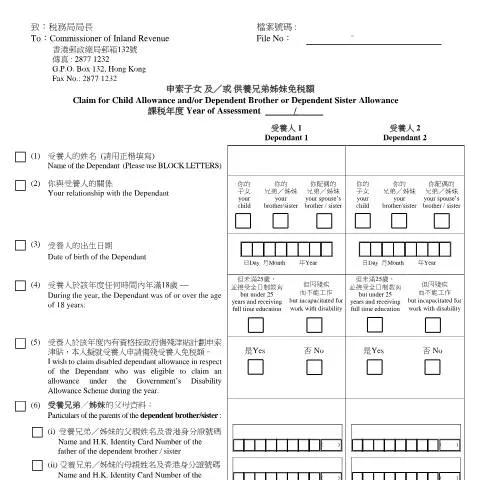
Understanding the IR 6044 Form: A Key to Family Tax Benefits in Hong Kong
The Claim for Child Allowance and/or Dependent Brother or Dependent Sister Allowance, identified by the reference code IR 6044, serves as a crucial instrument for families navigating the Salaries Tax and Personal Assessment system in Hong Kong. Designed to facilitate financial support for dependents, this document can often be the linchpin in maximizing tax benefits. This article delves into the nuances of completing this form, the intricacies of the application process, and the implications of its acceptance or rejection.
Navigating the Application Process: Initiation to Submission
Completing the IR 6044 involves several well-defined steps. Understanding this process can significantly enhance the likelihood of a successful claim.
1. Identifying Eligibility
Before initiating the application, it’s vital to ensure eligibility for the allowances. The applicant must be a resident of Hong Kong and have dependents that meet specific criteria. This includes:
- Children under the age of 18, or
- Dependent brothers or sisters under the age of 25 who are not financially independent.
2. Gathering Required Documentation
To complete the IR 6044, certain documents must be prepared. This includes:
- HKID numbers of dependents.
- Proof of relationship (e.g., birth certificates, legal documentation).
Failure to provide adequate documentation can lead to delays or outright rejection of the claim.
3. Completing the Form
The form itself is straightforward but requires careful attention to detail. Key sections include:
- Section 1: Applicant’s and dependents’ details, including names and relationships.
- Section 5: Specific declarations regarding any disabilities of the dependents, which may affect eligibility for additional allowances.
Each field must be filled out accurately. Incomplete or incorrect entries can lead to complications.
4. Submission Channels: Options for Filing
Once completed, the IR 6044 can be submitted through various channels:
- Online Submission: Utilizing the e-services available through the Inland Revenue Department’s portal.
- Paper Submission: Mailing the form directly to the appropriate offices.
- In-Person Submission: Visiting designated revenue offices for face-to-face processing.
What Happens After Submission?
Understanding the post-submission landscape is critical for managing expectations and timelines.
1. Processing Time
The average processing time for the IR 6044 can vary, but applicants may expect a timeframe of approximately 4 to 8 weeks. During this period, the Inland Revenue Department reviews the provided information and documentation.
2. Possible Outcomes
| Outcome | Description |
|---|---|
| Approval | The claim is accepted, and allowances are applied to the next tax assessment. |
| Rejection | The claim is denied due to insufficient information or ineligibility. |
| Request for Additional Information | The department may seek further evidence to support the claim. |
3. Understanding Notifications
Once a decision is made, applicants receive a notification detailing the outcome. In cases of rejection, the department will provide reasons, allowing applicants to understand the basis of the decision.
In Case of Rejection: Steps to Take
Receiving a rejection can be disheartening, but there are steps that can be taken to rectify the situation.
1. Analyzing the Rejection
Understanding the reason for rejection is the first step. Common causes include:
- Missing documentation.
- Incorrect information provided.
- Dependents not meeting eligibility criteria.
2. Correcting and Resubmitting
Once the reasons are understood, applicants should:
- Gather any missing documents.
- Correct inaccuracies in the initial submission.
- Consider seeking assistance from tax professionals if necessary.
3. Appealing the Decision
If the applicant believes the rejection was unjust, an appeal can be lodged. This involves:
- Submitting a written appeal to the Commissioner of Inland Revenue.
- Including any new evidence that supports the claim.
The Unique Role of the IR 6044 Form
The IR 6044 is specifically designed to cater to claims for Child Allowance and allowances related to dependent siblings. This focus differentiates it from other tax forms that might overlap in their requirements.
1. Distinguishing Features
What makes the IR 6044 unique?
- Targets specific demographics, primarily families with dependents.
- Offers a streamlined approach for claims concerning multiple dependents.
2. Comparison with Other Forms
To further clarify its role, consider how the IR 6044 compares with other relevant forms such as:
- IR 56B: This is used for reporting salaries and wages.
- IR 56E: For claims related to personal assessment.
While these forms also serve essential functions, they do not specifically address the allowances for children and siblings, making the IR 6044 a vital component for families.
Proactive Steps for a Successful Claim
Being proactive can significantly impact the success of the claim. Here are some actionable strategies:
1. Early Preparation
Begin gathering documents and filling out the form as soon as eligibility is confirmed. This will help avoid last-minute challenges.
2. Regular Follow-Ups
After submission, keeping an eye on the application status can help catch any potential issues early on. Utilize the online tracking system if available.
3. Seeking Professional Assistance
For those unfamiliar with the process or facing complex situations, consulting a tax professional can provide clarity and direction.
Conclusion: Enhancing Your Family’s Financial Landscape
The IR 6044 form stands as a powerful tool for families in Hong Kong looking to optimize their tax benefits through the Child and Dependent Allowance schemes. By understanding the intricacies of the application process, preparing the necessary documentation, and being proactive in addressing issues, applicants can enhance their chances of securing crucial financial support. The journey from application to approval may seem daunting, but with careful navigation and attention to detail, it can significantly ease the financial burden of dependent care.
Eligibility Criteria for Child Allowance in Hong Kong
The Child Allowance in Hong Kong is designed to provide financial support to families with dependent children. To qualify for this allowance, certain eligibility criteria must be met. Firstly, the applicant must be a resident of Hong Kong and possess a valid Hong Kong Identity Card (HKID). Additionally, the child for whom the allowance is being claimed must be aged under 18 at the end of the tax year (i.e., by 31 March). It is important to note that the child must also be a dependent, which means that the applicant must provide more than half of the child’s financial support during the year.
Moreover, a person can claim for multiple children, provided they meet the eligibility criteria for each child. However, if the child is being supported by another claimant—such as a spouse—the family will need to decide who will make the claim for the allowance. In instances where parents are separated or divorced, only one party can claim the Child Allowance for a specific child during a tax year.
For children with disabilities, there is an additional provision that allows for an increased allowance amount, which aims to provide further support. It is essential for applicants to keep proper documentation of their relationship with the child, as the Inland Revenue Department (IRD) may request supporting documents to verify eligibility.
The specific form used for claiming Child Allowance is the "Salaries Tax Return" (Form BIR60), and applicants must complete the relevant sections pertaining to allowances. The application process is generally straightforward; however, it is advisable to submit claims as early as possible to avoid missing deadlines, allowing ample time for any potential queries from the IRD.
Dependency Criteria for Dependent Brother or Sister Allowance
The Dependent Brother or Sister Allowance is a provision for taxpayers who are supporting their siblings. To be eligible for this allowance, the dependent brother or sister must be under 18 years old or, if aged 18 or above, they must be receiving full-time education at a recognized institution. Furthermore, it is crucial that the taxpayer provides the majority of the financial support for their sibling during the year in question.
For a sibling to qualify as a dependent, they should not have an annual income exceeding a specified threshold, which might vary from year to year. This threshold is set by the IRD and is adjusted regularly according to inflation rates. Given that this allowance seeks to alleviate financial burdens on taxpayers who support their siblings, applicants must prepare to furnish adequate proof of financial support, such as bank statements or records of regular monetary transfers.
It is noteworthy that the taxpayer can claim for only one sibling at a time for a specific tax year, even if they have multiple siblings who meet the criteria. In the case of shared financial responsibilities among family members, careful consideration should be given to who should be making the claim, as only one individual can claim the allowance for a sibling within a tax year.
The application for the Dependent Brother or Sister Allowance is also included in the Salaries Tax Return (Form BIR60). Applicants must ensure that they accurately complete the sections relevant to dependent siblings, as any discrepancies could result in delays or refusal of claims. To avoid complications, it is advisable to keep detailed records of all financial contributions made towards the sibling’s welfare.
Common Challenges and How to Overcome Them When Claiming Allowances
While the application process for the Child Allowance and Dependent Brother or Sister Allowance may seem straightforward, applicants often encounter various challenges that can complicate their claims. One common issue is the timely submission of the required documentation. The deadline for submitting the Salaries Tax Return is usually at the end of June each year, but it can be extended if the taxpayer is represented by a tax representative. It is crucial to be aware of these deadlines and plan accordingly to avoid penalties or refusal of claims.
Another challenge arises from the proof of dependency. Taxpayers may need to provide substantial documentation to demonstrate that they are providing adequate financial support to their dependents. This may include bank statements, financial transfer receipts, and even educational records if claiming for a dependent brother or sister in full-time education. It is advisable to maintain these records throughout the year to ensure that all necessary documentation is readily available when needed.
Additionally, the complexities of family situations can create further issues. For instance, in cases of divorce or separation, determining who qualifies to claim the allowances and ensuring that only one person claims for each dependent can be a source of conflict and confusion. Clear communication between family members and a mutual agreement regarding claims can help to mitigate such disagreements. In some cases, consulting with a tax professional may also be beneficial to navigate these complexities effectively.
Finally, applicants should be prepared for possible inquiries from the IRD regarding their claims. The department may request additional information or documentation to substantiate the claims made. Responding promptly to these inquiries and providing the requested documentation will help to facilitate a smoother process and minimize delays in receiving the allowances.