Navigating the IR 76C: A Key Document in Salary Tax Assessment
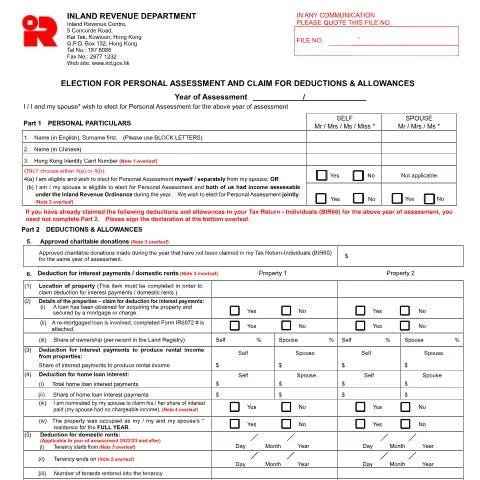
Completing the Election for Personal Assessment and Claim for Deductions & Allowances (IR 76C) is a crucial step for Hong Kong residents looking to optimize their tax situation. This document provides valuable opportunities for individuals to assess their income collectively with their spouses, unlocking potential deductions and allowances that can significantly impact their overall tax burden.
Demystifying Personal and Spousal Assessments
In the context of the IR 76C, understanding the distinction between personal and spousal assessments is vital. While personal assessment evaluates an individual’s income, spousal assessment allows couples to combine their incomes for a more advantageous tax position. This approach can lead to a lower combined tax liability, especially if one spouse has a significantly lower income than the other.
Eligibility Criteria
- Both individuals must have assessable income.
- Spouses can choose to elect for joint assessment if both are eligible.
- In certain scenarios, an individual may opt for separate assessments to avoid potential tax liabilities affecting their spouse.
This flexibility is designed to cater to various financial situations, significantly affecting how tax liabilities are calculated.
The Critical Components of the IR 76C
Filling out the IR 76C requires attention to detail. Each section of the form plays a specific role in evaluating the eligibility for deductions and allowances.
Part 1: Personal Particulars
The first section requires essential information such as:
- Names in English and Chinese
- Hong Kong Identity Card Number
- Election of assessment type (joint or separate)
This data is foundational and will determine the subsequent processing of the assessment.
Part 2: Deductions & Allowances
One of the most significant aspects of the IR 76C is its focus on deductions. Here, taxpayers can claim various allowances based on their unique situations:
- Approved charitable donations
- Interest deductions related to property rentals
- Child and dependent parent allowances
Each of these deductions requires specific documentation, which must be accurately reported to ensure validity. Notably, the precise details regarding property ownership and rental agreements must be meticulously provided to avoid penalties.
Key Considerations for Completing the Form
Completing the IR 76C is not merely a matter of filling out boxes; it requires a strategic approach. Taxpayers should consider the following:
Understanding Allowable Deductions
Taxpayers need to recognize which deductions they are eligible for based on their personal circumstances:
- Home Loan Interest Deductions: Individuals may claim deductions for interest payments on loans secured against property.
- Dependent Allowances: Families with children or dependents can claim allowances that reduce overall taxable income.
- Medical Premiums: Contributions to health insurance schemes may also be deductible, offering further financial relief.
Documenting Your Claims
To substantiate claims for various deductions, adequate documentation is essential. Taxpayers must be prepared to present:
- Receipts for charitable contributions
- Loan agreements for interest deductions
- Legal documentation proving relationship to dependents
Failure to provide this documentation can result in disqualification of claims, leading to an increased tax liability.
Submission Procedures: Timeliness and Accuracy
Submitting the IR 76C is time-sensitive. The form must be filed by the prescribed deadlines, usually coinciding with the broader Salaries Tax cycle. Delays can incur penalties, emphasizing the importance of punctuality.
Methods of Submission
Taxpayers have several options for submitting their completed forms:
- Online Submission: Utilizing the Inland Revenue Department’s e-services portal can expedite the process.
- Mail Submission: Forms can also be mailed directly to the Inland Revenue Department.
- Walk-in Services: For those who prefer in-person interaction, submissions can be made at designated service centers.
Post-Submission Tracking
Once submitted, monitoring the status of your application is advisable. Taxpayers can follow up through the Inland Revenue Department’s customer service channels. Being proactive can help resolve any issues swiftly.
Potential Outcomes and Implications
After the IR 76C is processed, taxpayers may receive either a revised tax assessment or a notice indicating the result of their claims. The implications of these outcomes can vary:
Tax Refunds and Liabilities
Successful claims can lead to significant tax refunds or reduced liabilities:
- Refunds: If deductions lower the overall taxable income below the amount already paid, taxpayers may receive refunds.
- Increased Liabilities: Conversely, incorrect claims or misinterpretations of eligibility can result in back taxes owed.
The Importance of Record-Keeping
Due to the complex nature of tax filings, maintaining accurate records of submissions and all related documents is critical. This documentation can serve as a defense in case of audits or queries from the tax authorities.
Special Cases and Exceptions to Keep in Mind
While the guidelines for the IR 76C are generally clear, several special cases warrant consideration:
Joint Assessments for Temporarily Separated Spouses
In situations where spouses are temporarily separated, they can still elect for a joint assessment under specific circumstances:
- Both parties must have assessable income.
- Documentation proving the separation period may be required.
Special Allowances for Disabled Dependents
Families caring for disabled dependents can benefit from additional allowances that may not apply to other taxpayers:
- Specific documentation confirming the disability and care arrangements will be necessary for claims.
Conclusion: Maximizing Benefits through Informed Participation
Completing the IR 76C is a journey that requires careful understanding of both the form itself and the broader tax landscape. By staying informed and organized, individuals can leverage this document to optimize their tax positions effectively.
Engaging in proactive communication with the Inland Revenue Department and seeking assistance when necessary can further enhance the likelihood of favorable outcomes. By approaching the IR 76C with diligence and awareness, taxpayers can uncover valuable opportunities for financial relief.
Understanding Personal Assessment in Hong Kong
Personal Assessment is a distinctive feature of the tax system in Hong Kong. It provides an option for individuals to assess their income collectively, allowing them to benefit from various deductions and allowances that may not be available under Salaries Tax. This form of assessment is particularly advantageous for married couples, as they can potentially reduce their overall tax liability by opting for joint assessment.
To qualify for Personal Assessment, you must first ensure that you meet the criteria set out by the Inland Revenue Department (IRD). This includes being a resident of Hong Kong, having income from salaries, property, or business, and fulfilling the necessary obligations under the Basic Law of the Hong Kong Special Administrative Region. It is essential to submit your claim for Personal Assessment no later than 30 days after receiving your tax return. Failing to meet this deadline may result in the loss of potential deductions and allowances.
Another critical aspect of Personal Assessment is the computation of income. You need to accumulate all sources of income and present them in the application process. This includes salaries, rental income, and profits from business activities. Furthermore, it is important to maintain accurate records and documentation, as the IRD may require evidence to substantiate your claims.
Deductions and Allowances: Maximizing Your Tax Benefits
When filing for Personal Assessment, understanding the various deductions and allowances available is crucial to maximizing your tax benefits. The IRD allows for numerous deductions, each with specific conditions and documentation requirements. Key deductions include expenses related to employment, such as self-education expenses, professional association fees, and contributions to mandatory provident funds (MPF).
Moreover, allowances play a significant role in reducing taxable income. Personal allowances, married person’s allowances, and allowances for dependent parents or grandparents can substantially lower your tax liability. For instance, if you are supporting your parents and they reside with you, you may qualify for an additional allowance. It is paramount to review your situation thoroughly and consider any changes in personal circumstances that may affect your eligibility for these tax breaks.
Besides personal and dependent allowances, taxpayers can also explore deductions related to charitable donations, home loan interest, and even contributions to retirement schemes. Engaging with the IRD's resources or consulting with a tax professional can provide you with insights tailored to your unique financial circumstances, ensuring that you are not leaving any potential deductions unclaimed.
Electronic Services and Submission Process for Personal Assessment
The IRD has embraced technology to enhance the efficiency of tax filing and assessment processes. Taxpayers are encouraged to utilize e-services for submitting tax returns and claims for Personal Assessment. The application process can be completed online through the IRD's eTax platform, which offers a user-friendly interface and step-by-step guidance.
When submitting your Personal Assessment online, it is important to prepare your documents in advance, including proof of income, deductions, and any relevant identification like your Hong Kong Identity Card (HKID). The eTax system allows for secure document uploads and real-time corrections, reducing the chances of errors that could lead to delays.
Additionally, utilizing electronic services facilitates quicker processing times. The IRD typically gives priority to electronically filed applications, resulting in faster assessment and potentially earlier tax refunds. However, ensure that you adhere to the deadlines outlined by the IRD, particularly the submission deadline of 30 days after receiving your tax return. Late submissions can incur penalties and may complicate your personal assessment process.
For taxpayers who may be less familiar with technological tools, the IRD provides bilingual support materials and helplines to assist in navigating the online system. Engaging in these resources can significantly improve your experience and compliance with Hong Kong's rigorous tax obligations.