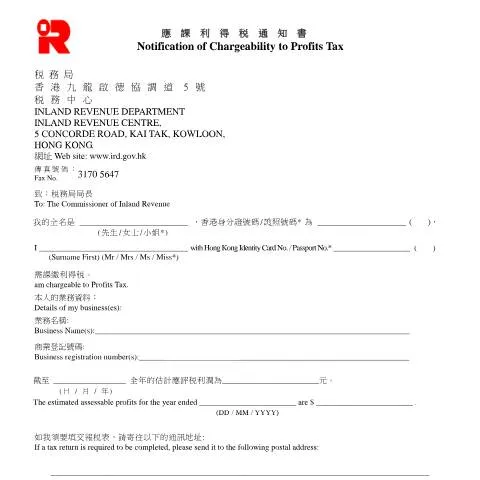
Understanding the Notification of Chargeability to Profits Tax (IR 6168)
The Notification of Chargeability to Profits Tax (form IR 6168) is a pivotal document for businesses operating within Hong Kong’s economic landscape. It's designed to notify the Inland Revenue Department (IRD) of a taxpayer’s liability concerning profits tax, a tax that is imposed on profits derived from business activities in the region. This form is crucial not only for compliance purposes but also for determining the subsequent steps in the tax assessment process.
Who is Required to Submit Form IR 6168?
This form must be submitted by every individual and entity deemed chargeable to profits tax under the Hong Kong tax regime. This includes:
- Corporations
- Partnerships
- Unincorporated businesses
The notification must be lodged even if a business is not currently generating profits, as it establishes the company’s intent to remain compliant with local tax regulations. Importantly, failure to submit this form can lead to penalties or additional scrutiny from the IRD.
The Process of Completing the IR 6168 Form
To streamline your experience with the IR 6168, attention to detail during completion is essential. Below is a breakdown of the form’s key sections and how to accurately fill them out:
Section by Section Analysis
- Personal Information:
Begin with your name, including surname and title (Mr/Mrs/Miss). Ensure that the name matches the official identification documents.
- Identification Details:
Provide your Hong Kong Identity Card number or passport number. Accuracy is paramount here, as discrepancies can lead to processing delays.
- Business Name and Registration:
Clearly state the name of your business along with the registration number. This identifies your operation within the IRD’s records.
- Estimated Profits:
This section requires an estimation of assessable profits for the tax year ending. It's vital to approach this with careful calculations based on historical financial data.
- Mailing Address:
Indicate your preferred address for receiving any correspondence regarding tax matters. An accurate address ensures that important communication reaches you promptly.
Avoiding Common Pitfalls
While filling out the IR 6168, several common errors can arise, leading to complications in processing. Here are a few tips to help avoid these pitfalls:
- Ensure that all sections are complete before submission.
- Double-check the accuracy of your business registration number.
- Use the correct format for dates, adhering to the specified DD/MM/YYYY format.
Submission Channels: Choosing Your Path
The IR 6168 can be submitted through multiple channels - each offering distinct advantages:
Online Submission
Utilizing the e-Service portal allows for immediate submission and confirmation. This option is often favored for its efficiency and ease of tracking.
Paper Submission
You may also opt for traditional paper submission. Ensure that the completed form is sent to the correct address, specifically:
Inland Revenue Department Inland Revenue Centre 5 Concorde Road Kai Tak, Kowloon Hong Kong
When choosing this option, consider the mailing time and potential delays.
In-Person Submission
If you prefer a face-to-face interaction, the option to submit the document in person at designated IRD offices is available. This method allows for immediate queries to be addressed.
The Timeline: Key Dates and Expectations
Understanding the timeline associated with the IR 6168 can help manage expectations and ensure compliance. Key dates to remember include:
- Submission Deadline: The form should typically be submitted within one month after the end of the financial year, which runs from April 1 to March 31.
- Assessment Notification: Following submission, you can expect an assessment notice from the IRD within a few months, detailing your taxable profits and potential tax liabilities.
Profiles and Specific Scenarios: Who Needs to Take Action?
Different profiles may influence how the IR 6168 is filled out and submitted. Understanding these profiles can guide businesses in ensuring compliance:
Start-ups and New Businesses
Newly established entities should be particularly diligent in completing the IR 6168 to secure their status within the tax system from the outset, even if they anticipate little to no income in their first year.
Established Businesses with Fluctuating Profits
For established entities, properly estimating profits can be complex due to market fluctuations. Historical data and future projections can aid in providing a realistic estimate.
Foreign Entities Operating in Hong Kong
Foreign businesses must navigate additional complexities concerning the IR 6168. They may need to provide supporting documentation regarding their business registration in their home country.
Regulatory Framework Surrounding the IR 6168
The foundation of the IR 6168 is rooted in the Basic Law of the Hong Kong Special Administrative Region, which upholds the integrity of financial operations within its jurisdiction. The Profits Tax Ordinance governs the application and enforcement of profits tax, ensuring that all businesses contribute fairly to the economy.
Historical Context
The regulation surrounding profits tax has evolved, reflecting changes in economic conditions and global financial practices. This evolution emphasizes the importance of the IR 6168 as a tool for compliance and transparency.
Post-Submission Steps: What Happens Next?
Once the IR 6168 has been submitted, businesses can expect a series of follow-up actions from the IRD:
Assessment Review
The IRD will review the submitted form, including the estimated profits. Should there be any discrepancies or further information needed, the business will be contacted directly.
Issuance of Tax Returns
Following the assessment, a Profit Tax Return will be issued, detailing the taxable profits and the corresponding tax liability based on the information provided.
Appeal Process
If a business disagrees with the assessment, there are established procedures for appealing the decision, ensuring transparency and fairness in the process.
Practical Tips for Streamlining Your Experience
To optimize your experience with the IR 6168 process, consider the following:
Fill in your form directly online
No printing: type your details into the boxes of the official form, tick, then download the PDF ready to send.
- 1Type into the form boxes
- 2Tick in one click
- 3Save and download the PDF
- Maintain accurate financial records throughout the year to simplify the estimation of assessable profits.
- Engage a tax professional if uncertain about any aspect of the form or process.
- Leverage electronic submission for expediency and ease of tracking.
By understanding the nuances of the Notification of Chargeability to Profits Tax, businesses can better navigate the complexities of Hong Kong’s tax system, ensuring compliance while strategically managing their tax obligations.
Understanding Chargeability to Profits Tax
In Hong Kong, the concept of chargeability to Profits Tax is pivotal for businesses operating within its jurisdiction. Under the Inland Revenue Ordinance, a company is chargeable to Profits Tax if it carries on a trade, profession, or business in Hong Kong and derives profits from those activities. This section will delve deeper into the criteria that determine whether a business entity is subject to Profits Tax.
The primary criterion hinges on the locality of profit generation. If the profits are derived from Hong Kong, irrespective of the residency status of the business, the entity must comply with the Profits Tax regulations. Conversely, profits sourced outside Hong Kong are exempt from taxation, which is a significant advantage for companies with international operations.
Moreover, businesses are required to self-assess their chargeability. This means that upon the completion of their financial year, they must evaluate whether they were engaged in a trade or business, alongside their profit sources. When assessing chargeability, companies should also consider their operational presence, which includes offices, employees, and significant economic activities within Hong Kong.
Additionally, the threshold for chargeability is not strictly defined in terms of profit figures but is instead governed by the nature and activities of the business. For example, a company that occasionally sells goods to local customers may not be deemed chargeable if such transactions are isolated and not part of a continuous business operation. The key takeaway here is to establish a "permanent establishment" in Hong Kong, which is a critical factor influencing the chargeability to Profits Tax.
Consequences of Non-Compliance with Profits Tax Notification
Failing to notify the Inland Revenue Department (IRD) of chargeability can have serious repercussions for businesses. Upon assessment of their profits, companies are required to inform the IRD if they believe they are chargeable to Profits Tax. Failing to do so can lead to penalties and interest charges. Specifically, businesses risk incurring a fine for late notification, which could escalate over time, as well as a potential interest charge on any unpaid tax.
Moreover, the IRD conducts regular audits and compliance checks, particularly targeting entities that have not been forthcoming in their tax obligations. An audit can disrupt business operations and lead to significant financial strain. In severe cases, persistent non-compliance can result in legal action against the company and its directors, further complicating the operational landscape.
Another consequence of failing to notify chargeability is the adverse impact on a company’s reputation. In the age of digital records and transparency, a history of non-compliance can deter potential business partners, investors, and customers. Companies must remain vigilant and transparent regarding their tax obligations to maintain trust within the market.
To mitigate these risks, it is advisable for businesses to establish robust internal procedures for tax compliance and notification. Regular training and updates on the importance of Profits Tax obligations can help create an informed workforce, ensuring that companies adhere to the regulations set forth by the IRD.
Filing Requirements and Best Practices for Notification
To successfully notify the IRD of chargeability to Profits Tax, companies must adhere to specific filing requirements and best practices. First and foremost, it is imperative to understand the annual filing timeline for the tax year, which runs from 1 April to 31 March. The notification must be completed within the stipulated timeframe to avoid penalties. The IRD usually issues a notification letter after the end of the tax year, which serves as a prompt for businesses to evaluate their chargeability status.
When preparing the notification, the company must ensure that all necessary documentation is accurate and up-to-date. This includes financial statements, business registration details, and any other relevant documents that can support their claim of chargeability or exemption. Electronic filing through the IRD’s e-Tax system is highly recommended, as it provides a streamlined, efficient process that automatically records submission dates, reducing the risk of human error.
Moreover, companies should consider consulting with tax professionals who possess specific knowledge of Hong Kong's tax landscape. Engaging with a tax consultant or adviser can provide invaluable insights on the complexities of the Profits Tax system, helping to ensure that all aspects of chargeability are understood and addressed appropriately. This can be particularly beneficial for businesses with intricate structures or multi-jurisdictional operations.
Lastly, businesses that foresee potential disputes or queries regarding their Profits Tax status should maintain comprehensive records and documentation. Having detailed accounts, transaction logs, and correspondence with the IRD can facilitate smoother resolutions if challenges arise. Implementing a proactive approach to tax compliance and notification is essential for maintaining a healthy business environment in Hong Kong.