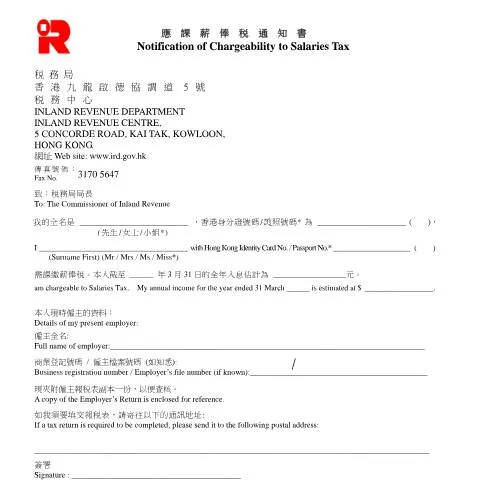
Navigating the IR 6167: Your Guide to the Notification of Chargeability to Salaries Tax
Encountering the Notification of Chargeability to Salaries Tax, officially known as IR 6167, is an essential step for individuals working in Hong Kong. It's crucial to grasp its intricacies, not just as a formality, but as a legislative requirement that can dictate your tax obligations and rights. This document plays a pivotal role in the larger framework of tax compliance within the Hong Kong Special Administrative Region.
Understanding the Role of IR 6167 in Your Tax Responsibilities
At its core, the IR 6167 form serves as a notification to the Inland Revenue Department regarding your chargeability for salaries tax. This is not merely a bureaucratic hurdle; it is a declaration that can influence your tax status for the financial year ending 31 March. As such, it is imperative that the form is filled out accurately and submitted on time to avoid complications.
Who Needs to Submit This Form?
The Notification of Chargeability to Salaries Tax must be submitted by:
- Individuals who are employed in Hong Kong and receive income.
- New residents or individuals whose employment situation has changed.
- Anyone whose estimated annual income meets the threshold for taxation.
Understanding who is obligated to submit this form helps prevent misunderstandings that could lead to penalties.
Channels for Submission: Choosing the Right Path
Once you've completed the IR 6167, the next step is to submit the form. There are multiple channels to do this, each with its distinct advantages and considerations.
Online Submission via e-Services
Hong Kong’s Inland Revenue Department offers robust e-services that allow for the submission of tax forms online. This method is increasingly popular for its speed and efficiency:
- Advantages: Immediate confirmation of submission, reduced paperwork, and streamlined processing.
- Considerations: Requires a reliable internet connection and knowledge of the online portal.
Paper Submission
For those who prefer traditional methods or lack access to digital services, submitting a paper form remains an option. Here’s what to consider:
- Advantages: Familiarity and the ability to physically handle documents.
- Considerations: Slower processing times and potential delays in confirmation.
In-Person Submission at the Inland Revenue Department
Submitting your form in person at the Inland Revenue Centre can be beneficial for individuals with complex situations requiring immediate clarification. Here are its pros and cons:
- Advantages: Direct interaction with officials, instant feedback, and the opportunity to resolve issues at the point of submission.
- Considerations: Longer wait times and the necessity of physically traveling to the department.
Deciphering Each Section of the Form
Filling out the IR 6167 requires careful attention to detail. The form consists of several sections, each demanding specific information:
Personal Information
This section requires your full name, Hong Kong Identity Card or Passport number, and contact information. Ensure that:
- Your name matches exactly with the identity documents.
- Contact details are current, as any correspondence will be sent here.
Income Estimation
Estimating your annual income accurately is crucial. The form asks for your estimated earnings for the fiscal year ending 31 March. Keep in mind:
- Estimations should be realistic and based on your current salary, bonuses, and any additional income.
- Providing an inflated figure may lead to complications in your tax assessment.
Employer Information
This section requires details about your current employer. You will need:
- The name and address of your employer.
- Your employer’s registration number if known.
Double-check that the employer information is accurate to avoid any processing delays.
The Impact of Non-Compliance: Risks and Consequences
Neglecting to submit the IR 6167 can have dire consequences, such as:
Legal Implications
Hong Kong's tax regulations mandate that all tax obligations are met. Failing to file this notification can lead to:
- Penalties imposed by the Inland Revenue Department.
- Increased scrutiny of your tax returns, potentially leading to audits.
Financial Consequences
Non-compliance can also lead to:
- Accrual of unpaid taxes, which can accumulate interest.
- Possible legal actions, including liens against assets.
Timeline for Submission and Processing
Being aware of the timeline surrounding the IR 6167 is crucial. Here’s what you need to know:
Key Dates
| Event | Date |
|---|---|
| Fiscal Year Ends | 31 March |
| Form Submission Deadline | Usually within one month post fiscal year end |
| Tax Assessment Issued | Approximately 3 months after submission |
Understanding these dates can help you avoid late submissions and potential penalties.
Differentiation from Other Tax Forms
It’s essential to distinguish the IR 6167 from other related forms, such as the Employer’s Return. Each serves a unique purpose:
IR 6167 vs Employer’s Return
| Form | Purpose |
|---|---|
| IR 6167 | Notification of individual chargeability to salaries tax |
| Employer’s Return | Reports total remuneration for all employees |
This differentiation is crucial for accurate tax reporting and compliance.
Final Thoughts: Your Obligations and Rights
Submitting the IR 6167 is not just a bureaucratic step; it is a declaration of your income and responsibilities. By understanding the form’s requirements, submission methods, and implications of non-compliance, you empower yourself as a taxpayer in Hong Kong.
Remember, the objective is not mere compliance but ensuring that your tax obligations are met efficiently and accurately. In doing so, you safeguard your rights and avoid unnecessary complications with the Inland Revenue Department.
Understanding the Notification of Chargeability to Salaries Tax
The Notification of Chargeability to Salaries Tax, often referred to simply as the “Notification,” is a crucial document that indicates the Hong Kong Inland Revenue Department (IRD) has determined an individual is liable to pay Salaries Tax based on their income for the relevant year. This document is significant as it marks the beginning of an individual's tax obligation in Hong Kong.
Fill in your form directly online
No printing: type your details into the boxes of the official form, tick, then download the PDF ready to send.
- 1Type into the form boxes
- 2Tick in one click
- 3Save and download the PDF
The Importance of Notification Timelines
Receiving the Notification is typically a part of the annual tax assessment process that follows the financial year, which runs from 1 April to 31 March. The IRD sends out these notifications around May or June each year to employees who have submitted an Employer's Return (Form BIR56A). It is essential for recipients to be aware of the specific timeline as the notification must be carefully reviewed for any inaccuracies or queries. Prompt action is crucial, as there are strict deadlines for submitting tax returns and addressing discrepancies.
Responding to Your Notification
Upon receiving your Notification of Chargeability, you should carefully examine the details included. This document will reference your total assessable income for the tax year and will include the estimated tax amount due. If you believe that the information presented is incorrect or if there are deductions or allowances that you are entitled to but not accounted for, it’s imperative to respond to the IRD as soon as possible. You may need to provide additional documents, such as proof of expenses or declarations of non-taxable income, to substantiate your position.
Common Errors and Oversights
While reviewing the Notification of Chargeability, there are several common errors or oversights that taxpayers may encounter. Understanding these can aid in proper compliance and avoid potential penalties.
Mismatch in Income Reporting
One prevalent issue arises from discrepancies between the income reported by employers and what appears on the Notification. It is advisable to cross-check the figures on your Notification against your payslips and the latest Employer's Return. Any inconsistencies should be addressed immediately by contacting your employer for clarification and potentially submitting a correction to the IRD.
Failure to Claim Allowances
Another common oversight is the failure to claim eligible allowances or deductions. For instance, if you are a Hong Kong resident, you may be entitled to personal allowances, such as for dependent relatives or charitable donations. It is advisable to familiarize yourself with the list of allowable deductions as outlined in the Salaries Tax guidelines on the IRD website. Failure to claim these can lead to a higher tax liability than necessary.
Late Responses to Notifications
Taxpayers often underestimate the importance of timely responses to their Notification of Chargeability. The IRD has strict deadlines, and failing to respond within the stipulated timeframe can result in penalties or a delay in your tax assessment. Always refer to the date indicated on the Notification for submission of your tax return, which is typically due by early June following the end of the tax year.
Utilizing E-Services for Tax Compliance
Hong Kong has increasingly moved towards e-services to streamline tax compliance, making it essential for taxpayers to familiarize themselves with these digital tools in context to the Notification of Chargeability.
Electronic Submission of Tax Returns
Once you receive your Notification, you can utilize the eTax platform to submit your tax return electronically. This service allows for a faster and more efficient submission process while reducing paper waste. Taxpayers who opt for e-filing often receive their tax assessments more quickly than those who file paper returns. The eTax platform is user-friendly and provides comprehensive guidelines, making it accessible even for those who may be less tech-savvy.
Accessing Your Tax Information Online
Another significant advantage of the e-service approach is that taxpayers can access their tax information, including past assessments and payments, through the IRD's online portal. Keeping track of your tax history can be a valuable resource, especially when preparing for future tax returns or if you need to reference previous filings. This information can also assist in planning financial decisions, such as major investments or life changes that may affect your tax situation.
Utilizing Online Resources for Assistance
In addition to the eTax platform, the IRD provides a wealth of online resources that include guidelines, FAQs, and downloadable forms. These resources are invaluable when preparing for your tax return after receiving the Notification of Chargeability. Should you have more specific queries or require clarification, consider reaching out via the IRD’s dedicated e-Services customer support, which offers assistance through various channels, including email and live chat.